

Sports Court Construction
Backyard, school, club and council courts built start to finish: slab, surface, lines, nets, fencing and lighting. Backyard half courts from about $10,000.
Jamie (24/7 quotes): 0468 069 002AS 1742.2 Compliant
Fully Insured
24/7 Availability

15+ Years
Get FREE Quote
Fixed-Price Quote Within 48 Hours
Trusted by 5,000+ businesses
VicRoads approved · AS/NZS compliant · $20M insured
Compliance-Ready Guarantee: every job is marked to AS/NZS 2890 & AS 1742, dimensionally verified, and delivered with full compliance documentation, backed by our 12-month workmanship guarantee.
Last updated:
What is Sports Court Construction?
Line Marking Australia builds sports courts across Australia, from backyard half courts to school multi-sport courts and club tennis, pickleball and padel courts. We handle the whole job: site checks, base and slab, surface, line marking, posts, hoops, nets, fencing and lighting. Backyard half courts start from around $10,000 installed.
Most people come to us with a simple idea: a court in the backyard, a new court at school, or more courts for a busy club. Then the questions start. What surface? How big? Do we need a permit? What will it cost?
This page walks you through it, the way we'd explain it on site. It's written from the jobs our crews do every week, from marking ovals and indoor school halls to building courts on modular tiles and acrylic.
Which sports courts do you build?
We build and line mark courts for almost every sport played in Australia. If it has lines, a net or a hoop, we can build it:
- Pickleball courts, including converting tennis courts to pickleball
- Tennis courts in acrylic hard court or synthetic grass
- Padel courts, indoor and outdoor
- Basketball courts: backyard, half court and full size
- Netball, futsal, volleyball and beach volleyball courts
- Multi-sport courts that fit several sports on one surface
- Squash, badminton, bocce and handball courts
- Cricket nets, synthetic cricket pitches, putting greens and gaga pits
We also do the extras that finish a court: resurfacing, court painting, lighting, fencing, in-ground hoops, rebound walls and court tiles.
How much does it cost to build a sports court in Australia?
A sports court in Australia costs anywhere from about $10,000 for a backyard half court to $100,000 or more for a full-size court with lighting and fencing. The surface, the size, the ground you're starting with and the extras you add make the biggest difference.
These are the lowest published Australian starting prices we could find. Every court is quoted on its own site, so use them as a guide, not a fixed price:
| Court | Starting price (installed) | Source |
|---|---|---|
| Backyard basketball half court (up to about 165 m², including slab) | from about $10,000 | Published Australian builder pricing, 2026 |
| Home pickleball court | from about $20,000 | Published Australian builder pricing, 2026 |
| Tennis court | from about $40,000 | Oneflare cost guide, 2026 |
| Padel court | from about $60,000 | Sydney club build reported in the trade press |
| Full-size basketball court (about 420 m²) | from about $70,000 | Published Australian builder pricing, 2026 |
| Tennis court resurfacing (acrylic recoat) | from about $8,000 | Airtasker cost guide, 2026 |
What pushes the price up: sloping or soft ground that needs extra earthworks, poor drainage, long distances for trucks and machinery, premium cushioned surfaces, lighting, tall fencing and council requirements. We price all of that up front so there are no surprises.
Which court surface is best?
The best court surface depends on the sport, who's playing and how much maintenance you want. Acrylic hard courts suit most sports and last for years, cushioned acrylic is kinder on joints, synthetic grass is popular for tennis, and modular tiles go down fast and drain well.
| Surface | Best for | Good to know |
|---|---|---|
| Acrylic hard court (on concrete or asphalt) | Tennis, pickleball, basketball, netball, multi-sport | True ball bounce, low maintenance, recoat roughly every 7 to 10 years |
| Cushioned acrylic | Pickleball, tennis, retirement villages, clubs | Extra rubber layers for comfort; costs more than standard acrylic |
| Synthetic grass (sand-filled) | Tennis, multi-use club and school courts | Soft underfoot, plays in light rain; needs regular brushing and sand top-ups |
| Modular court tiles | Backyard courts, schools, quick builds | Clip together on a slab, drain fast, easy to repair one tile |
| Timber sports floor (indoor) | School halls, stadiums | Re-coat and re-line when the floor is sanded |
Tennis Australia sorts court surfaces into categories in its National Court Surface Policy, and we follow its guidance for club and community tennis courts.
How long does it take to build a court?
Most backyard courts take about one to three weeks on site once approvals are sorted, and larger school, club or council courts take three to eight weeks. Concrete needs time to cure before the surface goes on, and weather can add days. We give you a timeline before work starts.
The usual order of works:
- Site visit, measure-up and design
- Approvals and service checks (Before You Dig Australia)
- Excavation, drainage and compacted base
- Concrete or asphalt slab, then curing time
- Surface: acrylic, cushioned acrylic, synthetic grass or tiles
- Line marking for each sport
- Posts, hoops, nets, fencing and lighting
- Final check and handover
Do you need council approval to build a court?
Many courts need some form of council approval in Australia, especially if they include lighting, fencing over 2 m, retaining walls, large earthworks or are in a heritage or flood-prone area. The rules differ between councils and states, so we check your local requirements early and help you prepare what the council needs.
Things councils commonly look at:
- Lighting: light spill onto neighbours, managed under AS/NZS 4282 (control of the obtrusive effects of outdoor lighting)
- Fencing and retaining walls: height, location and engineering
- Noise: particularly for pickleball and padel near homes
- Drainage and stormwater: where the water from the slab goes
- Setbacks and site coverage on residential blocks
How we keep every court build compliant
Compliance is built into every job we take on, not added at the end. On every court build we:
- Check council requirements for your site before we quote the final price
- Run a Before You Dig Australia (BYDA) check before any excavation
- Work under Work Health and Safety laws, with a Safe Work Method Statement for high-risk construction work such as excavation and mobile plant
- Control silica dust when cutting or grinding concrete, using water suppression or on-tool vacuum extraction, in line with the WHS rules for respirable crystalline silica
- Manage sediment and stormwater on site so runoff doesn't leave the site
- Use builders who hold the licence your state requires for the size of the job, with current public liability insurance
- Build to the sport's court dimensions and the relevant Australian Standards, such as AS 3600 for concrete structures, AS 1428.1 for accessible paths to the court and the AS 2560 series for sports lighting
Can one contractor build the whole court?
Yes. Line Marking Australia manages the whole court build with one point of contact, from the site visit and slab through to the surface, line marking, posts, nets, fencing and lighting. You don't need to chase a concreter, a surfacer and a line marker separately.
Which courts can share one surface?
Multi-sport courts are the smart choice for schools, community centres and bigger backyards. A single acrylic or tile court can carry basketball, netball, pickleball, tennis, futsal and volleyball lines in different colours, so each sport is easy to read. We plan the layout with you first, so the lines you use most are the clearest.
Are there grants for school, club and community courts?
Yes. Clubs, schools and councils often fund new courts, resurfacing and lighting through state sport infrastructure programs, community benefit funds and council grants. Recent examples include the South Australian Community Facilities Program and the Queensland Gambling Community Benefit Fund, which has funded club resurfacing, lighting and fencing. We can provide quotes and scopes to support your application.
Courts we've built and marked
A few recent jobs from our Victorian crews:
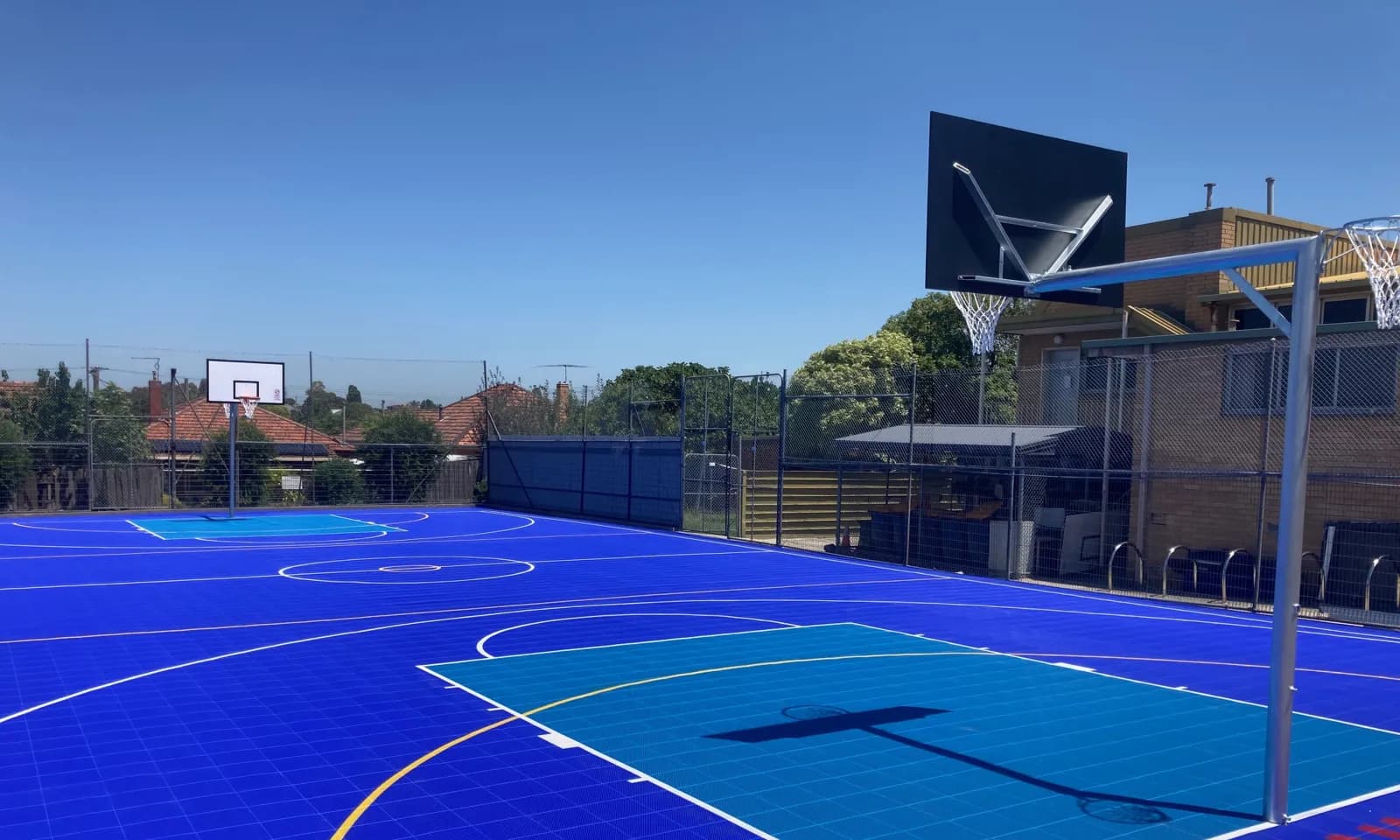
- School multi-sport court on modular tiles with basketball and netball lines and new hoops
- Backyard half court on tiles, finished with a key, three-point line and a feature wall
- Indoor school sports hall lined for basketball, netball, volleyball and badminton
- Football oval boundary and centre lines, plus painted club and sponsor logos
What do you need from me to quote a court?
The more we know, the more accurate your quote. When you enquire, tell us the court type, the size you'd like, whether it's indoor or outdoor, what's on the ground now, how trucks can get in, your preferred surface, any lighting or fencing, and your timing and budget. Photos and a rough sketch help a lot.
Key Benefits
One contact, whole build: slab, surface, lines, nets, fencing and lighting managed together
Every court type: pickleball, tennis, padel, basketball, netball, multi-sport and more
Compliance built in: council checks, BYDA, SWMS, dust and sediment controls on every job
Clear starting prices: backyard half courts from about $10,000; itemised quotes
Line marking specialists: courts marked to each sport's dimensions, since 2009

Site Inspection
Free assessment and detailed quote

Professional Marking
Expert application with premium materials

Quality Assurance
Final inspection and compliance sign-off
Compliance Standards
Local council approval
Planning or building approval checked for lighting, fencing, earthworks, drainage, setbacks and overlays before the final quote.
Before You Dig Australia
Underground services located before any excavation.
WHS Act & SWMS
Work Health and Safety laws followed, with Safe Work Method Statements for high-risk construction work.
Silica dust controls
Water suppression or on-tool vacuum extraction when cutting or grinding concrete.
AS 3600 · AS 1428.1
Concrete structures to AS 3600; accessible paths to the court considered against AS 1428.1.
AS 2560 · AS/NZS 4282
Sports lighting to the AS 2560 series, with light spill controlled under AS/NZS 4282.
Fully Compliant & Certified
All our work meets or exceeds Australian Standards and state road authority requirements
VicRoads Approved
Registered Contractor
$20M Public Liability
$10M Professional Indemnity
5,000+ Projects
Since 2009
Fixed Prices
Not Estimates
AS 1742
Traffic Control Devices
Specifies line colours, widths, arrow designs, and placement for road markings. Ensures all traffic control devices meet national safety standards.
AS/NZS 2890
Parking Facilities
Covers bay dimensions (2.4m × 5.4m standard, 2.4m × 5.4m accessible plus a 2.4m shared zone), aisle widths, and traffic flow requirements for compliant parking areas.
AS 4586
Slip Resistance
Defines slip resistance classifications (P rating) for pedestrian surfaces. Critical for wet areas, ramps, and high-traffic zones.
AS/NZS 1428
Access & Mobility
Sets requirements for accessible parking bays, tactile indicators, and mobility access. Essential for DDA compliance and accessibility audits.
What Our Clients Say
Results based on typical project outcomes. Individual results may vary.
Upload your site plans for a detailed quote within 48 hours
Get an accurate, fixed-price quote tailored to your specific project requirements
Frequently Asked Questions
A sports court in Australia costs from about $10,000 for a backyard half court to $100,000 or more for a full-size court with lighting and fencing. Size, surface, ground conditions and extras drive the price. Line Marking Australia quotes every court for its own site.
Line Marking Australia builds pickleball, tennis, padel, basketball, netball, futsal, volleyball, squash, badminton, bocce and multi-sport courts, plus cricket nets, putting greens and gaga pits, and adds resurfacing, lighting and fencing.
Most backyard courts take one to three weeks on site once approvals are in place, and school, club or council courts take three to eight weeks. Concrete must cure before the surface goes on, and wet weather can add days.
Many courts in Australia need council approval, especially with lighting, fences over about 2 m, retaining walls, big earthworks or heritage and flood overlays. Rules differ by council, so Line Marking Australia checks your local requirements before the final quote.
Acrylic on concrete or asphalt suits most sports, cushioned acrylic is easier on joints, synthetic grass is popular for tennis and modular tiles are fast to install and drain well. The best choice depends on the sport, the players and the upkeep you want.
Yes. Line Marking Australia manages the whole build with one contact: site visit, earthworks, slab, surface, line marking, posts, nets, fencing and lighting.
Yes. Schools, clubs and councils often use state sport infrastructure programs, community benefit funds and council grants for new courts, resurfacing and lighting. Line Marking Australia can supply quotes and scopes for applications.
Every build includes a council check, a Before You Dig Australia search, Safe Work Method Statements for high-risk work, silica dust controls, sediment control, builders licensed for your state and construction to the sport's dimensions and relevant Australian Standards.
Related Services

Basketball Court Line Marking
Learn more about this service
Multi-Sport Court Line Marking
Learn more about this service
Pickleball Court Construction
Learn more about this service
Pickleball Courts for Retirement Villages
Learn more about this service
Sports Court Marking with Competition-Grade Precision
Learn more about this service
Tennis Court Line Marking?
Learn more about this service
More Sports & Playground Line Marking Services
Ready to Get Your Line Marking Sorted?
Upload your site plans and receive a fixed-price quote within 48 hours. No surprises, no cost blowouts, just clear pricing you can take to your committee or manager.
Or call us directly: 0417 460 236