

Sports Courts for Sports Clubs
Tennis, pickleball, padel and netball courts, lighting and resurfacing, with grant-ready quotes and works planned around your season.
Jamie (24/7 quotes): 0468 069 002AS 1742.2 Compliant
Fully Insured
24/7 Availability

15+ Years
Get FREE Quote
Fixed-Price Quote Within 48 Hours
Trusted by 5,000+ businesses
VicRoads approved · AS/NZS compliant · $20M insured
Compliance-Ready Guarantee: every job is marked to AS/NZS 2890 & AS 1742, dimensionally verified, and delivered with full compliance documentation, backed by our 12-month workmanship guarantee.
Last updated:
What is Sports Courts for Sports Clubs?
Line Marking Australia builds and renews courts for sports clubs across Australia: tennis courts, pickleball conversions, padel courts, netball courts, lighting and resurfacing. We give committees itemised, grant-ready quotes and plan works around your season. Tennis courts start from about $40,000 installed and acrylic resurfacing from about $8,000.
Club committees are volunteers with day jobs. You need a clear scope, a price you can take to members and funders, and a build that doesn't wipe out half the season.
We line mark courts and ovals for clubs every week, including football ovals with boundary lines and painted club and sponsor logos. Here's what club committees ask us before a court project.
Which court projects are clubs investing in?
Sports clubs in Australia are mostly investing in four things: resurfacing tired courts, adding lights for night competition, converting tennis courts to pickleball, and adding padel. Tennis Australia and the National Pickleball League are converting tennis venues into multi-sport racquet hubs, and many clubs are following the same path.
- Tennis courts: new acrylic or synthetic grass courts and full rebuilds
- Pickleball: lines added to tennis courts, or dedicated pickleball courts
- Padel courts: a new revenue stream for racquet clubs
- Netball courts: resurfacing, re-lining and new courts
- Lighting and fencing for night comps and security
How much do club courts cost?
Club court costs depend on the sport, the surface and the ground you're building on. A tennis court starts from about $40,000 (Oneflare cost guide, 2026), a padel court from about $60,000 (a Sydney club build reported in the trade press) and acrylic resurfacing from about $8,000 (Airtasker cost guide, 2026). Lighting and fencing are quoted per site.
| Club project | Starting price (installed) | Source |
|---|---|---|
| Tennis court | from about $40,000 | Oneflare cost guide, 2026 |
| Padel court | from about $60,000 | Sydney club build reported in the trade press |
| Pickleball court | from about $20,000 | Published Australian builder pricing, 2026 |
| Tennis court acrylic resurfacing | from about $8,000 | Airtasker cost guide, 2026 |
| Lighting, fencing, netball courts | Quoted per site | We itemise it in your quote |
What grants can clubs use for courts?
Clubs fund most court projects with grants from state sport infrastructure programs, community benefit funds and councils. South Australia's Community Facilities Program awarded Mount Gambier Tennis Club $431,000, and Queensland's Gambling Community Benefit Fund offers up to $35,000 for club resurfacing, lighting and fencing. Eligibility and rounds vary.
We supply the itemised quotes, scopes, site plans and product data that grant assessors expect, so your volunteers aren't writing technical specs from scratch.
Should we convert tennis courts to pickleball?
Converting a tennis court to pickleball is one of the best-value projects a club can do. One tennis court can carry two pickleball courts while keeping tennis, or up to four dedicated courts with enough run-off. AusPlay found about 92,000 Australians played pickleball in the year to June 2024.
| Option | Pickleball courts | Tennis kept? |
|---|---|---|
| Shared lines | Two | Yes |
| Dedicated conversion | Up to four | No |
See our tennis court to pickleball conversion page for the process.
Is padel worth adding to our club?
Padel can be a strong addition for racquet clubs with spare space, because a court is only 20 m by 10 m and the game is easy for new players to pick up. Courts start from about $60,000. Glass walls, lighting and noise near homes need careful planning and often council approval. Read more on padel court construction.
Do we need lights for night competition?
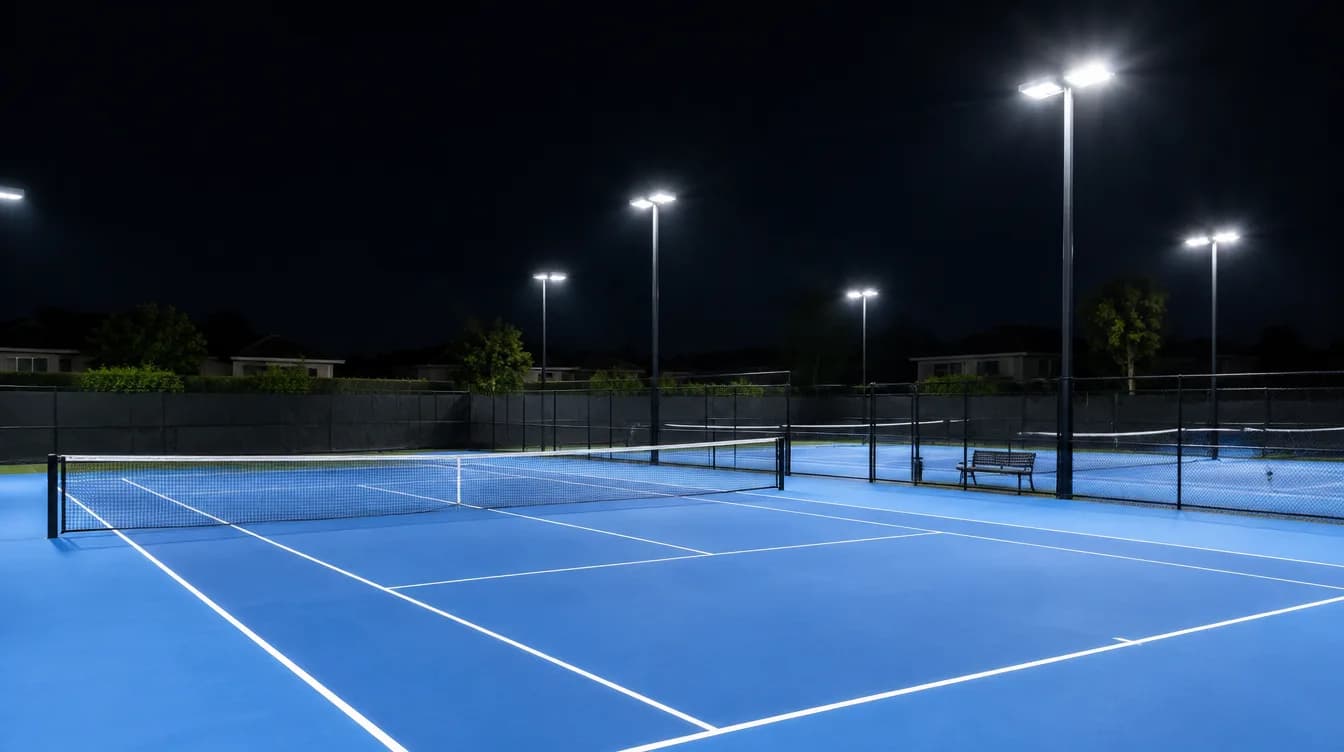
Court lighting lets clubs run night competitions, coaching and social play year-round, which lifts membership and court hire income. We design club lighting to the AS 2560 sports lighting series, with light spill onto neighbours limited under AS/NZS 4282. Lighting usually needs council approval, so we check that first.
- LED floodlights with even light across the court
- Timers and booking-linked controls to cut running costs
- Pole positions planned to avoid glare for players and neighbours
How often should club courts be resurfaced?
Tennis Australia's Victorian maintenance guides suggest club acrylic courts are resurfaced about every 7 to 10 years and synthetic grass about every 10 to 15 years. Heavy use, sun exposure and drainage change the timing. Recoating before cracks spread is far cheaper than a full rebuild, so plan resurfacing in your capital budget.
What do netball clubs need from a court?
Netball clubs need courts that are 30.5 m by 15.25 m with safe run-off, a slip-resistant surface that grips in dew, and lines that stay crisp through a winter season. Most netball projects we see are resurfacing and re-lining older asphalt courts, adding lights, or building an extra court for growing junior numbers.
- Crack repair and acrylic resurfacing on existing asphalt courts
- New courts with drainage designed for winter rain
- Goal post sleeves and padding
- Lighting for weeknight training
- Club colours and logos painted beside the court
Can you work around our season?
Yes. We plan club court works for the off-season or stage them court by court so members can keep playing. For a multi-court club, we can resurface or convert one bank of courts at a time, with fencing and signage separating the work zone from courts still in use.
Acrylic coatings need dry, mild weather to cure properly, so we agree a realistic window with your committee and build in a buffer for rain. Fixtures and pennant draws can then be planned with confidence.
How we keep every club court build compliant
Every club court project follows the same compliance steps, whether it's a recoat or a new bank of courts. We check council requirements, locate underground services, follow Work Health and Safety laws and use builders who hold the licence your state requires, with public liability insurance, and build to Tennis Australia guidance for club tennis.
- Council requirements checked for lighting, fencing over about 2 m, earthworks and noise
- Before You Dig Australia (BYDA) check before excavation
- Safe Work Method Statements for excavation and mobile plant
- Silica dust controls when cutting or grinding concrete
- Sediment and stormwater controls on site
- Tennis Australia guidance for club and community tennis
- AS 2560 sports lighting with spill limited under AS/NZS 4282
- Each sport's court dimensions and slip-resistant textured finishes
What do you need from our committee to quote?
To quote a club court project, we need to know what you want to build or fix, how many courts, and your timing around the season and any grant round. Photos, a site plan and your existing court details help most. We then return an itemised quote your committee and funders can work with.
- Court type and sports; new build, resurface or conversion
- Number of courts and current surface (acrylic, synthetic grass, asphalt)
- Known cracks, drainage problems or slope
- Machinery access
- Preferred surface and colours
- Posts, nets, fencing, lighting and power supply
- Council approvals, lease conditions and landlord consent
- Season dates, grant deadlines and budget
Key Benefits
Grant-ready quotes: itemised scopes, plans and product data for funders
Pickleball and padel: conversions and new courts that bring in new members
Season-friendly staging: off-season works or one bank of courts at a time
Night play: AS 2560 lighting with neighbour-aware design
Resurfacing plans: recoat before cracks spread and costs climb

Site Inspection
Free assessment and detailed quote

Professional Marking
Expert application with premium materials

Quality Assurance
Final inspection and compliance sign-off
Compliance Standards
Tennis Australia guidance
Club and community tennis courts built with Tennis Australia guidance in mind.
Local council approval
Requirements checked for lighting, fencing, earthworks and noise near neighbours.
AS 2560 · AS/NZS 4282
Sports lighting to the AS 2560 series with light spill limited under AS/NZS 4282.
Before You Dig Australia
Underground services located before any excavation.
WHS Act & SWMS
Safe Work Method Statements, silica dust controls and sediment controls.
Fully Compliant & Certified
All our work meets or exceeds Australian Standards and state road authority requirements
VicRoads Approved
Registered Contractor
$20M Public Liability
$10M Professional Indemnity
5,000+ Projects
Since 2009
Fixed Prices
Not Estimates
AS 1742
Traffic Control Devices
Specifies line colours, widths, arrow designs, and placement for road markings. Ensures all traffic control devices meet national safety standards.
AS/NZS 2890
Parking Facilities
Covers bay dimensions (2.4m × 5.4m standard, 2.4m × 5.4m accessible plus a 2.4m shared zone), aisle widths, and traffic flow requirements for compliant parking areas.
AS 4586
Slip Resistance
Defines slip resistance classifications (P rating) for pedestrian surfaces. Critical for wet areas, ramps, and high-traffic zones.
AS/NZS 1428
Access & Mobility
Sets requirements for accessible parking bays, tactile indicators, and mobility access. Essential for DDA compliance and accessibility audits.
What Our Clients Say
Results based on typical project outcomes. Individual results may vary.
Upload your site plans for a detailed quote within 48 hours
Get an accurate, fixed-price quote tailored to your specific project requirements
Frequently Asked Questions
A tennis court starts from about $40,000 installed (Oneflare cost guide, 2026), and acrylic resurfacing from about $8,000 (Airtasker cost guide, 2026). Line Marking Australia itemises surface, fencing and lighting so club committees can see every cost.
Clubs use state sport infrastructure programs, community benefit funds and council grants. Mount Gambier Tennis Club received $431,000 through South Australia's Community Facilities Program. Line Marking Australia supplies itemised quotes and scopes for applications.
Yes. One tennis court can carry two pickleball courts while keeping tennis, or up to four dedicated pickleball courts. Line Marking Australia repairs, resurfaces, marks contrasting lines and fits pickleball posts and nets.
A padel court starts from about $60,000, based on a Sydney club build reported in the trade press. The court is 20 m by 10 m. Line Marking Australia checks council requirements for glass walls, lighting and noise before quoting.
Club court lighting usually needs council approval. Line Marking Australia designs lighting to the AS 2560 sports lighting series and limits light spill under AS/NZS 4282, then checks your council's requirements before the final quote.
Tennis Australia's Victorian maintenance guides suggest acrylic courts are resurfaced about every 7 to 10 years and synthetic grass about every 10 to 15 years. Line Marking Australia can stage resurfacing court by court so members keep playing.
Related Services

Court Resurfacing
Learn more about this service
Netball Court Construction
Learn more about this service
Padel Court Construction
Learn more about this service
Sports Court Lighting
Learn more about this service
Tennis Court Construction
Learn more about this service
Tennis Court to Pickleball Conversion
Learn more about this service
More Sports & Playground Line Marking Services
Ready to Get Your Line Marking Sorted?
Upload your site plans and receive a fixed-price quote within 48 hours. No surprises, no cost blowouts, just clear pricing you can take to your committee or manager.
Or call us directly: 0417 460 236