

Tennis Court Construction
Acrylic and synthetic grass tennis courts for homes, schools, clubs and councils, built start to finish. New courts from about $40,000.
Jamie (24/7 quotes): 0468 069 002AS 1742.2 Compliant
Fully Insured
24/7 Availability

15+ Years
Get FREE Quote
Fixed-Price Quote Within 48 Hours
Trusted by 5,000+ businesses
VicRoads approved · AS/NZS compliant · $20M insured
Compliance-Ready Guarantee: every job is marked to AS/NZS 2890 & AS 1742, dimensionally verified, and delivered with full compliance documentation, backed by our 12-month workmanship guarantee.
Last updated:
What is Tennis Court Construction?
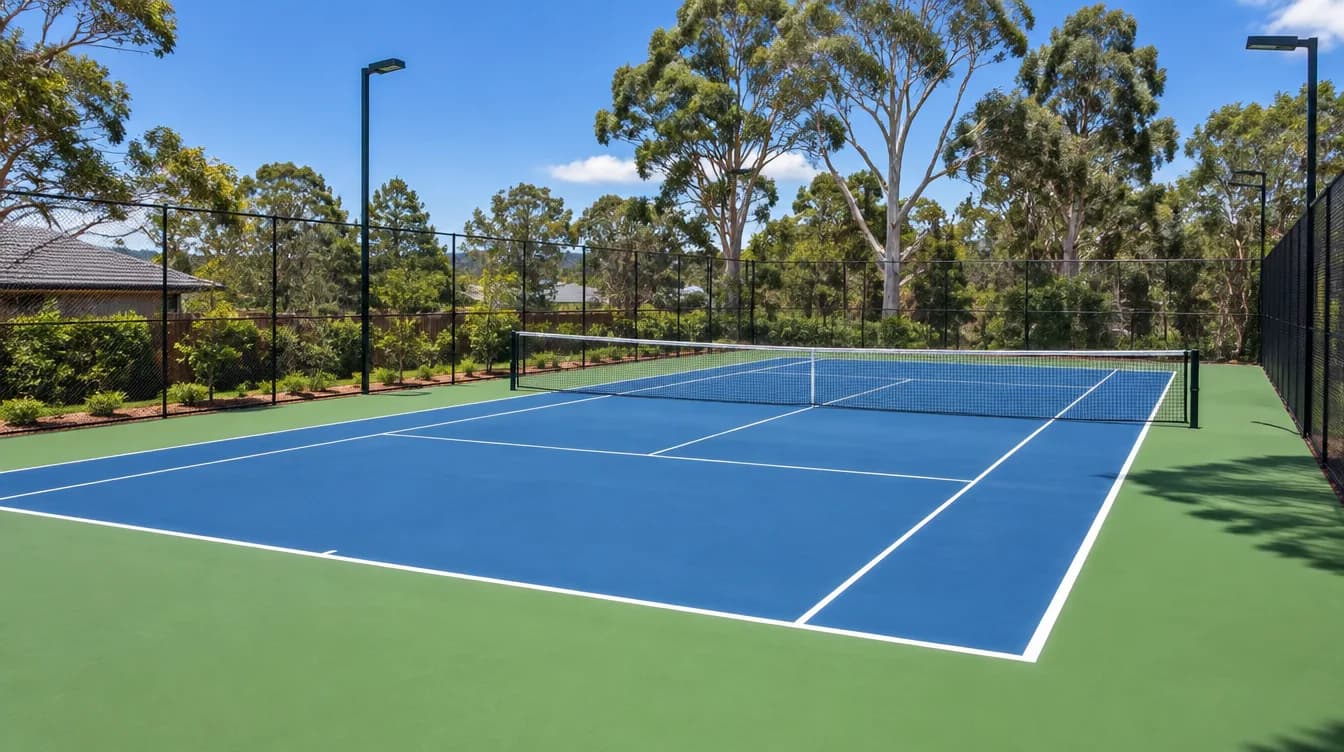
Line Marking Australia builds tennis courts across Australia for homes, schools, clubs, councils and resorts. A new tennis court starts from about $40,000 (Oneflare cost guide, 2026). We manage the whole job: earthworks, base, slab, acrylic or synthetic grass surface, line marking, posts, nets, fencing and lighting, with one point of contact.
A tennis court is one of the bigger projects you can take on at home or at a club. It's a large slab of ground that has to drain properly, play true and still look good in ten years. Getting the base right matters more than anything you see on top.
We've written this the way we'd explain it on site: what it costs, which surface to pick, how long it takes and what councils look for. Every court is quoted on its own ground, so treat the figures as a guide.
How much does it cost to build a tennis court in Australia?
Building a tennis court in Australia costs from about $40,000 (Oneflare cost guide, 2026), and the final price depends on the ground, the surface, fencing and lighting. A flat, firm site with good truck access sits at the lower end. Sloping blocks, reactive soil, retaining walls and night lighting all add cost.
| Item | Starting point | What moves the price |
|---|---|---|
| New tennis court (base, slab, surface, lines, net) | From about $40,000 (Oneflare cost guide, 2026) | Slope, soil, access, surface choice |
| Acrylic resurfacing of an existing court | From about $8,000 (Airtasker cost guide, 2026) | Crack repairs, number of coats, colours |
| Synthetic grass surface | Quoted per site | Turf type, sand infill, base condition |
| Fencing | Quoted per site | Height, length, gates, windbreak mesh |
| Lighting | Quoted per site | Light levels, poles, power supply, spill control |
The biggest swing in price is usually the ground itself. Cut and fill, drainage and retaining walls can cost as much as the surface, so we look at the site before we give you a firm number and itemise every part of the quote.
Acrylic hard court or synthetic grass: which is better for a tennis court?
For an Australian tennis court, acrylic hard court gives a true, consistent bounce and needs little day-to-day care, while synthetic grass is softer underfoot and plays in light rain. Acrylic suits players who want a classic hard court. Synthetic grass suits clubs, schools and families who value comfort and all-weather play.
| Acrylic hard court | Synthetic grass (sand-filled) | |
|---|---|---|
| Base | Concrete or asphalt slab | Asphalt, concrete or compacted crushed rock |
| How it plays | True, consistent bounce; faster | Slower, lower bounce; forgiving on joints |
| Wet weather | Slippery until dry | Playable in light rain |
| Upkeep | Blow off leaves, wash occasionally | Regular brushing and sand top-ups |
| Resurfacing | About every 7 to 10 years | About every 10 to 15 years |
| Extra lines | Easy to add pickleball or basketball lines | Lines inlaid in the turf; harder to change |
The resurfacing intervals above come from Tennis Australia's Victorian maintenance guides. Tennis Australia also sorts surfaces into categories in its National Court Surface Policy, and we follow its guidance for club and community courts. Cushioned acrylic is a third option if you want hard-court play that is kinder on knees.
How much space do you need for a tennis court?
A doubles tennis court in Australia has a playing area of 23.77 m by 10.97 m, plus run-off behind the baselines and beside the sidelines so players can chase the ball safely. The total fenced area is much bigger than the lines, so measure your whole block before you fall in love with a spot.
- Playing area: 23.77 m × 10.97 m for doubles, with the singles lines inside it
- Run-off: generous space behind each baseline and beside each sideline, which we plan to suit your level of play
- Orientation: roughly north–south where possible, so the low sun isn't in a server's eyes
- Room to build: space around the court for machinery, fencing footings and drainage
Can you build a tennis court in your backyard?
Yes, a tennis court can be built in an Australian backyard if the block is big enough for the playing area plus run-off, trucks can get in, and the council rules allow it. Larger suburban, acreage and rural blocks are the most common sites. Where space is tight, we can talk about a multi-sport or pickleball court instead.
On a home court we look closely at neighbours, because fencing, lighting and ball noise are what councils and next door ask about. Planting, windbreak mesh and lighting designed to keep light on the court all help. Our backyard sports courts page covers the smaller options.
How long does it take to build a tennis court?
A new tennis court usually takes a few weeks on site in Australia once approvals are in place, and longer on sloping or wet ground. Concrete needs to cure before the acrylic coats go on, and synthetic grass needs a dry base to lay well. A resurface on a sound court is much quicker.
- Site visit, survey and design
- Council check and Before You Dig Australia search
- Excavation, drainage and compacted base
- Concrete or asphalt slab, then curing time
- Acrylic coats or synthetic grass and sand infill
- Line marking, net posts and net
- Fencing, gates and lighting
Do you need council approval for a tennis court?
A tennis court may need council approval in Australia, especially when it includes lighting, fences over about 2 m, retaining walls, big earthworks, or sits in a heritage or flood overlay. Rules differ between councils, so we check your local requirements early and help prepare plans and details the council asks for.
Lighting gets the most attention. Councils want light spill kept off neighbouring homes, which is covered by AS/NZS 4282, and they may set hours of use. Tall fencing and stormwater from a large slab are the next most common questions.
What tennis court fencing and lighting do you need?
Most Australian tennis courts are fully fenced with chain-wire mesh on steel posts to keep balls in, and many add LED lighting for evening play. Fence height, gates and windbreak mesh are set to suit the site and council rules. Lighting is designed for even light on the court with little spill outside it.
- Fencing: galvanised or powder-coated posts, chain-wire mesh, pedestrian and maintenance gates, optional windbreak or privacy mesh
- Lighting: LED floodlights on poles, designed to the AS 2560 series for sports lighting and AS/NZS 4282 for obtrusive light
- Extras: seating, shade, a practice wall or a ball machine area
See sports court lighting and sports court fencing for more detail on each.
How often does a tennis court need resurfacing?
An acrylic tennis court usually needs resurfacing about every 7 to 10 years, and a synthetic grass court about every 10 to 15 years, according to Tennis Australia's Victorian maintenance guides. Acrylic resurfacing starts from about $8,000 (Airtasker cost guide, 2026). Shade, traffic and drainage all change how long a surface lasts.
Signs it's time: faded or worn colour, cracks, slippery patches, ponding after rain, or lines that have lost their crispness. We repair cracks, clean, recoat and re-line in one job. Our court resurfacing page explains the process.
How we keep every tennis court build compliant
Every tennis court we build follows the same compliance steps, so you aren't left chasing paperwork. That means checking council requirements before the final quote, locating underground services, managing safety and dust on site, and building to the court dimensions and Australian Standards that apply to a tennis court.
- Council planning and building requirements checked for lighting, fencing, retaining walls, earthworks, drainage, setbacks and overlays
- Before You Dig Australia (BYDA) check before excavation
- Work Health and Safety laws followed, with Safe Work Method Statements for excavation and mobile plant
- Silica dust controls (water suppression or on-tool vacuum extraction) when cutting or grinding concrete
- Sediment and stormwater controls during earthworks
- Concrete slabs to AS 3600, accessible paths to the court considered against AS 1428.1
- Sports lighting to AS 2560.1:2018 and AS 2560.2:2021, with obtrusive light controlled under AS/NZS 4282
- Tennis Australia guidance followed for club and community courts
- Builders who hold the licence your state requires, with public liability insurance
Can a tennis court also be used for pickleball?
Yes, an Australian tennis court can carry pickleball lines as well as tennis lines, and a fully converted court can hold several dedicated pickleball courts. Tennis Australia and the National Pickleball League are turning tennis venues into multi-sport racquet hubs, so many clubs now plan both sports from day one.
If you're building new, adding pickleball lines in a contrasting colour costs little at the line marking stage. If you already have an older court, a resurface is the right time to add them.
What do you need from me to quote a tennis court?
To quote a tennis court in Australia we need to understand the site, the surface you want and the extras. A few photos and a rough sketch of the area with measurements let us give you a realistic starting figure, and a site visit lets us firm it up into an itemised quote.
- New court, resurface or conversion of an existing court
- Home, school, club, council or resort site
- What's on the ground now: lawn, old court, gravel or bush
- Slope, drainage and any trees close to the court
- Truck and machinery access to the site
- Preferred surface: acrylic, cushioned acrylic or synthetic grass
- Extra sports to mark, such as pickleball
- Fencing, lighting and power supply
- Any council approvals already in place
- Plans or photos, your timing and your budget
Key Benefits
Whole build, one contact: earthworks, slab, surface, lines, net, fencing and lighting managed together
Acrylic or synthetic grass: honest advice on the surface that suits your players and upkeep
Clear starting price: new courts from about $40,000, itemised per site
Compliance built in: council checks, BYDA, SWMS, dust and sediment controls
Ready for pickleball: extra sports marked in contrasting colours

Site Inspection
Free assessment and detailed quote

Professional Marking
Expert application with premium materials

Quality Assurance
Final inspection and compliance sign-off
Compliance Standards
Local council approval
Lighting, fencing, retaining walls, earthworks, drainage, setbacks and overlays checked before the final quote.
Before You Dig Australia
Underground services located before any excavation.
WHS Act & SWMS
Safe Work Method Statements for excavation and mobile plant; silica dust controls when cutting concrete.
AS 3600 · AS 1428.1
Concrete slabs to AS 3600; accessible paths to the court considered against AS 1428.1.
AS 2560 · AS/NZS 4282
Sports lighting to AS 2560.1:2018 and AS 2560.2:2021, with light spill controlled under AS/NZS 4282.
Tennis Australia guidance
Court dimensions of 23.77 m × 10.97 m and Tennis Australia guidance for club and community courts.
Fully Compliant & Certified
All our work meets or exceeds Australian Standards and state road authority requirements
VicRoads Approved
Registered Contractor
$20M Public Liability
$10M Professional Indemnity
5,000+ Projects
Since 2009
Fixed Prices
Not Estimates
AS 1742
Traffic Control Devices
Specifies line colours, widths, arrow designs, and placement for road markings. Ensures all traffic control devices meet national safety standards.
AS/NZS 2890
Parking Facilities
Covers bay dimensions (2.4m × 5.4m standard, 2.4m × 5.4m accessible plus a 2.4m shared zone), aisle widths, and traffic flow requirements for compliant parking areas.
AS 4586
Slip Resistance
Defines slip resistance classifications (P rating) for pedestrian surfaces. Critical for wet areas, ramps, and high-traffic zones.
AS/NZS 1428
Access & Mobility
Sets requirements for accessible parking bays, tactile indicators, and mobility access. Essential for DDA compliance and accessibility audits.
What Our Clients Say
Results based on typical project outcomes. Individual results may vary.
Upload your site plans for a detailed quote within 48 hours
Get an accurate, fixed-price quote tailored to your specific project requirements
Frequently Asked Questions
A tennis court in Australia costs from about $40,000 (Oneflare cost guide, 2026). Slope, soil, drainage, truck access, the surface you choose, fencing and lighting decide the final figure. Line Marking Australia visits the site and itemises every part of the quote.
Acrylic gives a true, faster bounce and needs little routine care. Synthetic grass is softer, plays in light rain and suits families and clubs, but needs regular brushing and sand top-ups. Line Marking Australia builds both and helps you choose for your site.
A doubles tennis court has a playing area of 23.77 m by 10.97 m. You also need run-off behind the baselines and beside the sidelines, plus room for fencing, so the total area is much larger than the lines themselves.
A new tennis court usually takes a few weeks on site once approvals are sorted. Earthworks, drainage, slab curing time and wet weather all affect the timeline. Line Marking Australia gives you a schedule before work starts.
Often, yes. Councils commonly look at lighting, fences over about 2 m, retaining walls, earthworks, drainage, setbacks and heritage or flood overlays. Line Marking Australia checks your council's rules before the final quote and helps prepare what it asks for.
Tennis Australia's Victorian maintenance guides suggest resurfacing acrylic courts about every 7 to 10 years and synthetic grass about every 10 to 15 years. Acrylic resurfacing starts from about $8,000 (Airtasker cost guide, 2026).
Yes. Line Marking Australia designs LED tennis court lighting to the AS 2560 series for sports lighting, with light spill controlled under AS/NZS 4282. Lighting often needs council approval, so we check that first and plan the power supply.
Yes. Pickleball lines can be marked on a tennis court in a contrasting colour, and a full conversion can create several dedicated pickleball courts. Adding them during construction or a resurface is the most cost-effective time.
Related Services

Court Resurfacing
Learn more about this service
Sports Court Construction
Learn more about this service
Sports Court Fencing
Learn more about this service
Sports Court Lighting
Learn more about this service
Tennis Court Line Marking?
Learn more about this service
Tennis Court to Pickleball Conversion
Learn more about this service
More Sports & Playground Line Marking Services
Ready to Get Your Line Marking Sorted?
Upload your site plans and receive a fixed-price quote within 48 hours. No surprises, no cost blowouts, just clear pricing you can take to your committee or manager.
Or call us directly: 0417 460 236