

Tennis Court Construction Darwin
Tennis courts for Top End homes, schools, clubs and resorts, designed for monsoon rain, strong UV and cyclone winds. New courts from about $40,000.
Jamie (24/7 quotes): 0468 069 002AS 1742.2 Compliant
Fully Insured
24/7 Availability

15+ Years
Get FREE Quote
Fixed-Price Quote Within 48 Hours
Trusted by 5,000+ businesses
VicRoads approved · AS/NZS compliant · $20M insured
Compliance-Ready Guarantee: every job is marked to AS/NZS 2890 & AS 1742, dimensionally verified, and delivered with full compliance documentation, backed by our 12-month workmanship guarantee.
Last updated:
What is Tennis Court Construction Darwin?
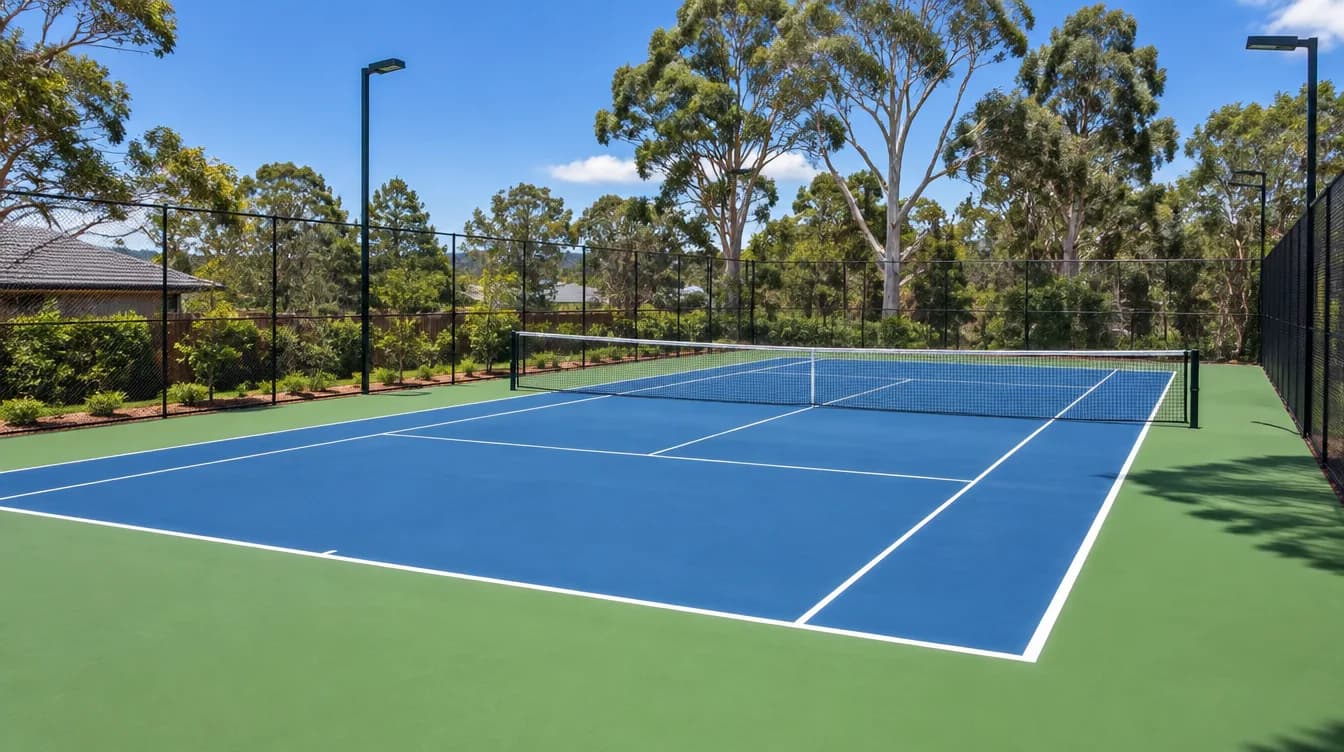
Line Marking Australia arranges tennis court construction in Darwin through our network of local builders, for homes, schools, clubs and resorts across the Top End. A new tennis court in Australia starts from about $40,000 (Oneflare cost guide, 2026). We plan the slab, drainage, surface, lines, net posts, fencing and lighting for tropical conditions.
Building a tennis court in Darwin is not the same as building one in Melbourne. The wet season dumps heavy rain in short bursts, the sun is fierce all year and cyclone season shapes how fences and light poles are designed.
We coordinate the whole job so you deal with one contact. Here is how a Darwin tennis court comes together, and the questions we get asked most.
How much does a tennis court cost in Darwin?
A tennis court in Darwin starts from about $40,000 for a new acrylic hard court, based on the Oneflare cost guide (2026). Final pricing depends on earthworks, drainage, the surface, fencing and lighting, and on getting materials and machinery to your site, so every Top End court is quoted per site.
| Project | Starting point |
|---|---|
| New tennis court (acrylic hard court) | From about $40,000 (Oneflare cost guide, 2026) |
| Acrylic resurface of an existing court | From about $8,000 (Airtasker cost guide, 2026) |
| Wind-rated fencing and windbreak | Quoted per site |
| Court lighting for night play | Quoted per site |
Drainage is the line item Darwin owners tend to underestimate. A court that sheds monsoon rain properly costs a little more up front and saves a lot later.
What tennis court surface suits Darwin's tropical climate?
For Darwin, an acrylic hard court on a well-drained concrete slab is the most common tennis surface because it dries fast after storms and copes with heat. Lighter, UV-stable colours stay cooler underfoot. Synthetic grass also works in the tropics, but it needs regular brushing to keep the sand infill even and stop mould.
| Surface | In the Top End |
|---|---|
| Acrylic hard court | Quick to dry, true bounce, recoat about every 7 to 10 years |
| Cushioned acrylic | Softer on joints, popular with clubs and older players |
| Synthetic grass (sand-filled) | Plays soon after rain, needs brushing and sand top-ups, replaced about every 10 to 15 years |
Those intervals come from Tennis Australia's Victorian maintenance guides. In Darwin's sun, expect colour to fade sooner on darker shades.
When is the best time to build a tennis court in Darwin?
The best time to build a tennis court in Darwin is the dry season, roughly May to October. Excavation, concrete pours and acrylic coatings all need dry weather, and acrylic cannot be applied in rain or high humidity at the wrong time of day. Booking your build for the dry avoids weeks of wet-season delays.
- Get approvals and design done during the wet season
- Book earthworks and the slab early in the dry
- Allow curing time before the acrylic goes on
- Finish lines, posts and fencing before the build-up to the next wet
Do you need council approval for a tennis court in Darwin?
A tennis court in Darwin may need approval, but the path differs from other states. Planning is set by the NT Planning Scheme, and building permits are issued by private registered building certifiers rather than councils. City of Darwin, Palmerston and Litchfield councils still care about drainage into their stormwater systems, driveways and works near the road.
Lighting, tall fencing, retaining walls and shade structures are the parts most likely to need a certifier. Light spill and noise near neighbours also come up on residential blocks, so we check your site before you commit.
Who needs to be registered to build a court in the Northern Territory?
In the Northern Territory, the Building Practitioners Board registers building contractors. Residential contractors must be registered for houses, units and related work valued at $25,000 or above, and commercial contractor registration now covers Class 3 to 9 buildings. A stand-alone court may fall outside those categories, so the right practitioners are confirmed per site.
Fencing, light poles, retaining walls and shade roofs can bring in a building certifier and registered practitioners. We make sure the builders we arrange hold the registration the job needs, plus public liability insurance.
How do you design a Darwin tennis court for cyclones and storms?
A Darwin tennis court is designed for storms by engineering the fence posts, footings, windbreak and light poles for the wind loads that apply in a cyclone region. Windbreak mesh catches a lot of wind, so it is fixed so it can be removed or released when a cyclone warning is issued.
- Engineered footings for fence and light poles
- Removable or release-clip windbreak mesh
- Net posts and equipment that can be secured or stored
- Generous falls and edge drains so the slab sheds sudden downpours
How often does a tennis court need resurfacing in the Top End?
An acrylic tennis court usually needs resurfacing about every 7 to 10 years, according to Tennis Australia's Victorian maintenance guides, and Darwin's UV can push that toward the shorter end. A resurface starts from about $8,000 (Airtasker cost guide, 2026). Cleaning off mould and algae each dry season helps the coating last.
Signs your Darwin court is due: faded or chalky colour, slippery patches after rain, cracks and ponding water. We repair cracks, fix low spots, recoat and re-line in one visit.
Who builds tennis courts in Darwin?
Line Marking Australia arranges Darwin tennis courts through our network of local builders, with one contact managing design, approvals, slab, surface, line marking, fencing and lighting. We do not run a Darwin yard. Instead we match your job with experienced local trades and keep the whole build on track from start to handover.
Typical Darwin buyers include homeowners on larger rural-residential blocks, schools, resorts and community clubs. See our main tennis court construction page for the national guide, or our courts for hotels and resorts page if guests will use it.
How we keep every tennis court build compliant in Darwin
Every Darwin tennis court we arrange follows the same compliance steps, adjusted for Territory rules and tropical weather. That means checking planning and certifier requirements first, locating services before digging, and building to the court dimensions and Australian Standards that apply to slabs, access and lighting.
- Planning and building certifier requirements checked for lighting, fencing, retaining walls and drainage
- Before You Dig Australia (BYDA) check before excavation
- Work Health and Safety laws, with Safe Work Method Statements for excavation and mobile plant
- Silica dust controls when cutting concrete, plus sediment and stormwater controls in the wet
- Concrete to AS 3600, accessible paths considered against AS 1428.1
- Sports lighting to AS 2560.1:2018 and AS 2560.2:2021, light spill limited under AS/NZS 4282
- Court playing area of 23.77 m by 10.97 m for doubles, plus run-off, with Tennis Australia guidance for club courts
For other court types, see our sports court construction hub.
What do you need from me to quote a tennis court in Darwin?
To quote a tennis court in Darwin we need to understand your site, how water moves across it in the wet, and what you want from the court. Photos and rough measurements are a great start. The more detail you give, the closer the first quote will be to the final price.
- New court, resurface or conversion to multi-sport
- Full-size court or a smaller hit-up court
- Home, school, club, resort or strata site
- What is on the ground now and how much it slopes
- Where stormwater goes during heavy rain
- Machinery and truck access
- Preferred surface: acrylic, cushioned acrylic or synthetic grass
- Extra lines, such as pickleball
- Fencing, windbreak, lighting and power
- Any approvals or certifier advice so far
- Plans, photos and your timing within the dry season
- Your budget range
Key Benefits
Built for the tropics: drainage, UV-stable colours and wind-rated fencing planned from day one
Dry-season scheduling: approvals in the wet, construction in the dry
Local builder network: experienced Top End trades, one LMA contact
Clear starting price: new courts from about $40,000, every extra itemised
Compliance covered: NT certifier checks, BYDA, SWMS and Australian Standards

Site Inspection
Free assessment and detailed quote

Professional Marking
Expert application with premium materials

Quality Assurance
Final inspection and compliance sign-off
Compliance Standards
NT planning & certifier
NT Planning Scheme and building certifier requirements checked for lighting, fencing, retaining walls and drainage.
Building Practitioners Board
Builders arranged hold the NT registration the work requires, with public liability insurance.
Before You Dig Australia
Underground services located before any excavation.
WHS & SWMS
Safe Work Method Statements for excavation and mobile plant, silica dust controls when cutting concrete.
AS 3600 · AS 1428.1
Concrete slab to AS 3600 with falls for monsoon rain; accessible paths considered against AS 1428.1.
AS 2560 · AS/NZS 4282
Sports lighting to the AS 2560 series with light spill limited for neighbours.
Fully Compliant & Certified
All our work meets or exceeds Australian Standards and state road authority requirements
VicRoads Approved
Registered Contractor
$20M Public Liability
$10M Professional Indemnity
5,000+ Projects
Since 2009
Fixed Prices
Not Estimates
AS 1742
Traffic Control Devices
Specifies line colours, widths, arrow designs, and placement for road markings. Ensures all traffic control devices meet national safety standards.
AS/NZS 2890
Parking Facilities
Covers bay dimensions (2.4m × 5.4m standard, 2.4m × 5.4m accessible plus a 2.4m shared zone), aisle widths, and traffic flow requirements for compliant parking areas.
AS 4586
Slip Resistance
Defines slip resistance classifications (P rating) for pedestrian surfaces. Critical for wet areas, ramps, and high-traffic zones.
AS/NZS 1428
Access & Mobility
Sets requirements for accessible parking bays, tactile indicators, and mobility access. Essential for DDA compliance and accessibility audits.
What Our Clients Say
Results based on typical project outcomes. Individual results may vary.
Upload your site plans for a detailed quote within 48 hours
Get an accurate, fixed-price quote tailored to your specific project requirements
Frequently Asked Questions
A new tennis court in Darwin starts from about $40,000, based on the Oneflare cost guide (2026). Drainage, earthworks, surface, wind-rated fencing and lighting change the final figure, so Line Marking Australia quotes every Darwin court for its own site.
Build a Darwin tennis court in the dry season, roughly May to October. Concrete pours and acrylic coatings need dry weather. Line Marking Australia suggests sorting design and approvals during the wet so the build starts early in the dry.
An acrylic hard court on a well-drained concrete slab suits Darwin best for most owners, because it dries quickly after storms. Lighter UV-stable colours run cooler. Synthetic grass also works but needs regular brushing to manage sand and mould.
A Darwin tennis court may need planning approval under the NT Planning Scheme and a building permit from a private registered building certifier, especially with lighting, tall fencing, retaining walls or shade roofs. Line Marking Australia checks your site first.
Fence posts, footings, windbreak and light poles on a Darwin tennis court should be engineered for cyclone-region wind loads. Windbreak mesh is usually fixed so it can be removed or released before a cyclone, and loose equipment is stored away.
Tennis Australia's Victorian maintenance guides suggest resurfacing acrylic courts about every 7 to 10 years, and Darwin's strong UV can shorten that. Resurfacing starts from about $8,000 (Airtasker cost guide, 2026). Regular cleaning of mould and algae helps.
Line Marking Australia arranges Darwin tennis courts through our network of local builders. You get one contact for the whole job, from design and approvals through to the slab, surface, lines, fencing and lighting.
Related Services

Backyard Sports Courts
Learn more about this service
Sports Court Construction
Learn more about this service
Sports Courts for Hotels and Resorts
Learn more about this service
Sports Courts for Sports Clubs
Learn more about this service
Tennis Court Construction
Learn more about this service
More Sports & Playground Line Marking Services
Ready to Get Your Line Marking Sorted?
Upload your site plans and receive a fixed-price quote within 48 hours. No surprises, no cost blowouts, just clear pricing you can take to your committee or manager.
Or call us directly: 0417 460 236