

Basketball Court Construction
Backyard half courts and full-size school, council and club courts, built on tiles or acrylic. Half courts from about $10,000 including the slab.
Jamie (24/7 quotes): 0468 069 002AS 1742.2 Compliant
Fully Insured
24/7 Availability

15+ Years
Get FREE Quote
Fixed-Price Quote Within 48 Hours
Trusted by 5,000+ businesses
VicRoads approved · AS/NZS compliant · $20M insured
Compliance-Ready Guarantee: every job is marked to AS/NZS 2890 & AS 1742, dimensionally verified, and delivered with full compliance documentation, backed by our 12-month workmanship guarantee.
Last updated:
What is Basketball Court Construction?
Line Marking Australia builds basketball courts across Australia, from backyard half courts to full-size school, council and club courts. A backyard half court of up to about 165 m², including the slab, starts from about $10,000, and a full-size court of about 420 m² starts from about $70,000 (published Australian builder pricing, 2026).
Most of our basketball enquiries start in the backyard. Kids have outgrown the driveway hoop, and the family wants a proper key, a three-point line and a surface that doesn't wreck the ball. Schools and councils come to us for bigger courts that take heavy use.
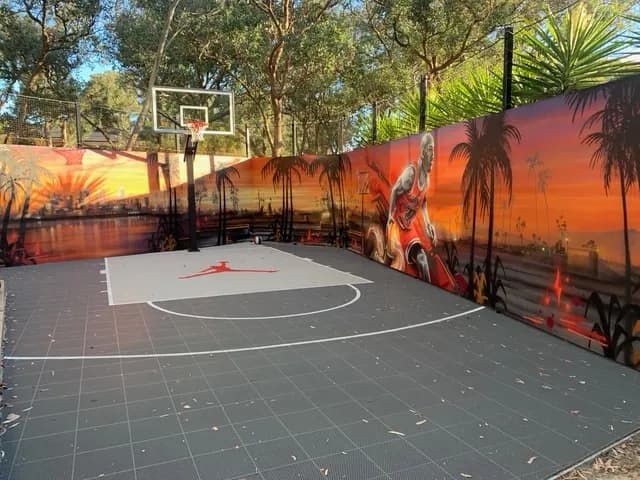
Our crews have built backyard half courts on modular tiles finished with a painted feature wall, and school courts on tiles with new hoops. Here's how we'd plan yours.
How much does a backyard basketball court cost in Australia?
A backyard basketball half court in Australia costs from about $10,000 for up to about 165 m², including the slab, and a full-size court of about 420 m² costs from about $70,000 (published Australian builder pricing, 2026). Site preparation, the surface, the hoop, fencing and lighting decide where your court lands.
| Court | Typical area | Starting price |
|---|---|---|
| Backyard half court (slab, surface, lines) | Up to about 165 m² | From about $10,000 (published Australian builder pricing, 2026) |
| Full-size basketball court | About 420 m² | From about $70,000 (published Australian builder pricing, 2026) |
| Small shooting pad or key only | Smaller than a half court | Quoted per site |
| In-ground hoop, rebound fencing, lighting | Add-ons | Quoted per site |
What pushes the price up: a sloping yard that needs cut, fill or retaining, poor drainage, tight access for trucks and concrete pumps, premium tiles, a glass backboard and night lighting. We itemise each one so you can build now and add extras later.
What size should a backyard basketball court be?
A backyard basketball court in Australia can be anything from a small shooting pad to a half court or a full court. A full FIBA court is 28 m by 15 m, so most homes build a half court sized to the block. We size it around the key, the three-point line you want and safe run-off.
| Option | Size guide | Good for |
|---|---|---|
| Shooting pad | Enough for the key and a few metres around it | Young kids, smaller yards |
| Half court | Up to about 165 m² is common for homes | Teenagers, one-on-one and three-on-three |
| Full court | 28 m × 15 m playing area (FIBA), about 420 m² with surrounds | Schools, councils, clubs, large rural blocks |
Leave space beyond the lines so players don't run into a fence or wall, and set the hoop so the sun isn't in shooters' eyes in the late afternoon.
What size concrete slab do you need for a half court?
The concrete slab for a backyard half court in Australia is usually sized to the court plus run-off, which for many homes means a slab of up to about 165 m². The slab thickness, reinforcement and falls are designed for your soil and drainage, and the hoop footing is set into the ground separately.
- Area: the playing lines you want plus a safety margin on each side
- Falls: a gentle slope so rain runs off rather than ponding at the key
- Joints: control joints planned so they don't sit where players land
- Hoop footing: an in-ground post set in its own concrete footing
- Curing: concrete needs time to cure before tiles or acrylic go on
Tiles or acrylic: which surface is best for a basketball court?
Modular tiles and acrylic are the two most popular basketball court surfaces in Australia. Tiles clip together on a slab, drain fast and are quick to install, which suits backyards and schools. Acrylic is painted onto concrete or asphalt, gives a smooth, consistent finish and suits full-size courts and multi-sport layouts.
| Modular court tiles | Acrylic coating | |
|---|---|---|
| Installation | Clipped together on a slab or asphalt; fast | Several coats on cured concrete or asphalt |
| Feel | Slight give, good grip, drains through the gaps | Smooth and consistent; textured for grip |
| Wet weather | Dries quickly | Needs time to dry after rain |
| Repairs | Replace a single damaged tile | Patch and recoat |
| Best for | Backyards, schools, quick builds | Full courts, councils, multi-sport courts |
Both take crisp lines in contrasting colours. Our sports court tiles page covers tile options in more detail.
Can you build a backyard basketball court without concrete?
A backyard basketball court in Australia almost always needs a firm, flat base, and concrete or asphalt gives the longest life. Some modular tile systems can go on a well-compacted crushed rock base, but they can move or sag over time if the ground is soft. We look at your soil and drainage before recommending a base.
If you already have a sound concrete area, like an old patio or driveway extension, we can often lay tiles or acrylic straight over it after repairs, which saves the cost of a new slab.
Which basketball hoop should you choose?
For a backyard or school basketball court in Australia, an in-ground hoop on a steel post set in a concrete footing is the most stable choice. It handles dunks and hanging better than a portable stand. Many in-ground hoops have adjustable height, so younger players can start low and move up.
- In-ground hoop: fixed post in a concrete footing, the best for backyard and school courts
- Wall-mounted hoop: for indoor halls or a sturdy wall at the end of the court
- Adjustable height: worth it for families with younger children
- Rebound fencing or walls: keep balls out of gardens and neighbours' yards
We supply and install hoops as part of the court, or separately through basketball hoop installation.
How long does it take to build a basketball court?
A backyard basketball half court usually takes about one to three weeks on site in Australia once approvals are sorted, and larger school or council courts take longer. Concrete must cure before the surface goes on, and wet weather can add days. Tiling a sound existing slab can take only a day or two.
- Site visit and measure-up
- Council check and Before You Dig Australia search
- Excavation, base and drainage
- Slab pour and hoop footing, then curing time
- Tiles or acrylic, then line marking
- Hoop, fencing and lighting
Do you need council approval for a basketball court?
A backyard basketball court may need council approval in Australia, depending on the earthworks, retaining walls, fence height, lighting and any heritage or flood overlays. A simple slab and hoop on flat ground often needs nothing, but rules differ between councils, so we check your local requirements early.
Neighbours mostly notice the bouncing ball and lights at night. Placing the hoop away from bedroom windows, adding rebound fencing and using lighting designed to stay on the court under AS/NZS 4282 all help.
How we keep every basketball court build compliant
Every basketball court we build follows the same compliance steps, whether it's a backyard half court or a full school court. We check council requirements, locate services before digging, manage safety and dust on site, and build the slab, lighting and lines to the standards and court dimensions that apply.
- Council requirements checked for earthworks, retaining walls, fencing over about 2 m, lighting, drainage and overlays
- Before You Dig Australia (BYDA) check before excavation
- Work Health and Safety laws, with Safe Work Method Statements for excavation and mobile plant
- Silica dust controls when cutting or grinding concrete
- Sediment and stormwater controls during earthworks
- Slabs to AS 3600; slip-resistant textured finishes
- Lighting to AS 2560.1:2018 and AS 2560.2:2021, with spill controlled under AS/NZS 4282
- FIBA court dimensions (28 m × 15 m) for full courts
- For schools: work scheduled for holidays where possible and Working with Children checks for crews
Do you build basketball courts for schools, councils and clubs?
Yes. Line Marking Australia builds and lines basketball courts for schools, councils, clubs and community centres across Australia, from single outdoor courts to multi-sport courts with netball and other lines. We've built a school multi-sport court on modular tiles with new hoops, and lined indoor school sports halls for basketball.
Schools usually want a hard-wearing surface, durable hoops and extra sports marked on the same court. Councils focus on lighting, accessibility and neighbour impact. See multi-sport court construction if you want several sports on one surface.
What do you need from me to quote a basketball court?
To quote a basketball court in Australia we need to know the size you want, what's on the ground now and how we get machinery in. Photos of the area, a rough sketch with measurements and a note of any slope give us enough for a starting figure, then a site visit firms it up.
- Shooting pad, half court or full court
- New build, resurface, or tiles over an existing slab
- Home, school, council or club site
- What's on the ground now: lawn, pavers, old concrete
- Slope, drainage and nearby trees
- Access for trucks and a concrete pump
- Preferred surface: tiles or acrylic, and colours
- Other sports to mark, such as netball or pickleball
- Hoop type, rebound fencing, lighting and power
- Any approvals in place, your timing and your budget
Key Benefits
Backyard to full size: shooting pads, half courts and full courts for homes, schools and councils
Tiles or acrylic: the surface that suits your yard, players and budget
Clear starting prices: half courts from about $10,000 including the slab
Hoops and extras: in-ground hoops, rebound fencing and lighting installed
Line marking specialists: crisp keys, three-point lines and extra sports in contrasting colours

Site Inspection
Free assessment and detailed quote

Professional Marking
Expert application with premium materials

Quality Assurance
Final inspection and compliance sign-off
Compliance Standards
Local council approval
Earthworks, retaining walls, fencing, lighting, drainage and overlays checked before the final quote.
Before You Dig Australia
Underground services located before excavation and hoop footings.
WHS Act & SWMS
Safe Work Method Statements for excavation and mobile plant; silica dust controls when cutting concrete.
AS 3600
Slabs and footings designed to AS 3600, with slip-resistant textured finishes.
AS 2560 · AS/NZS 4282
Court lighting to the AS 2560 series with light spill controlled under AS/NZS 4282.
FIBA court dimensions
Full courts marked to 28 m × 15 m; half courts sized to the block.
Fully Compliant & Certified
All our work meets or exceeds Australian Standards and state road authority requirements
VicRoads Approved
Registered Contractor
$20M Public Liability
$10M Professional Indemnity
5,000+ Projects
Since 2009
Fixed Prices
Not Estimates
AS 1742
Traffic Control Devices
Specifies line colours, widths, arrow designs, and placement for road markings. Ensures all traffic control devices meet national safety standards.
AS/NZS 2890
Parking Facilities
Covers bay dimensions (2.4m × 5.4m standard, 2.4m × 5.4m accessible plus a 2.4m shared zone), aisle widths, and traffic flow requirements for compliant parking areas.
AS 4586
Slip Resistance
Defines slip resistance classifications (P rating) for pedestrian surfaces. Critical for wet areas, ramps, and high-traffic zones.
AS/NZS 1428
Access & Mobility
Sets requirements for accessible parking bays, tactile indicators, and mobility access. Essential for DDA compliance and accessibility audits.
What Our Clients Say
Results based on typical project outcomes. Individual results may vary.
Upload your site plans for a detailed quote within 48 hours
Get an accurate, fixed-price quote tailored to your specific project requirements
Frequently Asked Questions
A backyard basketball half court of up to about 165 m², including the slab, costs from about $10,000 (published Australian builder pricing, 2026). Slope, access, tiles or acrylic, the hoop and lighting change the final price. Line Marking Australia itemises every part.
A full-size basketball court of about 420 m² costs from about $70,000 (published Australian builder pricing, 2026). Earthworks, drainage, the surface, hoops, fencing and lighting decide the final figure. Line Marking Australia quotes each court on its own site.
A full FIBA basketball court is 28 m by 15 m. Most backyard courts are half courts of up to about 165 m², sized to the block, with run-off so players don't hit fences. Line Marking Australia sizes the court around the key and three-point line you want.
Modular tiles go down fast, drain quickly and let you replace a single damaged tile. Acrylic gives a smooth, consistent painted finish and suits full courts and multi-sport layouts. Line Marking Australia builds both and recommends one for your site and budget.
Some tile systems can sit on a well-compacted crushed rock base, but concrete or asphalt gives the longest life and the best bounce. Line Marking Australia checks your soil and drainage, and can often tile over a sound existing slab.
It depends on your council. Earthworks, retaining walls, tall fencing, lighting and overlays are the usual triggers, while a simple slab on flat ground often needs no approval. Line Marking Australia checks your local rules before the final quote.
A backyard half court usually takes about one to three weeks on site once approvals are sorted. Concrete curing and wet weather affect the timeline. Tiling over a sound existing slab can take only a day or two.
Yes. Line Marking Australia supplies and installs in-ground basketball hoops set in concrete footings, wall-mounted hoops for halls, and rebound fencing, either as part of a new court or on their own.
Related Services

Backyard Sports Courts
Learn more about this service
Basketball Court Line Marking
Learn more about this service
In-Ground Basketball Hoop Installation
Learn more about this service
Multi-Sport Court Construction
Learn more about this service
Sports Court Construction
Learn more about this service
Sports Court Tiles
Learn more about this service
More Sports & Playground Line Marking Services
Ready to Get Your Line Marking Sorted?
Upload your site plans and receive a fixed-price quote within 48 hours. No surprises, no cost blowouts, just clear pricing you can take to your committee or manager.
Or call us directly: 0417 460 236