

In-Ground Basketball Hoop Installation
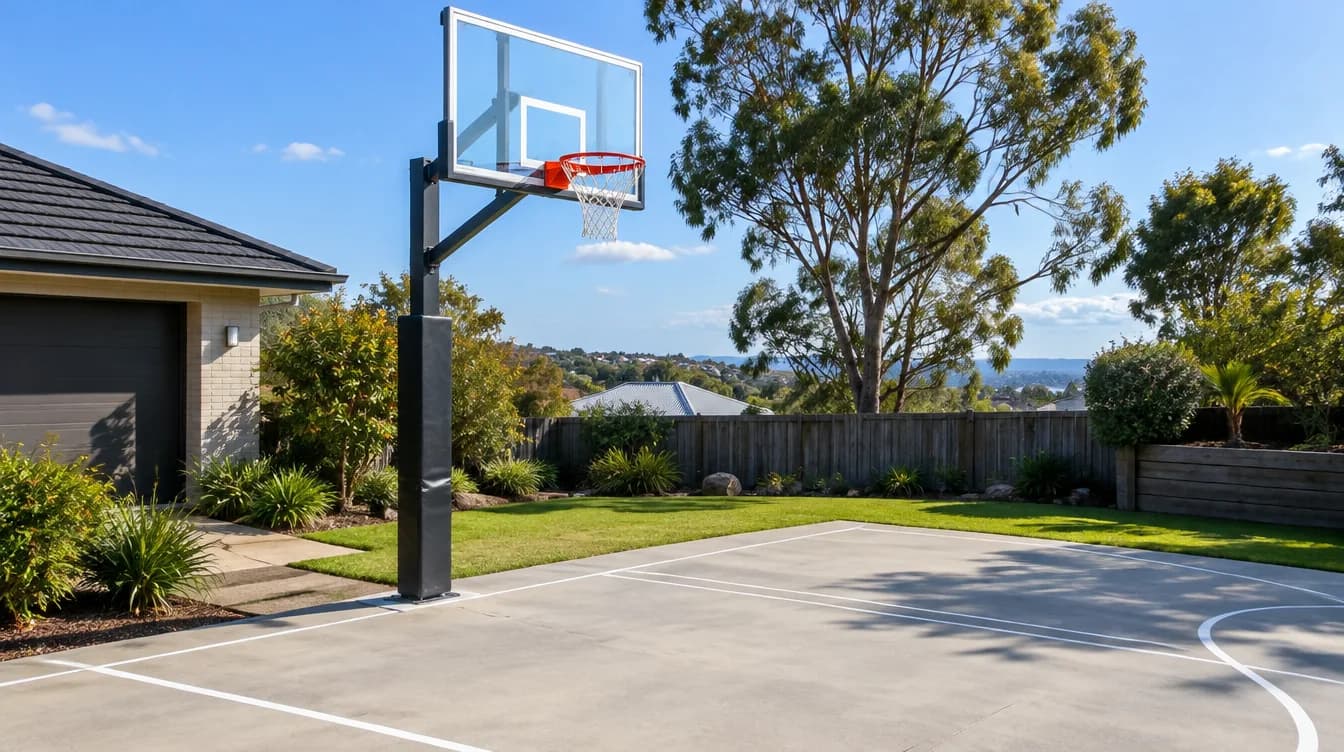
In-ground hoops set on proper concrete footings for driveways, backyard half courts, schools and parks, with court lines marked to match.
Jamie (24/7 quotes): 0468 069 002AS 1742.2 Compliant
Fully Insured
24/7 Availability

15+ Years
Get FREE Quote
Fixed-Price Quote Within 48 Hours
Trusted by 5,000+ businesses
VicRoads approved · AS/NZS compliant · $20M insured
Compliance-Ready Guarantee: every job is marked to AS/NZS 2890 & AS 1742, dimensionally verified, and delivered with full compliance documentation, backed by our 12-month workmanship guarantee.
Last updated:
What is In-Ground Basketball Hoop Installation?
Line Marking Australia installs in-ground basketball hoops across Australia for driveways, backyard half courts, schools and parks. We set the pole on a concrete footing to the manufacturer's specification, level it, fit the backboard and ring, and mark the court lines. Hoop installation is quoted per site; complete backyard half courts start from about $10,000.
An in-ground hoop is the step up from a portable stand. It doesn't wobble, it doesn't need a sandbag or water base, and it plays like a real court. But it's only as good as the footing it sits on.
We install hoops on new courts we build and on existing driveways and slabs. Here's what goes into doing it properly.
Is an in-ground basketball hoop better than a portable hoop?
An in-ground basketball hoop is more stable than a portable hoop because the pole is set in a concrete footing rather than balanced on a weighted base. The ring rebounds more like a court hoop, the backboard shakes less and it handles wind better. Portable hoops suit renters or anyone who needs to move the hoop.
| Feature | In-ground hoop | Portable hoop |
|---|---|---|
| Stability | Very stable, set in concrete | Relies on a sand or water-filled base |
| Play feel | Closer to a court hoop | More backboard shake |
| Wind | Footing designed for wind loads | Can tip over in strong wind |
| Moving it | Fixed, some use a removable anchor | Can be wheeled away |
| Installation | Footing, curing time and setup | Assembly only |
What size footing does an in-ground basketball hoop need?
An in-ground basketball hoop needs a concrete footing sized to the hoop manufacturer's specification, which depends on the pole size, backboard size and overhang. Bigger glass backboards and longer overhangs need deeper, wider footings. We follow the manufacturer's footing details and check your soil, because soft or reactive ground may need more.
How we install the footing:
- Check underground services with Before You Dig Australia
- Mark the hoop position against the court lines
- Dig the footing hole to the specified size
- Set the anchor kit or pole, level and plumb it
- Pour the concrete and let it cure for the time the manufacturer specifies
- Fit the pole, backboard, ring and net, and check the ring height
What height is a basketball hoop?
A regulation basketball ring is 3.05 m (10 feet) from the ground to the top of the rim. Many in-ground hoops for homes and schools are adjustable, so the ring can be lowered for younger children and raised to full height as they grow. We set and check the ring height when we install the hoop.
- Fixed height: simplest and toughest, good for schools and parks
- Adjustable height: a crank or lever lowers the ring for younger players
- Overhang: the distance from the pole to the backboard; more overhang keeps players away from the pole
Should a basketball hoop go on the driveway or a court?
A basketball hoop can go beside a driveway or on a dedicated court. A driveway hoop is cheaper because the slab is already there, but cars, slope and joints get in the way. A backyard half court gives a flat, safe playing area with proper lines, and backyard half courts start from about $10,000 including the slab.
Things to check for a driveway hoop:
- Slope of the driveway, which affects shooting and dribbling
- Space behind the backboard so balls don't roll onto the street
- Room to play without cars parked in the way
- Where the footing can go without cutting the driveway
If you want a proper court, see our basketball court construction page.
Do you need a permit for a basketball hoop?
A basketball hoop installed inside your own property usually doesn't need a permit in Australia, but rules vary between councils, so it's worth checking, especially in heritage or overlay areas. Hoops on the road or footpath are a different matter, and most councils don't allow them because they block traffic and pedestrians.
If the hoop is part of a bigger court project with fencing, lighting or earthworks, council approval may be needed for those parts. We check before we start.
Can you install a hoop on an existing slab?
Yes. Many in-ground hoops can be installed beside an existing slab, or the slab can be cut to place the footing exactly where the court lines need it. When cutting concrete, we use water suppression or on-tool vacuum extraction to control silica dust, then patch the slab neatly around the new pole.
Some hoops use a bolt-down anchor on a suitable footing, which lets the hoop be removed later. We'll recommend the best option for your slab and hoop.
Can you convert a portable basketball hoop to in-ground?
Some portable basketball systems can be converted to in-ground with a kit from the manufacturer, but many can't, because the pole and base aren't designed to be set in concrete. We check the make and model first. If it can't be converted safely, a purpose-built in-ground hoop is the better long-term option.
Do you install basketball hoops at schools and parks?
Yes. Line Marking Australia installs fixed and adjustable basketball hoops at schools, parks and community courts, and marks the court lines to match. One of our Victorian crews built a school multi-sport court on modular tiles with new hoops, plus basketball and netball lines. School work is scheduled for holidays where possible.
For full school projects, see sports courts for schools, and for lines on an existing court, see basketball court line marking.
How we keep every hoop installation compliant
Every basketball hoop installation we do follows the same safety and construction checks, whether it's a single driveway hoop or a set of hoops at a school. Digging footings, cutting concrete and working on school sites all carry rules, so these are the steps we apply to every hoop job.
- Before You Dig Australia check before digging the footing
- AS 3600 for concrete footings, plus the hoop manufacturer's footing specification
- Silica dust controls when cutting or grinding concrete
- Work Health and Safety laws with Safe Work Method Statements for high-risk construction work such as excavation
- Local council check where fencing, lighting or earthworks are part of the project
- Court dimensions so the hoop sits in the right place for the key and three-point line
- Licensed builders who hold the licence your state requires, with public liability insurance
- School sites: Working with Children checks for crews
What do you need from me to quote a hoop installation?
To quote a basketball hoop installation, we need to know where the hoop will go, what surface it sits on and which hoop you have or want. Photos of the spot, the driveway or slab and the area behind the backboard help us plan the footing and price accurately. Tell us:
- Hoop make and model, if you've chosen one
- Driveway, existing court, or new court build
- Indoor or outdoor, and site type: home, school, park or club
- What's on the ground now (concrete, pavers, grass)
- Slope and drainage around the hoop
- Access for a small excavator or concrete
- Whether you want court lines marked
- Fencing, rebound nets or lighting
- Photos, plans and timing
- Your budget
Key Benefits
Proper footings: built to the hoop maker's spec and your soil
Correct ring height: 3.05 m regulation height set and checked, or adjustable
Driveway or court: we advise on the best spot and the slab
Lines to match: key and three-point lines marked around the hoop
Homes and schools: fixed or adjustable hoops for every setting

Site Inspection
Free assessment and detailed quote

Professional Marking
Expert application with premium materials

Quality Assurance
Final inspection and compliance sign-off
Compliance Standards
Before You Dig Australia
Underground services located before the footing is dug.
AS 3600 & manufacturer spec
Concrete footings built to AS 3600 and the hoop maker's footing details.
Silica dust controls
Water suppression or on-tool extraction when cutting slabs.
WHS Act & SWMS
Safe Work Method Statements for excavation work.
Court dimensions
Hoops positioned to suit the key and three-point line.
Fully Compliant & Certified
All our work meets or exceeds Australian Standards and state road authority requirements
VicRoads Approved
Registered Contractor
$20M Public Liability
$10M Professional Indemnity
5,000+ Projects
Since 2009
Fixed Prices
Not Estimates
AS 1742
Traffic Control Devices
Specifies line colours, widths, arrow designs, and placement for road markings. Ensures all traffic control devices meet national safety standards.
AS/NZS 2890
Parking Facilities
Covers bay dimensions (2.4m × 5.4m standard, 2.4m × 5.4m accessible plus a 2.4m shared zone), aisle widths, and traffic flow requirements for compliant parking areas.
AS 4586
Slip Resistance
Defines slip resistance classifications (P rating) for pedestrian surfaces. Critical for wet areas, ramps, and high-traffic zones.
AS/NZS 1428
Access & Mobility
Sets requirements for accessible parking bays, tactile indicators, and mobility access. Essential for DDA compliance and accessibility audits.
What Our Clients Say
Results based on typical project outcomes. Individual results may vary.
Upload your site plans for a detailed quote within 48 hours
Get an accurate, fixed-price quote tailored to your specific project requirements
Frequently Asked Questions
Yes, for most homes and schools. An in-ground basketball hoop is set in a concrete footing, so it's more stable, shakes less, handles wind better and plays more like a court hoop. Portable hoops suit renters or anyone who needs to move the hoop.
An in-ground basketball hoop footing is sized to the manufacturer's specification, based on pole size, backboard size and overhang. Line Marking Australia follows those details and checks your soil, because soft or reactive ground may need a larger footing.
A regulation basketball ring is 3.05 m (10 feet) from the ground to the top of the rim. Adjustable in-ground hoops let the ring be lowered for younger children. Line Marking Australia sets and checks the ring height at installation.
A basketball hoop inside your own property usually doesn't need a permit in Australia, but council rules vary, so check, especially in heritage areas. Most councils don't allow hoops on roads or footpaths. Larger court projects may need approval for other works.
Yes. Line Marking Australia can install an in-ground hoop beside an existing driveway or cut the slab to place the footing where it's needed, using silica dust controls, then patch the concrete neatly around the pole.
Basketball hoop installation is quoted per site, depending on the hoop, footing size, cutting existing concrete and access. If you want a full backyard half court with a hoop, those start from about $10,000 including the slab (published Australian builder pricing, 2026).
Related Services

Backyard Sports Courts
Learn more about this service
Basketball Court Construction
Learn more about this service
Basketball Court Line Marking
Learn more about this service
Rebound Wall Installation
Learn more about this service
Sports Court Tiles
Learn more about this service
Sports Courts for Schools
Learn more about this service
More Sports & Playground Line Marking Services
Ready to Get Your Line Marking Sorted?
Upload your site plans and receive a fixed-price quote within 48 hours. No surprises, no cost blowouts, just clear pricing you can take to your committee or manager.
Or call us directly: 0417 460 236