

Sports Court Fencing
Chain-wire fencing, windscreens and gates for tennis, pickleball, basketball and multi-sport courts at homes, schools, clubs and council parks.
Jamie (24/7 quotes): 0468 069 002AS 1742.2 Compliant
Fully Insured
24/7 Availability

15+ Years
Get FREE Quote
Fixed-Price Quote Within 48 Hours
Trusted by 5,000+ businesses
VicRoads approved · AS/NZS compliant · $20M insured
Compliance-Ready Guarantee: every job is marked to AS/NZS 2890 & AS 1742, dimensionally verified, and delivered with full compliance documentation, backed by our 12-month workmanship guarantee.
Last updated:
What is Sports Court Fencing?
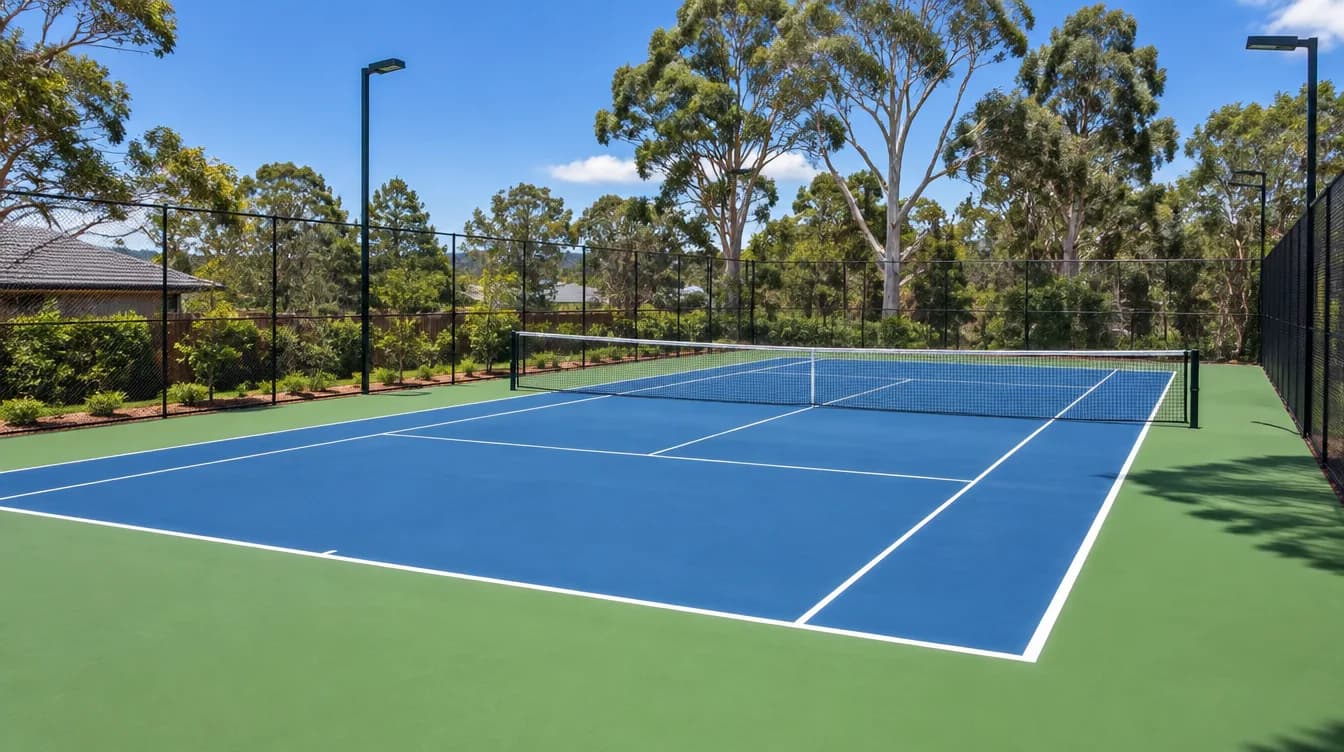
Line Marking Australia installs tennis court fencing across Australia, along with fencing for pickleball, basketball, netball and multi-sport courts. We supply chain-wire fences on galvanised or powder-coated posts, windscreens and gates, and check council rules for taller fences. Court fencing is quoted per site, based on length, height and ground conditions.
A good court fence keeps balls in, stops stray players walking across the court and protects the surface. It also has to stand up to wind, especially once windscreens are fitted, and look tidy for years.
We build and line mark courts, so we plan fencing around the court layout, the run-off and the gates you'll actually use. Here's what to think about.
What type of fence is used for tennis courts?
Tennis courts in Australia are usually fenced with chain-wire mesh, also called chain-link, on galvanised or powder-coated steel posts set in concrete footings. Chain-wire is strong, lets players and spectators see through it, handles balls hitting it all day and suits tennis, pickleball, basketball and multi-sport courts.
| Fence option | Best for | Good to know |
|---|---|---|
| Galvanised chain-wire | Club, school and council courts | Hard-wearing and the most common choice |
| Black powder-coated chain-wire | Home courts and premium club courts | Blends into gardens and looks tidy |
| Chain-wire with windscreens | Windy or exposed sites, privacy | Fence must be designed for the extra wind load |
| Weld mesh panels | Lower fences, school courts, surrounds | Rigid panels, often used for lower sections |
How high should a tennis court fence be?
Tennis court fences are usually taller than standard boundary fences so balls stay in the court, and Tennis Australia guidance sets the heights it recommends for club and community courts. Home courts often use lower sections along the sides. Because tennis fences commonly exceed about 2 m, many need council approval.
How we decide on fence height:
- Behind the baselines: the tallest sections, where most balls are hit
- Along the sides: often lower, to keep views open and save cost
- Between courts: divider fences or nets on multi-court sites
- Near neighbours: height, location and setbacks checked against council rules
Do you need council approval for a tennis court fence?
A tennis court fence may need council approval in Australia, especially if it's over about 2 m high, close to a boundary, in a heritage or flood overlay area, or combined with retaining walls or lighting. Rules differ between councils and states, so we check your local requirements before we finalise the design and price.
We can help you prepare drawings and details for the council, including fence heights, post spacing and footing details.
Do basketball courts need fencing?
Basketball courts don't always need full fencing, but many backyard, school and park courts in Australia use fences or ball-stop netting behind the hoops to stop balls rolling into gardens, roads or neighbouring yards. Fencing also keeps a school court separate from walkways and gives a park court a defined, safer edge.
For backyard half courts, a section of fence or netting behind the ring often does the job. Our basketball hoop installation and rebound wall pages cover rebound nets and walls that work alongside fencing.
What are tennis court windscreens?
Tennis court windscreens are fabric screens, usually made of shade-cloth style mesh, fixed to the chain-wire fence. They cut wind across the court, give players a cleaner background to see the ball and add privacy from neighbours or the street. Club logos and sponsor names can be printed on them.
Windscreens catch a lot of wind, so the fence posts, footings and bracing must be designed for that extra load. We plan this from the start rather than adding screens to a fence that wasn't built for them.
What gates does a court fence need?
A court fence usually needs at least one pedestrian gate for players and a wider double gate for maintenance machinery, such as a sweeper or resurfacing equipment. Gates should sit where people naturally walk to the court, with a level, accessible path leading to them. Self-closing hardware helps keep balls in.
- Pedestrian gate: for players, near seating or the clubhouse
- Double maintenance gate: wide enough for machinery access
- Accessible paths: designed with AS 1428.1 in mind for paths to the court
- Locks: keyed or coded locks for clubs and schools
Can you fence a pickleball court?
Yes. Pickleball courts are often fenced with chain-wire, sometimes lower than tennis fencing because pickleball balls don't travel as far. On converted tennis courts with several pickleball courts, divider fences or netting between courts stop balls rolling into the next game. Fencing can also help with screening near homes.
If you're converting a tennis court, see our tennis court to pickleball conversion page for layouts and fencing options.
Can you replace or repair an old court fence?
Yes. Line Marking Australia can repair sagging or torn chain-wire, replace rusted posts and rails, re-tension the mesh or replace the whole fence. Replacing a fence at the same time as a resurface or new lighting saves money, because access and site set-up are already planned and the work can be staged together.
If your court also needs a new surface, see court resurfacing.
How much does tennis court fencing cost in Australia?
Tennis court fencing in Australia is quoted per site, because the cost depends on the total length, fence height, mesh and post finish, windscreens, gates, footings and ground conditions such as rock or slope. We itemise each part so you can compare options, such as lower side fences or adding windscreens later.
Clubs may be eligible for grants. The Queensland Gambling Community Benefit Fund, for example, offers up to $35,000 for club projects including fencing, lighting and resurfacing.
How we keep every court fencing job compliant
Every court fencing job follows the same approval, safety and construction checks, whether it's a backyard tennis court or a school multi-sport court. Fences involve digging, concrete footings and sometimes council approval, so these are the steps that apply to every fence we build, before the first post goes in.
- Local council check for fences over about 2 m, setbacks, retaining walls and heritage or flood overlays
- Before You Dig Australia check before digging post holes
- AS 3600 for concrete post footings
- AS 1428.1 considered for accessible paths and gates to the court
- Work Health and Safety laws with Safe Work Method Statements for high-risk construction work, such as excavation and mobile plant
- Silica dust controls when cutting concrete for posts
- Licensed builders who hold the licence your state requires, with public liability insurance
- Tennis Australia guidance for club and community tennis courts
- School sites: work scheduled for school holidays where possible, and Working with Children checks for crews
What do you need from me to quote court fencing?
To quote court fencing, we need the court type and size, the fence length and heights you want, and photos of the site and any existing fence. A rough sketch showing where the gates should go, the boundaries and nearby neighbours helps us price accurately. Tell us:
- Court type and sports played
- New court, existing court or fence replacement
- Court size, number of courts, indoor or outdoor
- Site type: home, school, club, council or strata
- What's on the ground now, slope and any rock
- Machinery access
- Preferred fence finish and heights
- Windscreens, gates and locks
- Lighting or power planned at the same time
- Approvals, plans and photos
- Timing and budget
Key Benefits
Built for the court: fence heights, gates and dividers planned around the layout
Windscreen-ready: posts and footings designed for the extra wind load
Council checked: tall fence approvals sorted before you commit
Any court: tennis, pickleball, basketball, netball and multi-sport
Repairs or replacement: re-tensioning, new posts or a whole new fence

Site Inspection
Free assessment and detailed quote

Professional Marking
Expert application with premium materials

Quality Assurance
Final inspection and compliance sign-off
Compliance Standards
Local council approval
Checked for fences over about 2 m, setbacks, retaining walls and overlays.
Before You Dig Australia
Underground services located before post holes are dug.
AS 3600
Concrete post footings, including for windscreen wind loads.
AS 1428.1
Accessible paths and gates to the court considered.
WHS Act & SWMS
Safe Work Method Statements for excavation and mobile plant.
Fully Compliant & Certified
All our work meets or exceeds Australian Standards and state road authority requirements
VicRoads Approved
Registered Contractor
$20M Public Liability
$10M Professional Indemnity
5,000+ Projects
Since 2009
Fixed Prices
Not Estimates
AS 1742
Traffic Control Devices
Specifies line colours, widths, arrow designs, and placement for road markings. Ensures all traffic control devices meet national safety standards.
AS/NZS 2890
Parking Facilities
Covers bay dimensions (2.4m × 5.4m standard, 2.4m × 5.4m accessible plus a 2.4m shared zone), aisle widths, and traffic flow requirements for compliant parking areas.
AS 4586
Slip Resistance
Defines slip resistance classifications (P rating) for pedestrian surfaces. Critical for wet areas, ramps, and high-traffic zones.
AS/NZS 1428
Access & Mobility
Sets requirements for accessible parking bays, tactile indicators, and mobility access. Essential for DDA compliance and accessibility audits.
What Our Clients Say
Results based on typical project outcomes. Individual results may vary.
Upload your site plans for a detailed quote within 48 hours
Get an accurate, fixed-price quote tailored to your specific project requirements
Frequently Asked Questions
Tennis courts are usually fenced with chain-wire mesh on galvanised or powder-coated steel posts set in concrete footings. Line Marking Australia installs chain-wire court fencing with windscreens and gates for tennis, pickleball, basketball and multi-sport courts.
Tennis court fences are usually taller than boundary fences, especially behind the baselines, and Tennis Australia guidance sets recommended heights for club courts. Many tennis fences exceed about 2 m, so Line Marking Australia checks council approval early.
A court fence may need council approval if it's over about 2 m high, near a boundary, in a heritage or flood overlay, or built with retaining walls or lighting. Line Marking Australia checks your council's rules before finalising the design.
Not always. Many backyard, school and park basketball courts use fencing or ball-stop netting behind the hoops to keep balls out of gardens, roads and neighbouring yards. Line Marking Australia plans fencing around how the basketball court is used.
Tennis court windscreens are mesh screens fixed to the fence. They reduce wind, give players a clearer background to see the ball and add privacy. Because they add wind load, Line Marking Australia designs posts and footings for windscreens from the start.
Tennis court fencing in Australia is quoted per site. Cost depends on fence length and height, mesh and post finish, windscreens, gates, footings and ground conditions. Line Marking Australia itemises each part so you can compare options.
Yes. Pickleball courts are often fenced with chain-wire, sometimes lower than tennis fencing. On converted tennis courts, Line Marking Australia can add divider fences or netting between pickleball courts so balls don't roll into the next game.
Related Services

Court Resurfacing
Learn more about this service
Sports Court Construction
Learn more about this service
Sports Court Lighting
Learn more about this service
Sports Courts for Schools
Learn more about this service
Tennis Court Construction
Learn more about this service
Tennis Court to Pickleball Conversion
Learn more about this service
More Sports & Playground Line Marking Services
Ready to Get Your Line Marking Sorted?
Upload your site plans and receive a fixed-price quote within 48 hours. No surprises, no cost blowouts, just clear pricing you can take to your committee or manager.
Or call us directly: 0417 460 236