

Bocce Court Construction
Flat, well-drained bocce courts for retirement villages, clubs, venues and backyards, with boards, shade, seating and accessible paths.
Jamie (24/7 quotes): 0468 069 002AS 1742.2 Compliant
Fully Insured
24/7 Availability

15+ Years
Get FREE Quote
Fixed-Price Quote Within 48 Hours
Trusted by 5,000+ businesses
VicRoads approved · AS/NZS compliant · $20M insured
Compliance-Ready Guarantee: every job is marked to AS/NZS 2890 & AS 1742, dimensionally verified, and delivered with full compliance documentation, backed by our 12-month workmanship guarantee.
Last updated:
What is Bocce Court Construction?
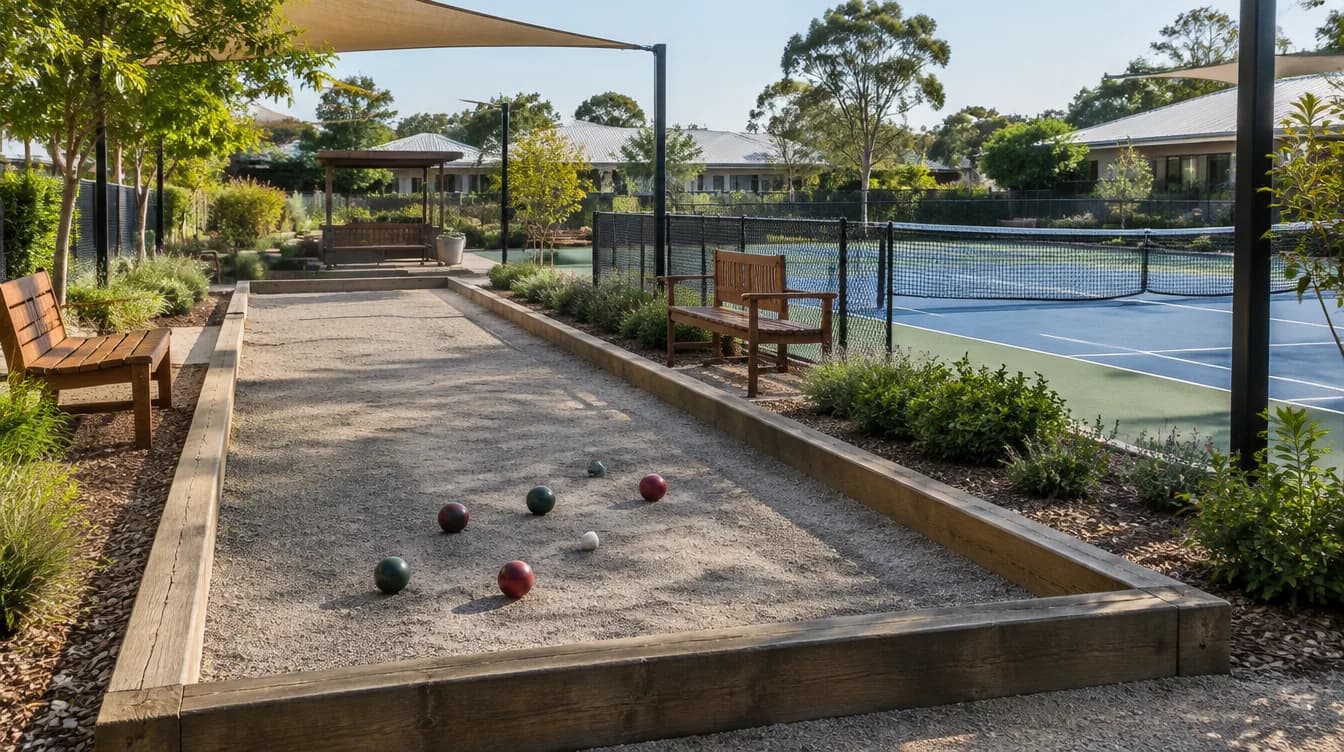
Line Marking Australia builds bocce courts across Australia for retirement villages, clubs, councils, hospitality venues and backyards. We handle excavation, drainage, a compacted base, timber or composite side and end boards, and a fine crushed rock or synthetic turf playing surface, plus shade, seating and accessible paths. Every bocce court is quoted per site.
Bocce is gentle, social and easy to pick up, which is why it's popular in retirement villages, Italian and community clubs, and backyards where families want something everyone can play.
A good bocce court looks simple, but it has to be flat and true, drain quickly after rain and hold its surface under rolling balls for years. That comes down to the layers under the surface and well-built boards.
How much does it cost to build a bocce court?
The cost of a bocce court in Australia depends on its length, the ground, the surface you choose, the boards and extras like shade, seating and lighting. A backyard court on flat, firm ground costs much less than a long club court on a slope. Line Marking Australia quotes each bocce court per site and itemises every part.
| Cost item | What affects it |
|---|---|
| Excavation and base | Court length, slope, soil and access |
| Drainage | Soil type and rainfall; ag pipe and gravel where needed |
| Side and end boards | Treated timber, hardwood or composite |
| Playing surface | Fine crushed rock or synthetic turf made for bocce |
| Extras | Shade, seating, paths, lighting and scoreboards |
What size is a bocce court?
Bocce courts in Australia range from short backyard courts to long club courts built to the rules of the competition being played. There's no single size you must use for social bocce, so we size the court to your space, keeping it long and narrow, with room at each end for players to stand and throw.
| Court type | Common sizes we build | Who it suits |
|---|---|---|
| Backyard court | Shorter and narrower, sized to the garden | Families, casual games |
| Village or social court | A longer court with seating along one side | Retirement villages, community centres |
| Club court | Full length to the competition's rules | Bocce clubs, community and cultural clubs |
What is the best surface for a bocce court?
The best bocce court surface in Australia is usually fine crushed rock compacted over a firm base, because it plays true, drains well and is the traditional choice. Synthetic turf made for bocce is lower maintenance and plays consistently in all weather. Both need a flat, well-drained base underneath to perform.
| Surface | Strengths | Upkeep |
|---|---|---|
| Fine crushed rock (compacted) | Traditional, true roll, good drainage | Rake, roll and top up occasionally |
| Synthetic turf for bocce | Consistent, low maintenance, clean | Brush and clear leaves |
Lawn can be used for casual games, but it rarely stays flat enough for a proper roll.
How do you build a bocce court?
Building a bocce court in Australia starts with setting out a long, level rectangle, excavating, adding drainage, then building up compacted base layers. Side and end boards are fixed in place, and the playing surface is spread, levelled and compacted or the synthetic turf is laid. Levels are checked along the whole length.
- Site visit, set-out and council check
- Before You Dig Australia search
- Excavation and drainage
- Compacted base layers, laser-levelled
- Side boards and end boards fixed
- Playing surface laid and compacted, or synthetic turf installed
- Paths, seating, shade and lighting
Why do retirement villages add bocce courts?
Retirement villages in Australia add bocce courts because the game is low impact, social and easy for residents of most abilities to enjoy. A bocce court suits residents who don't want a fast racquet sport. Shade, seating, handrails nearby and accessible paths make it a meeting place as much as a game.
- Accessible paths to the court considered against AS 1428.1
- Shade and seating along the court for players and spectators
- Raised or wide boards that are easy to see and safe to step past
- Resident consultation: state retirement villages legislation may require it for capital works
Many villages pair bocce with pickleball or a putting green. See sports courts for retirement villages and synthetic putting greens.
Can you build a bocce court in your backyard?
Yes, a bocce court suits many Australian backyards because it is long and narrow and can run along a fence line or beside a pool or lawn. A backyard court is usually shorter than a club court. We check drainage, levels, access and any council triggers before we start.
- Placement: a level strip with shade for afternoon games
- Edges: boards that double as a seat or garden edge
- Surface: synthetic turf if you want it to stay neat with little care
- Lighting: low garden lighting so games can run into the evening
Do you build bocce courts for clubs, venues and councils?
Yes. Line Marking Australia builds bocce courts for bocce and community clubs, golf clubs, hotels, wineries, cafes, councils and community centres across Australia. Venues like bocce because it keeps guests outside longer, and councils add courts to parks to give older residents a social space close to home.
Golf clubs can also see sports courts for golf clubs.
How do you maintain a bocce court?
A fine crushed rock bocce court in Australia needs regular raking and rolling to keep it flat, clearing leaves and debris, and occasional top-ups of surface material. A synthetic turf bocce court needs brushing and leaf clearing. Both last longer when boards are checked and drains are kept clear.
At handover we talk you through what to do after storms, how often to rake or brush, and how to tell when a top-up is due.
How we keep every bocce court build compliant
Every bocce court we build follows the same compliance steps. We check council requirements, locate underground services before digging, manage safety and sediment on site, and build accessible paths and any concrete or lighting to the Australian Standards that apply, with extra steps at retirement villages.
- Council requirements checked for earthworks, retaining walls, drainage, shade structures and lighting
- Before You Dig Australia (BYDA) check before excavation
- Work Health and Safety laws, with Safe Work Method Statements for excavation and mobile plant
- Sediment and stormwater controls during earthworks
- Accessible paths to the court considered against AS 1428.1; any concrete to AS 3600
- Lighting spill controlled under AS/NZS 4282
- Retirement villages: state legislation may require resident consultation on capital works
What do you need from me to quote a bocce court?
To quote a bocce court in Australia we need to know where it will go, how long you'd like it and who will play. Photos of the area, rough measurements and a note on slope and drainage let us suggest a size and surface and give you a realistic starting figure.
- Number of courts and preferred length
- Backyard, retirement village, club, venue or council site
- What's on the ground now, slope and drainage
- Access for machinery and materials
- Preferred surface: fine crushed rock or synthetic turf
- Boards, shade, seating, paths and lighting
- Approvals or resident consultation in progress
- Plans or photos, timing and budget
Key Benefits
Flat and true: laser-levelled bases for a consistent roll
Drains after rain: drainage built in under the surface
Village-ready: shade, seating and accessible paths
Surface choice: fine crushed rock or synthetic turf
Compliance built in: council checks, BYDA, SWMS and sediment controls

Site Inspection
Free assessment and detailed quote

Professional Marking
Expert application with premium materials

Quality Assurance
Final inspection and compliance sign-off
Compliance Standards
Local council approval
Earthworks, drainage, shade structures and lighting checked before the final quote.
Before You Dig Australia
Underground services located before excavation.
WHS Act & SWMS
Safe Work Method Statements for excavation and mobile plant.
AS 1428.1
Accessible paths to the court considered against AS 1428.1.
Retirement villages legislation
State legislation may require resident consultation on capital works.
Fully Compliant & Certified
All our work meets or exceeds Australian Standards and state road authority requirements
VicRoads Approved
Registered Contractor
$20M Public Liability
$10M Professional Indemnity
5,000+ Projects
Since 2009
Fixed Prices
Not Estimates
AS 1742
Traffic Control Devices
Specifies line colours, widths, arrow designs, and placement for road markings. Ensures all traffic control devices meet national safety standards.
AS/NZS 2890
Parking Facilities
Covers bay dimensions (2.4m × 5.4m standard, 2.4m × 5.4m accessible plus a 2.4m shared zone), aisle widths, and traffic flow requirements for compliant parking areas.
AS 4586
Slip Resistance
Defines slip resistance classifications (P rating) for pedestrian surfaces. Critical for wet areas, ramps, and high-traffic zones.
AS/NZS 1428
Access & Mobility
Sets requirements for accessible parking bays, tactile indicators, and mobility access. Essential for DDA compliance and accessibility audits.
What Our Clients Say
Results based on typical project outcomes. Individual results may vary.
Upload your site plans for a detailed quote within 48 hours
Get an accurate, fixed-price quote tailored to your specific project requirements
Frequently Asked Questions
Bocce court costs depend on length, ground conditions, surface, boards and extras such as shade and seating, so Line Marking Australia quotes each court per site. A backyard court on flat, firm ground costs much less than a long club court on a slope.
Bocce courts range from short backyard courts to full-length club courts built to the rules of the competition being played. Line Marking Australia sizes each court to the space available, keeping it long and narrow with room to throw at each end.
Fine crushed rock compacted over a firm base is the traditional bocce surface because it rolls true and drains well. Synthetic turf made for bocce is lower maintenance. Line Marking Australia builds both on a level, well-drained base.
Yes. Bocce is low impact, social and suits residents of most abilities. Line Marking Australia adds shade, seating and accessible paths, and notes that state retirement villages legislation may require resident consultation on capital works.
Yes. A bocce court is long and narrow, so it often fits along a fence line or beside a lawn or pool. Line Marking Australia checks levels, drainage, access and council triggers before building a backyard court.
A crushed rock bocce court needs raking, rolling, leaf clearing and occasional top-ups, while synthetic turf needs brushing. Line Marking Australia recommends checking the boards and keeping drains clear so the court stays flat and true.
Related Services

Backyard Sports Courts
Learn more about this service
Sports Court Construction
Learn more about this service
Sports Courts for Golf Clubs
Learn more about this service
Sports Courts for Retirement Villages
Learn more about this service
Synthetic Putting Greens
Learn more about this service
Ready to Get Your Line Marking Sorted?
Upload your site plans and receive a fixed-price quote within 48 hours. No surprises, no cost blowouts, just clear pricing you can take to your committee or manager.
Or call us directly: 0417 460 236