

Court Resurfacing
Acrylic recoats, crack repairs, synthetic grass replacement and fresh lines for tennis, basketball, netball and pickleball courts. Tennis recoats from about $8,000.
Jamie (24/7 quotes): 0468 069 002AS 1742.2 Compliant
Fully Insured
24/7 Availability

15+ Years
Get FREE Quote
Fixed-Price Quote Within 48 Hours
Trusted by 5,000+ businesses
VicRoads approved · AS/NZS compliant · $20M insured
Compliance-Ready Guarantee: every job is marked to AS/NZS 2890 & AS 1742, dimensionally verified, and delivered with full compliance documentation, backed by our 12-month workmanship guarantee.
Last updated:
What is Court Resurfacing?
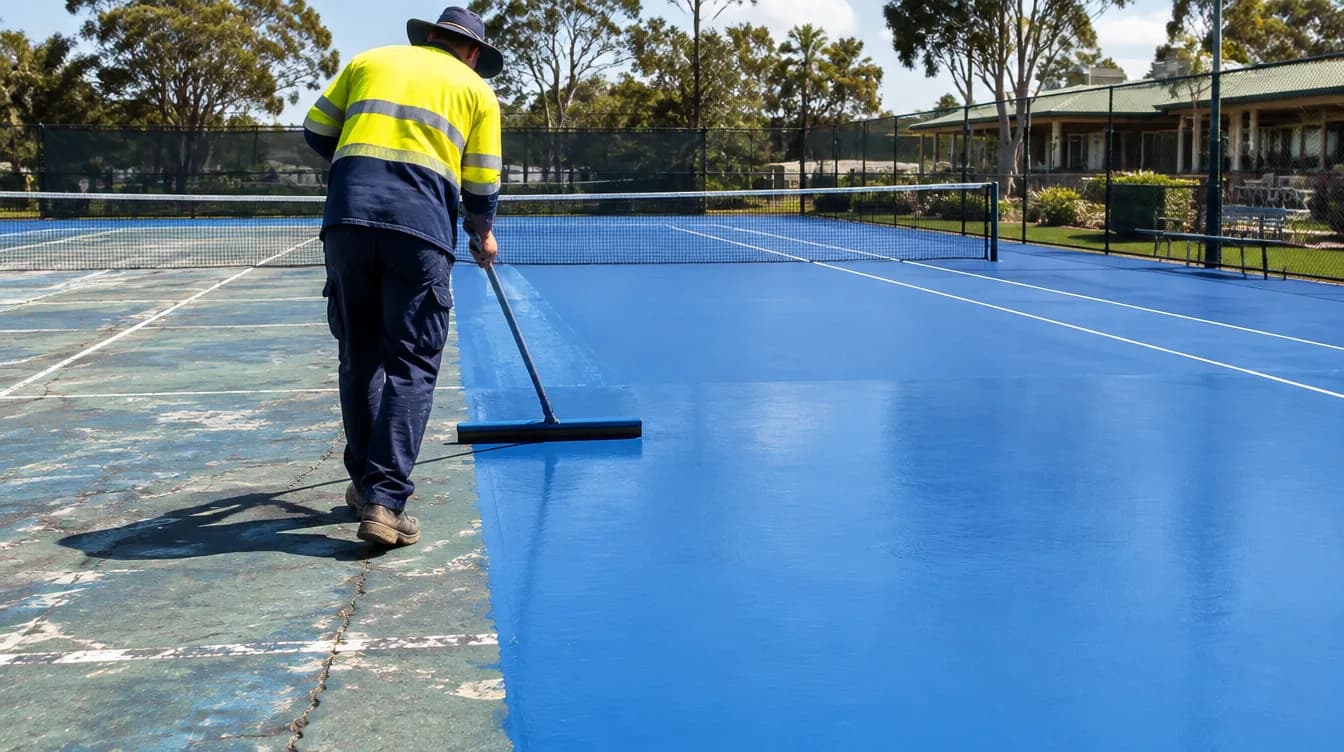
Line Marking Australia resurfaces tennis, basketball, netball and pickleball courts across Australia. We repair cracks, recoat acrylic, replace worn synthetic grass and re-mark every line. A tennis court acrylic resurfacing starts from about $8,000 (Airtasker cost guide, 2026), and we tell you honestly when a court needs a rebuild instead.
Most courts don't fail all at once. The colour fades, the surface gets slippery, a few cracks open up, and the lines go grey. By the time players complain, the court is usually overdue for a recoat.
The good news is that a sound slab can be brought back for a fraction of the cost of a new court. Here's how we work out what your court needs, what it costs and how long it takes.
How much does tennis court resurfacing cost in Australia?
Tennis court resurfacing in Australia starts from about $8,000 for an acrylic recoat on a sound court (Airtasker cost guide, 2026). The final price depends on the court size, how many cracks need repair, whether the base has moved, how many colours and sports you want lined, and access for equipment.
| Work | When it fits | Cost guide |
|---|---|---|
| Acrylic recoat and new lines | Faded or worn surface on a sound slab | From about $8,000 for a tennis court (Airtasker cost guide, 2026) |
| Crack repair plus recoat | Hairline to moderate cracks, no major movement | Quoted per site; we itemise the repairs |
| Synthetic grass replacement | Worn, flattened or torn synthetic grass | Quoted per site |
| Full rebuild | Failed base, heavy cracking, poor drainage | Quoted per site; new tennis courts start from about $40,000 (Oneflare cost guide, 2026) |
Basketball, netball and pickleball courts follow the same logic. The surface area, the condition of the base and the number of line colours drive the price, so we quote each court after we've seen it.
How often should a tennis court be resurfaced?
A tennis court should be resurfaced about every 7 to 10 years if it's acrylic and about every 10 to 15 years if it's synthetic grass, according to Tennis Australia's Victorian maintenance guides. Heavy use, full sun, tree debris and poor drainage can shorten that, while regular cleaning helps a surface last longer.
Signs your court is due:
- The colour has faded and the surface looks chalky or patchy
- The texture has worn smooth and the court feels slippery
- Cracks are opening or water sits in puddles after rain
- Synthetic grass is flat, bald or lifting at the joins
- The lines are faint or there are old lines you no longer use
Acrylic recoat or full rebuild: which does my court need?
An acrylic recoat suits a court whose concrete or asphalt base is still sound, with only surface wear and minor cracks. A full rebuild is needed when the base has moved, cracks keep coming back, water ponds badly or the court sits on failed ground. We check the base before recommending either.
What we look at on site:
- Cracks: how wide they are, whether they're moving and whether they go right through the slab
- Levels and ponding: where water sits after rain and whether the falls still work
- Edges and surrounds: tree roots, soft edges and drainage around the court
- Existing coatings: how many layers are on the court and whether they're bonding
If a recoat will only last a season or two, we'll tell you. A rebuild is a bigger job, and our tennis court construction team handles the base, slab and new surface in one project.
How do you repair cracks in a tennis court?
Cracks in a tennis court are repaired by cleaning them out, filling them with a flexible crack filler or acrylic patch, levelling the repair and then recoating so the repair blends in. Fine cracks usually disappear under the new coating. Large or moving cracks may need a crack membrane, and some return over time.
Our usual repair steps:
- Pressure clean the court and remove moss, dirt and loose coating
- Rout out and clean each crack
- Fill and level with a suitable filler, in several passes if needed
- Patch low spots where water ponds
- Apply the acrylic resurfacer and colour coats
- Re-mark the lines
We're upfront that structural cracks can come back, especially on reactive clay soils. We'll explain the options and expected results before you commit.
Can you replace worn synthetic grass on a tennis court?
Yes. Worn synthetic grass on a tennis court can be lifted and replaced with new sand-filled synthetic grass, usually on the existing base if it's still level and draining. We remove the old turf and sand, check and repair the base, lay and join the new grass, add the lines and top-dress with sand.
Some clubs use replacement time to switch surfaces, for example from synthetic grass to acrylic hard court, or to add pickleball lines. Tennis Australia classifies surfaces in its National Court Surface Policy, and we follow its guidance for club and community courts.
How long does it take to resurface a tennis court?
Resurfacing a tennis court usually takes a few days to about two weeks on site, depending on the crack repairs, the number of coats, synthetic grass removal and the weather. Acrylic coatings need dry, mild conditions to cure properly, so rain or extreme heat can push the schedule out.
We give you a timeline before we start and keep you posted if weather changes it. For clubs and schools, we plan around fixtures and school holidays where possible.
Can you resurface basketball, netball and pickleball courts too?
Yes. Line Marking Australia resurfaces basketball, netball, pickleball and multi-sport courts using the same steps as tennis: clean, repair, recoat and re-line. Resurfacing is also a good time to change the court layout, add a second sport or switch to colours that make each set of lines easier to read.
Once the surface is done, we mark each sport to its court dimensions. See our multi-sport court line marking page if you want to combine several sports on one court, or our court painting page for colour choices.
Is resurfacing a court worth it?
Resurfacing a court is worth it when the base is sound, because a recoat costs far less than a rebuild and restores grip, colour and clean lines. A tennis court recoat starts from about $8,000, compared with about $40,000 for a new tennis court (Oneflare cost guide, 2026). It isn't worth it on a failed base.
Delaying a recoat often costs more in the end. Water gets into open cracks, the base softens and a cheap repair turns into a rebuild.
Are there grants for club and school court resurfacing?
Yes. Clubs and community groups in Australia often fund court resurfacing through state and council grants. For example, the Queensland Gambling Community Benefit Fund offers up to $35,000 for club projects such as resurfacing, lighting and fencing. We can provide a detailed scope and itemised quote to support your application.
How we keep every resurfacing job compliant
Every court resurfacing job we do follows the same safety and compliance steps, whether it's a backyard tennis court or a bank of club courts. These are the checks that apply to resurfacing work, so you know the court is safe to play on and the job was done properly.
- Council check: we confirm whether your council needs to approve the work, especially if fencing, lighting, drainage or levels are changing
- Work Health and Safety: Safe Work Method Statements for high-risk construction work, such as excavation and mobile plant on rebuilds
- Silica dust controls: water suppression or on-tool vacuum extraction when cutting or grinding concrete
- Sediment and stormwater controls so cleaning water and debris don't leave the site
- Before You Dig Australia check before any excavation on a rebuild
- Slip-resistant textured finishes on every acrylic coat
- Licensed builders who hold the licence your state requires, with public liability insurance
- Tennis Australia guidance for club and community tennis, and each sport's court dimensions for the lines
- School sites: work scheduled for school holidays where possible, with Working with Children checks for crews
What do you need from me to quote a court resurface?
To quote a court resurface, we need to know the court type, its current surface, its size and condition, and what you'd like it to become. Photos of the whole court and close-ups of any cracks or puddles help us give you an accurate quote faster. Tell us:
- Court type and sports to mark (tennis, basketball, netball, pickleball, multi-sport)
- Resurface, conversion to another sport or a full rebuild
- Court size and number of courts, indoor or outdoor
- Site type: home, school, club, council, strata or other
- Current surface (acrylic, asphalt, concrete, synthetic grass) and its age
- Cracks, ponding, slope or drainage problems
- Access for vehicles and equipment
- Preferred surface and colours
- Equipment, fencing, lighting or power changes
- Any approvals, plans or photos you already have
- Timing and budget
Key Benefits
Honest assessment: we check the base and tell you if a recoat will last or a rebuild is needed
From about $8,000: tennis court acrylic recoats, with repairs itemised
Every court type: tennis, basketball, netball, pickleball and multi-sport
Fresh lines included: each sport re-marked to its court dimensions
Grant-ready quotes: detailed scopes for club and school funding applications

Site Inspection
Free assessment and detailed quote

Professional Marking
Expert application with premium materials

Quality Assurance
Final inspection and compliance sign-off
Compliance Standards
Local council check
Approval requirements checked when fencing, lighting, drainage or levels change.
WHS Act & SWMS
Safe Work Method Statements for high-risk construction work on rebuilds.
Silica dust controls
Water suppression or on-tool vacuum extraction when cutting or grinding concrete.
Sediment & stormwater
Cleaning water and debris kept on site.
Slip-resistant finish
Textured acrylic coats for grip underfoot.
Tennis Australia guidance
Club and community tennis courts resurfaced and lined to Tennis Australia guidance and court dimensions.
Fully Compliant & Certified
All our work meets or exceeds Australian Standards and state road authority requirements
VicRoads Approved
Registered Contractor
$20M Public Liability
$10M Professional Indemnity
5,000+ Projects
Since 2009
Fixed Prices
Not Estimates
AS 1742
Traffic Control Devices
Specifies line colours, widths, arrow designs, and placement for road markings. Ensures all traffic control devices meet national safety standards.
AS/NZS 2890
Parking Facilities
Covers bay dimensions (2.4m × 5.4m standard, 2.4m × 5.4m accessible plus a 2.4m shared zone), aisle widths, and traffic flow requirements for compliant parking areas.
AS 4586
Slip Resistance
Defines slip resistance classifications (P rating) for pedestrian surfaces. Critical for wet areas, ramps, and high-traffic zones.
AS/NZS 1428
Access & Mobility
Sets requirements for accessible parking bays, tactile indicators, and mobility access. Essential for DDA compliance and accessibility audits.
What Our Clients Say
Results based on typical project outcomes. Individual results may vary.
Upload your site plans for a detailed quote within 48 hours
Get an accurate, fixed-price quote tailored to your specific project requirements
Frequently Asked Questions
Tennis court resurfacing in Australia starts from about $8,000 for an acrylic recoat on a sound court (Airtasker cost guide, 2026). Crack repairs, synthetic grass replacement and rebuilds are quoted per site. Line Marking Australia itemises every part of the work in your quote.
Tennis Australia's Victorian maintenance guides suggest resurfacing acrylic tennis courts about every 7 to 10 years and synthetic grass courts about every 10 to 15 years. Heavy use, full sun, debris and poor drainage can shorten that time.
Recoat a court when the concrete or asphalt base is sound and the problem is surface wear or minor cracks. Rebuild when the base has moved, cracks keep returning or water ponds badly. Line Marking Australia checks the base on site before recommending either option.
Yes. Cracks in a tennis court are cleaned out, filled with a flexible filler, levelled and covered by the new acrylic coats. Fine cracks usually disappear, but large or moving structural cracks can return over time, especially on reactive clay soils.
Resurfacing a tennis court usually takes a few days to about two weeks on site, depending on crack repairs, the number of coats, any synthetic grass removal and the weather. Acrylic coatings need dry, mild weather to cure properly.
Yes. Line Marking Australia resurfaces basketball, netball, pickleball and multi-sport courts as well as tennis courts. We clean, repair, recoat and re-mark each sport to its court dimensions, and can change the layout or colours at the same time.
Often, yes. Clubs use state and council grants for court resurfacing. The Queensland Gambling Community Benefit Fund, for example, offers up to $35,000 for club resurfacing, lighting and fencing. Line Marking Australia can supply scopes and itemised quotes for applications.
Related Services

Court Painting
Learn more about this service
Sports Court Construction
Learn more about this service
Sports Courts for Sports Clubs
Learn more about this service
Tennis Court Construction
Learn more about this service
Tennis Court Line Marking?
Learn more about this service
Tennis Court to Pickleball Conversion
Learn more about this service
Ready to Get Your Line Marking Sorted?
Upload your site plans and receive a fixed-price quote within 48 hours. No surprises, no cost blowouts, just clear pricing you can take to your committee or manager.
Or call us directly: 0417 460 236