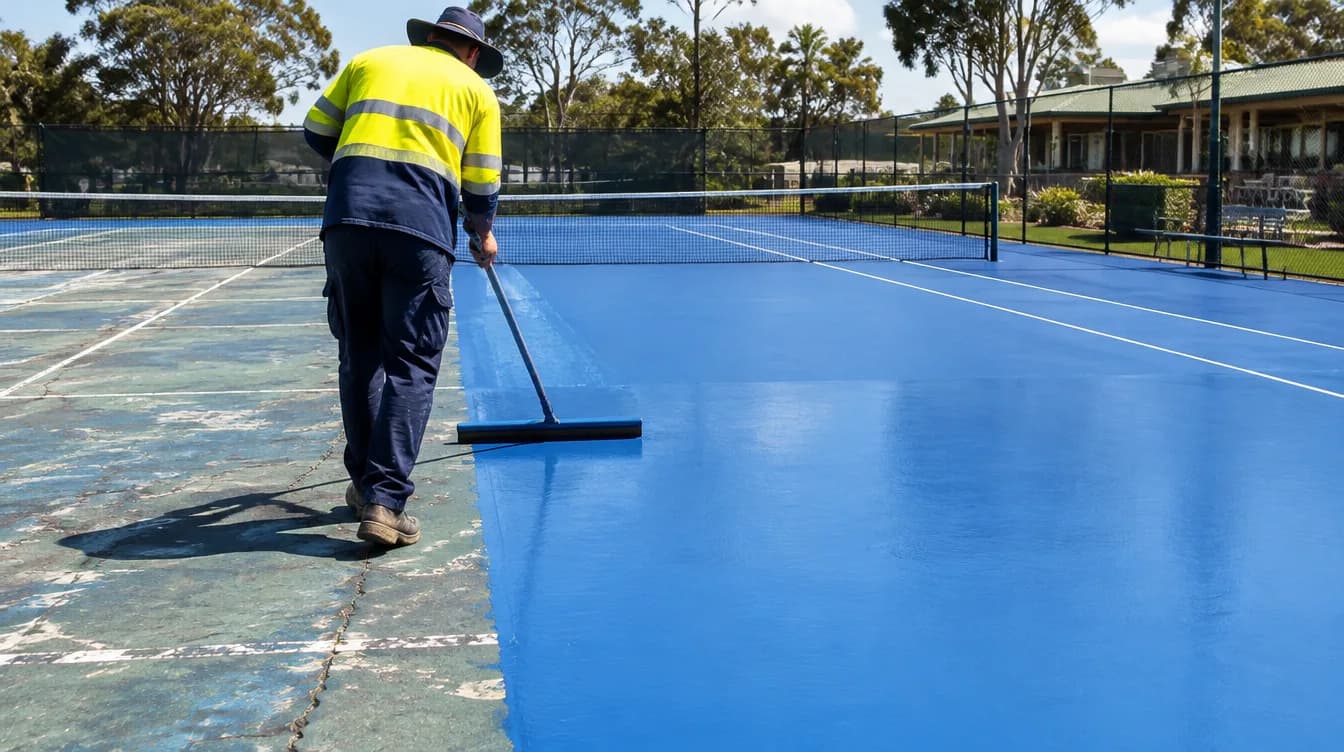
Strata Tennis Court Resurfacing
Crack repairs, acrylic recoats and fresh lines for body corporate tennis courts, with itemised quotes for the committee and low disruption for residents.
Jamie (24/7 quotes): 0468 069 002AS 1742.2 Compliant
Fully Insured
24/7 Availability

15+ Years
Get FREE Quote
Fixed-Price Quote Within 48 Hours
Trusted by 5,000+ businesses
VicRoads approved · AS/NZS compliant · $20M insured
Compliance-Ready Guarantee: every job is set out to the sport's official court dimensions, built by licensed local builders and handed over with full documentation.
Last updated:
Strata Tennis Court Resurfacing
Line Marking Australia resurfaces tennis courts for strata schemes and body corporate complexes across Australia, from crack repairs to full acrylic recoats and new lines. Tennis court acrylic resurfacing starts from about $8,000 (Airtasker cost guide, 2026), and every quote is itemised so the committee and owners can see where the money goes.
The tennis court is often the most visible shared facility in a complex. When it's faded and cracked, it drags down how the whole site looks, and residents stop using it.
Strata committees have a few extra hurdles: approvals, budgets spread across owners and residents living metres from the work. Here's how we handle them.
When does a strata tennis court need resurfacing?
A strata tennis court with an acrylic surface usually needs resurfacing about every 7 to 10 years, and a synthetic grass court about every 10 to 15 years, according to Tennis Australia's Victorian maintenance guides. Full sun, poor drainage, tree roots and leaf litter can shorten that, so condition matters more than age.
Signs your complex's court is due:
- Faded colour and grey, worn lines
- Cracks wider than a hairline, or cracks that keep reopening
- Puddles that sit after rain (birdbaths)
- Smooth, slippery patches or moss in shaded corners
- Flattened or bare synthetic grass, or lifting joins
How much does it cost to resurface a strata tennis court?
Resurfacing a strata tennis court starts from about $8,000 for an acrylic recoat (Airtasker cost guide, 2026). The final price depends on crack and patch repairs, drainage fixes, the number of coats, cushioned layers, synthetic grass replacement and line marking. We quote each strata court for its own condition and list every item separately.
| Scope | What it covers | Price guide |
|---|---|---|
| Clean and re-line | Pressure clean, minor repairs, new lines | Quoted per site |
| Acrylic recoat | Crack repairs, filler and colour coats, new lines | From about $8,000 (Airtasker, 2026) |
| Recoat with base repairs | Cut-out patches, levelling, drainage fixes, then recoat | Quoted per site |
| Synthetic grass replacement | Lift old turf, repair base, new turf and infill | Quoted per site |
Because the quote is itemised, your strata manager can work out each lot's share and plan it against the sinking or capital works fund.
How does a body corporate approve court resurfacing?
A body corporate approves court resurfacing according to its state's strata laws and the scheme's own by-laws, which set spending limits for the committee and when owners must vote at a general meeting. Your strata manager can confirm which approval applies. We supply the quote, scope and photos the committee needs to put a motion to owners.
To make approval easier we can provide:
- A condition report with photos of cracks, ponding and worn lines
- Two or three scope options, from re-line only to full recoat
- An itemised quote that matches the motion wording
- A proposed program showing how long the court will be closed
What's included in a strata court resurface?
A strata tennis court resurface repairs the base first, then rebuilds the surface. We clean the court, cut out and fill cracks, level low spots, apply acrylic filler and colour coats, and re-mark the tennis lines. Nets, posts and the gate are checked at the same time, so the court is ready to use straight away.
- Inspection and agreed scope
- Work zone fenced and signed for residents
- Pressure clean, moss and mould removed
- Crack repairs, patching and levelling
- Acrylic filler and colour coats in your chosen colours
- Tennis lines, and pickleball lines if the committee wants them
- Net, posts and windbreak checked, site cleaned and handed back
Acrylic or synthetic grass for a strata tennis court?
Acrylic suits most strata tennis courts because it's easy to clean, quick to re-line and can carry pickleball lines as well. Synthetic grass is softer underfoot and popular for social tennis, but it needs regular brushing and infill top-ups. Tennis Australia classifies both in its National Court Surface Policy. Your residents' use should guide the choice.
- Acrylic: resurfaced about every 7–10 years; suits shared tennis and pickleball lines
- Cushioned acrylic: rubber layers under the colour coat, gentler on joints
- Synthetic grass: replaced about every 10–15 years; needs leaf and debris control
How do you keep disruption to residents low?
We keep disruption to strata residents low by agreeing work hours with the committee, fencing and signing the work zone, keeping paths and car park routes clear, and controlling dust and wash-down water. One contact handles questions from the strata manager. Most acrylic resurfaces take about a week in good weather, because coats need drying time.
- Notice to residents before work starts, with dates and hours
- Noisy grinding kept to agreed daytime hours
- Deliveries and machinery routed away from entries and lifts
- Wet coats protected so residents and pets don't walk on them
Can we add pickleball lines when we resurface?
Yes. A resurface is the best time to add pickleball lines to a strata tennis court, because they go straight onto the fresh colour coat. Two pickleball courts fit on a tennis court with the tennis lines kept. Pickleball lines are marked in a contrasting colour, so residents can play either sport with portable nets.
Noise from paddles can carry to nearby balconies, so the committee may want to set playing hours in its by-laws before adding pickleball.
How can the complex make the new surface last?
A strata tennis court lasts longest when it's kept clean and dry. Blow or sweep leaves off weekly, wash the court down a few times a year, trim overhanging trees, keep drains clear and fix small cracks early. Tennis Australia's Victorian maintenance guides put acrylic resurfacing at about every 7 to 10 years with good care.
A simple maintenance item in the building's schedule, with a yearly court check, helps the committee budget for the next resurface well ahead of time.
How we keep every strata resurfacing job compliant
Every strata tennis court resurface we deliver follows safety laws, dust and stormwater controls, and the right court dimensions. On a residential site that means silica dust kept down when grinding or cutting, wash-down water kept out of stormwater drains, a fenced work zone, and lines marked to the 23.77 m by 10.97 m doubles court.
- Tennis court dimensions: 23.77 m × 10.97 m doubles, with Tennis Australia guidance followed
- Pickleball lines to 13.41 m × 6.10 m with a 2.13 m kitchen where added
- Silica dust controls (water suppression, on-tool vacuum extraction)
- Sediment and stormwater controls on wash-down and repairs
- Safe Work Method Statements for high-risk work
- Slip-resistant textured acrylic finish
- Builders who hold the licence your state requires, with public liability insurance
- Council approval checked if the scope includes new lighting or fencing over about 2 m
Read more on our court resurfacing page, see all the courts we deliver for complexes on our sports courts for strata page, or our tennis court construction page if the court needs a full rebuild.
What do you need from us to quote a strata court resurface?
To quote a strata tennis court resurface, Line Marking Australia needs the court's surface type, rough age and condition, photos of cracks and ponding, and access details for the complex. Tell us about any approvals already passed, the lines you want and your timing, and we'll return an itemised quote ready for the committee or general meeting.
- Current surface (acrylic, asphalt, synthetic grass) and when it was last done
- Photos of cracks, low spots, moss and the lines
- Lines wanted: tennis only, or tennis and pickleball
- Preferred surface and colours
- Access for machinery and where materials can be stored
- Resident work-hour rules in the by-laws
- Fencing, net and lighting condition
- Committee or general meeting dates, timing and budget
Related court pages
Key Benefits
Committee-ready quotes: itemised scopes and photos for the motion
From about $8,000: acrylic resurfacing, every repair listed
Low disruption: notice to residents, agreed hours, clear paths
Pickleball option: shared lines added on the fresh coat
Long-life finish: repairs done properly before the colour goes on

Site Inspection
Free assessment and detailed quote

Professional Marking
Expert application with premium materials

Quality Assurance
Final inspection and compliance sign-off
Compliance Standards
Tennis court dimensions
23.77 m × 10.97 m doubles court marked to Tennis Australia guidance.
Silica dust controls
Water suppression or on-tool vacuum extraction when grinding or cutting near homes.
Sediment & stormwater
Wash-down water and repair debris kept out of the complex's drains.
WHS & SWMS
Fenced work zone and SWMS for high-risk work on a residential site.
Licensed & insured
Builders who hold the licence your state requires, with public liability insurance.
Fully Compliant & Certified
Courts are set out to the sport's official dimensions and built to the Australian Standards that apply to slabs, surfaces and lighting
Licensed Local Builders
One contact, start to finish
$20M Public Liability
$10M Professional Indemnity
Official Dimensions
Set out before the slab
Fixed Prices
Not Estimates
Court layout
Official Dimensions
Courts are set out to the governing body's playing area and run-off, such as Tennis Australia, Basketball Australia or FIBA, before any concrete or surface goes down.
AS 3600
Concrete Structures
Slabs are designed for the site's soil, with falls for drainage and a Before You Dig Australia check before excavation.
AS 2560
Sports Lighting
Court lighting is designed to the AS 2560 series, with light spill onto neighbours limited under AS/NZS 4282.
AS 4586
Slip Resistance
Court surfaces and coatings are chosen for slip resistance and safe play when the court is damp.
Upload your site plans for a detailed quote within 48 hours
Get an accurate, fixed-price quote tailored to your specific project requirements
Frequently Asked Questions
Tennis Australia's Victorian maintenance guides suggest about every 7 to 10 years for acrylic and about every 10 to 15 years for synthetic grass. Line Marking Australia inspects strata courts and advises when sun, drainage or trees mean it's due sooner.
Tennis court acrylic resurfacing starts from about $8,000 (Airtasker cost guide, 2026). Line Marking Australia itemises crack repairs, drainage fixes, coats and lines, so the strata manager can work out each lot's share.
It depends on your state's strata laws and the scheme's by-laws, which set the committee's spending limits. Your strata manager can confirm. Line Marking Australia supplies the quote, scope and photos needed for a motion.
An acrylic resurface on a strata tennis court usually takes about a week in good weather, because each coat needs time to dry. Line Marking Australia gives residents notice, fences the work zone and keeps paths clear.
Yes. Line Marking Australia can mark two pickleball courts in a contrasting colour over the tennis lines during the resurface. Committees often set playing hours first, because paddle noise can carry to balconies.
Acrylic suits most strata courts because it's easy to clean, quick to re-line and can carry pickleball lines. Synthetic grass is softer but needs brushing and infill top-ups. Line Marking Australia quotes both if the committee wants to compare.
Related Services

Court Resurfacing
Learn more about this service
Pickleball Court Construction Canberra
Learn more about this service
Pickleball Court Construction Darwin
Learn more about this service
Sports Court Construction
Learn more about this service
Sports Court Fencing
Learn more about this service
Sports Court Lighting
Learn more about this service
More Body Corporate & Strata Line Marking Services
Ready to Get Your Line Marking Sorted?
Upload your site plans and receive a fixed-price quote within 48 hours. No surprises, no cost blowouts, just clear pricing you can take to your committee or manager.
Or call us directly: 0417 460 236