

Sports Courts for Strata
Tennis court resurfacing, repairs and pickleball conversions for strata schemes and body corporates, with itemised quotes ready for meeting papers.
Jamie (24/7 quotes): 0468 069 002AS 1742.2 Compliant
Fully Insured
24/7 Availability

15+ Years
Get FREE Quote
Fixed-Price Quote Within 48 Hours
Trusted by 5,000+ businesses
VicRoads approved · AS/NZS compliant · $20M insured
Compliance-Ready Guarantee: every job is marked to AS/NZS 2890 & AS 1742, dimensionally verified, and delivered with full compliance documentation, backed by our 12-month workmanship guarantee.
Last updated:
What is Sports Courts for Strata?
Line Marking Australia resurfaces, repairs and converts sports courts for strata schemes and body corporates across Australia, including tennis to pickleball conversions. We give committees clear, itemised quotes that are easy to divide across lots, and we work around residents. Tennis court acrylic resurfacing starts from about $8,000 (Airtasker cost guide, 2026).
The complex tennis court is often the most under-used and most argued-about piece of common property. Some owners want it fixed, some want pickleball, and some want to know why they're paying for it at all.
Committees and strata managers need facts: what's wrong with the court, what the options cost and how the work will affect residents. That's what we provide.
Should our complex resurface or convert its tennis court?
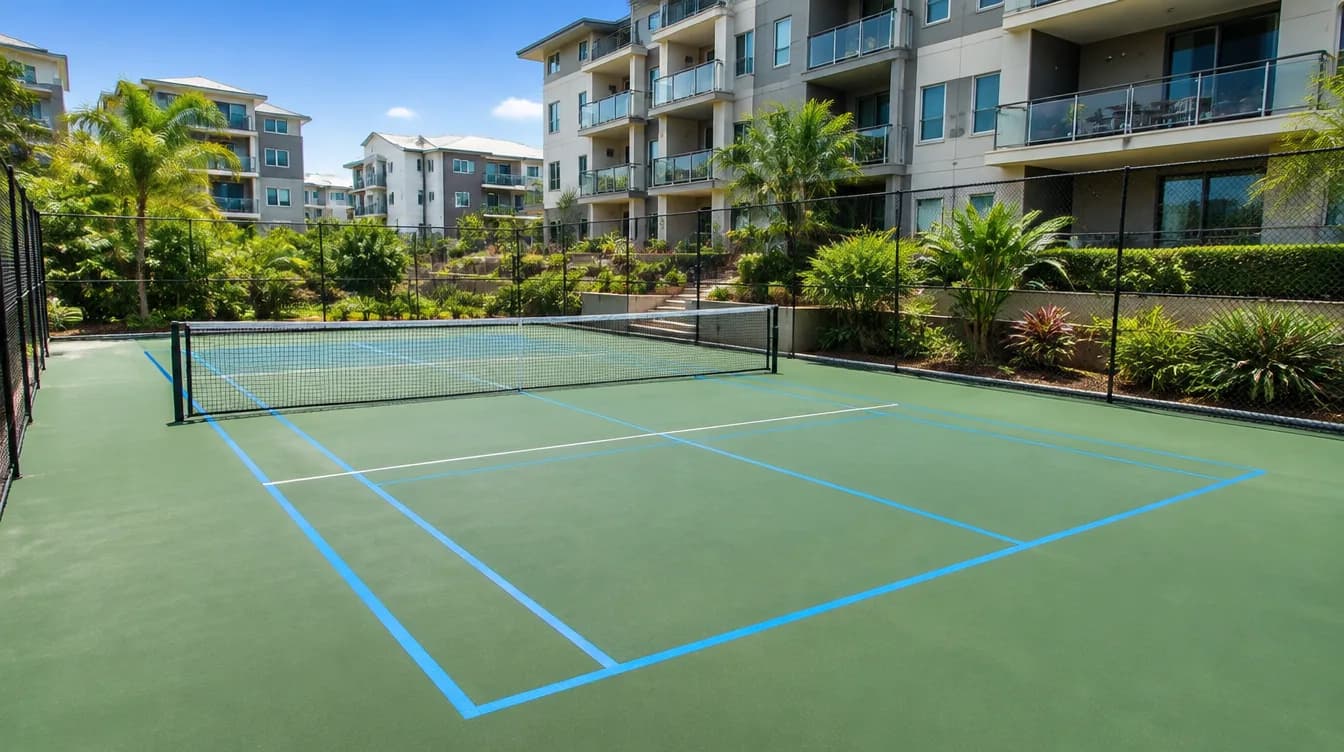
Whether a strata scheme should resurface or convert its tennis court depends on how residents want to use it. If tennis is still popular, resurfacing restores a safe, attractive court. If it sits empty, converting to pickleball, or adding pickleball lines beside tennis, often brings far more residents back onto the court.
| Option | What's involved | Best when |
|---|---|---|
| Resurface and re-line tennis | Crack repair, acrylic recoat, new lines | Tennis is still well used |
| Add pickleball lines | Recoat plus two pickleball courts marked over tennis | Owners want both sports |
| Dedicated pickleball conversion | Up to four pickleball courts, new posts and nets | Tennis is rarely played |
| Repair only | Crack and drainage repairs, line touch-up | Short-term fix while saving up |
How much does strata court resurfacing cost?
Tennis court acrylic resurfacing starts from about $8,000 (Airtasker cost guide, 2026). The final price depends on the court's condition, crack repairs, drainage, the coating system and whether you add pickleball lines, new nets or fencing repairs. A full rebuild of a failed court costs much more, so earlier resurfacing usually saves owners money.
What changes the price:
- Number and width of cracks, and whether the base has moved
- Ponding water and drainage repairs
- Standard or cushioned acrylic coating
- Extra lines for pickleball or basketball
- Net posts, fencing and lighting repairs
How do we work out the cost per lot?
A strata court project's cost per lot is usually the itemised quote shared across owners in line with how your scheme levies common property expenses, typically by unit entitlement or lot liability. Your strata manager confirms the method. We split our quote into clear items so the committee can model options and stage work if needed.
- Essential repairs (safety, cracks, drainage) listed first
- Resurfacing and line marking as separate items
- Optional upgrades such as pickleball lines, lighting and fencing listed last
Who needs to approve court works in a strata scheme?
Strata court works are approved by the committee or by owners at a general meeting, depending on your state's strata laws, your by-laws and the size of the spend. Changes to common property, like converting a tennis court, may need a resolution at a general meeting. Your strata manager will confirm the process.
We support the decision with condition photos, a written scope, options and itemised costs that can go straight into the meeting papers. Council approval is rarely needed for a straight resurface but may apply to new lighting or fencing.
Can our tennis court become pickleball courts?
Yes. A strata tennis court can carry two pickleball courts while keeping tennis, or up to four dedicated pickleball courts with enough run-off. Pickleball suits mixed-age complexes because it's quick to learn and social. Pickleball Australia reports more than 27,000 members across 410-plus clubs and venues (June 2026).
See our tennis court to pickleball conversion page for how a conversion works.
Is cushioned acrylic worth it for a strata court?
Cushioned acrylic is worth considering for a strata court when many residents are older or play pickleball regularly. Rubber layers under the textured top coat make the court softer on knees, hips and backs while keeping a true bounce. It costs more than a standard recoat, so we price both side by side.
- Standard acrylic: hard-wearing, lower cost, suits most complexes
- Cushioned acrylic: softer underfoot, popular with older players
- Lighter colours: stay cooler in summer and show lines clearly
How long will the court be out of action?
A strata court resurface usually closes the court for a short period while cracks are repaired and acrylic coats are applied and cured. Weather matters, because acrylic coatings need dry, mild conditions. We agree dates with the strata manager, give residents notice and keep the court fenced until it is ready to play on.
How do you work around residents?
Working in a strata complex means working beside people's homes. We agree access routes and hours with the strata manager, keep vehicles and materials out of residents' parking, and fence the court during works. Noise is low on most resurfacing jobs, and we clean up each day so common areas stay tidy.
- Notice to residents before work starts
- Agreed work hours that respect quiet periods
- One contact for the strata manager
- Dust controls when grinding or cutting concrete
How often should a strata court be resurfaced?
Tennis Australia's Victorian maintenance guides suggest acrylic courts are resurfaced about every 7 to 10 years and synthetic grass about every 10 to 15 years. Including the court in your scheme's maintenance or sinking fund plan means owners aren't hit with a surprise special levy when the surface finally fails.
Regular cleaning, removing moss and leaves and fixing small cracks early all stretch the time between resurfaces. Read more on court resurfacing.
How we keep every strata court project compliant
Every strata court project follows the same compliance steps as our commercial work. We check whether council approval applies, follow Work Health and Safety laws with Safe Work Method Statements, control silica dust when cutting or grinding concrete and use builders who hold the licence your state requires, with public liability insurance for common property work.
- Council requirements checked for lighting and fencing changes
- Before You Dig Australia (BYDA) check where digging is needed
- Safe Work Method Statements for high-risk work
- Silica dust controls: water suppression or on-tool vacuum extraction
- Slip-resistant textured finishes on every acrylic court
- Court dimensions for tennis (23.77 m × 10.97 m doubles) and pickleball (13.41 m × 6.10 m)
- Licensed, insured builders
What do you need from our committee to quote?
To quote a strata court project, we need to see the court and understand what owners want from it. Recent photos, the court's age and any past repairs are the best start. We then give the committee an itemised quote with options, ready for meeting papers and owner discussion.
- Resurface, conversion or repair, and the sports to mark
- Current surface and known cracks or ponding
- Access for vehicles and materials
- Preferred surface: standard or cushioned acrylic
- Nets, posts, fencing, lighting and power
- Approval process and meeting dates
- Preferred timing and budget or sinking fund amount
Key Benefits
Meeting-ready quotes: itemised options committees can take straight to owners
Resurface or convert: restore tennis, add pickleball lines or convert fully
From about $8,000: acrylic resurfacing, with every repair itemised
Resident-friendly: agreed hours, notice and one contact for the strata manager
Sinking fund planning: realistic resurfacing cycles for long-term budgets

Site Inspection
Free assessment and detailed quote

Professional Marking
Expert application with premium materials

Quality Assurance
Final inspection and compliance sign-off
Compliance Standards
Strata approvals supported
Scopes, photos and itemised options for committee or general meeting decisions.
Local council approval
Requirements checked where lighting or fencing changes are proposed.
WHS Act & SWMS
Safe Work Method Statements and fenced work zones on common property.
Silica dust controls
Water suppression or on-tool vacuum extraction when grinding or cutting.
Slip-resistant surface
Textured acrylic finishes on every resurfaced court.
Fully Compliant & Certified
All our work meets or exceeds Australian Standards and state road authority requirements
VicRoads Approved
Registered Contractor
$20M Public Liability
$10M Professional Indemnity
5,000+ Projects
Since 2009
Fixed Prices
Not Estimates
AS 1742
Traffic Control Devices
Specifies line colours, widths, arrow designs, and placement for road markings. Ensures all traffic control devices meet national safety standards.
AS/NZS 2890
Parking Facilities
Covers bay dimensions (2.4m × 5.4m standard, 2.4m × 5.4m accessible plus a 2.4m shared zone), aisle widths, and traffic flow requirements for compliant parking areas.
AS 4586
Slip Resistance
Defines slip resistance classifications (P rating) for pedestrian surfaces. Critical for wet areas, ramps, and high-traffic zones.
AS/NZS 1428
Access & Mobility
Sets requirements for accessible parking bays, tactile indicators, and mobility access. Essential for DDA compliance and accessibility audits.
What Our Clients Say
Results based on typical project outcomes. Individual results may vary.
Upload your site plans for a detailed quote within 48 hours
Get an accurate, fixed-price quote tailored to your specific project requirements
Frequently Asked Questions
Tennis court acrylic resurfacing starts from about $8,000 (Airtasker cost guide, 2026). Cracks, drainage, the coating system and extra lines change the price. Line Marking Australia itemises every part so committees can compare options.
Yes. Line Marking Australia can mark two pickleball courts over a strata tennis court while keeping tennis, or convert it into up to four dedicated pickleball courts. Common property changes may need approval at a general meeting.
Strata court costs are usually shared the way your scheme levies common property expenses, typically by unit entitlement or lot liability, as your strata manager confirms. Line Marking Australia splits quotes into clear items to help.
The committee or owners at a general meeting approve strata court works, depending on your state's strata laws, by-laws and the spend. Line Marking Australia supplies photos, scopes and itemised options for the meeting papers.
Tennis Australia's Victorian maintenance guides suggest acrylic courts are resurfaced about every 7 to 10 years and synthetic grass about every 10 to 15 years. Line Marking Australia recommends including the court in your sinking fund plan.
Line Marking Australia agrees access routes and hours with the strata manager, notifies residents, keeps parking clear, fences the court and controls dust. Most resurfacing work is relatively quiet and short.
Related Services

Court Painting
Learn more about this service
Court Resurfacing
Learn more about this service
Pickleball Court Line Marking
Learn more about this service
Tennis Court Line Marking?
Learn more about this service
Tennis Court to Pickleball Conversion
Learn more about this service
More Body Corporate & Strata Line Marking Services
Ready to Get Your Line Marking Sorted?
Upload your site plans and receive a fixed-price quote within 48 hours. No surprises, no cost blowouts, just clear pricing you can take to your committee or manager.
Or call us directly: 0417 460 236