

Court Resurfacing for Clubs
Crack repairs, acrylic recoats, synthetic grass renewal and fresh lines for club courts, staged so members keep playing. Acrylic resurfacing from about $8,000.
Jamie (24/7 quotes): 0468 069 002AS 1742.2 Compliant
Fully Insured
24/7 Availability

15+ Years
Get FREE Quote
Fixed-Price Quote Within 48 Hours
Trusted by 5,000+ businesses
VicRoads approved · AS/NZS compliant · $20M insured
Compliance-Ready Guarantee: every job is marked to AS/NZS 2890 & AS 1742, dimensionally verified, and delivered with full compliance documentation, backed by our 12-month workmanship guarantee.
Last updated:
What is Court Resurfacing for Clubs?
Line Marking Australia resurfaces club tennis, netball and multi-sport courts across Australia, from crack repairs and acrylic recoats to synthetic grass renewal and new lines. Tennis court acrylic resurfacing starts from about $8,000 per court (Airtasker cost guide, 2026), and we stage club jobs so members keep playing.
Every club court wears out eventually. Colour fades, cracks open, lines go grey and the surface loses its grip. Members notice, and so do visiting teams.
Resurfacing is one of the best-value projects a club can fund. These are the questions committees ask us before they commit.
How often should club courts be resurfaced?
Tennis Australia's Victorian maintenance guides suggest resurfacing acrylic courts about every 7 to 10 years and synthetic grass courts about every 10 to 15 years. Busy club courts, full sun, poor drainage and tree roots can shorten that. Regular cleaning and early crack repair help a club's courts last at the longer end.
| Surface | Typical resurfacing interval | Signs it's due |
|---|---|---|
| Acrylic hard court | About every 7–10 years | Faded colour, worn lines, smooth slippery patches, cracking |
| Synthetic grass | About every 10–15 years | Flattened fibres, bare patches, lifting joins, uneven bounce |
Intervals from Tennis Australia's Victorian maintenance guides.
How much does club court resurfacing cost?
Club court resurfacing starts from about $8,000 per court for a tennis court acrylic recoat (Airtasker cost guide, 2026). The real figure depends on crack and patch repairs, drainage fixes, how many coats you need, cushioned layers, synthetic grass replacement and line marking. We quote every club court for its condition, and itemise each repair.
Resurfacing a bank of courts in one job is usually better value per court, because set-up and mobilisation are shared. If budget is tight, we can rank the courts by condition so the worst are done first.
What's involved in resurfacing a club court?
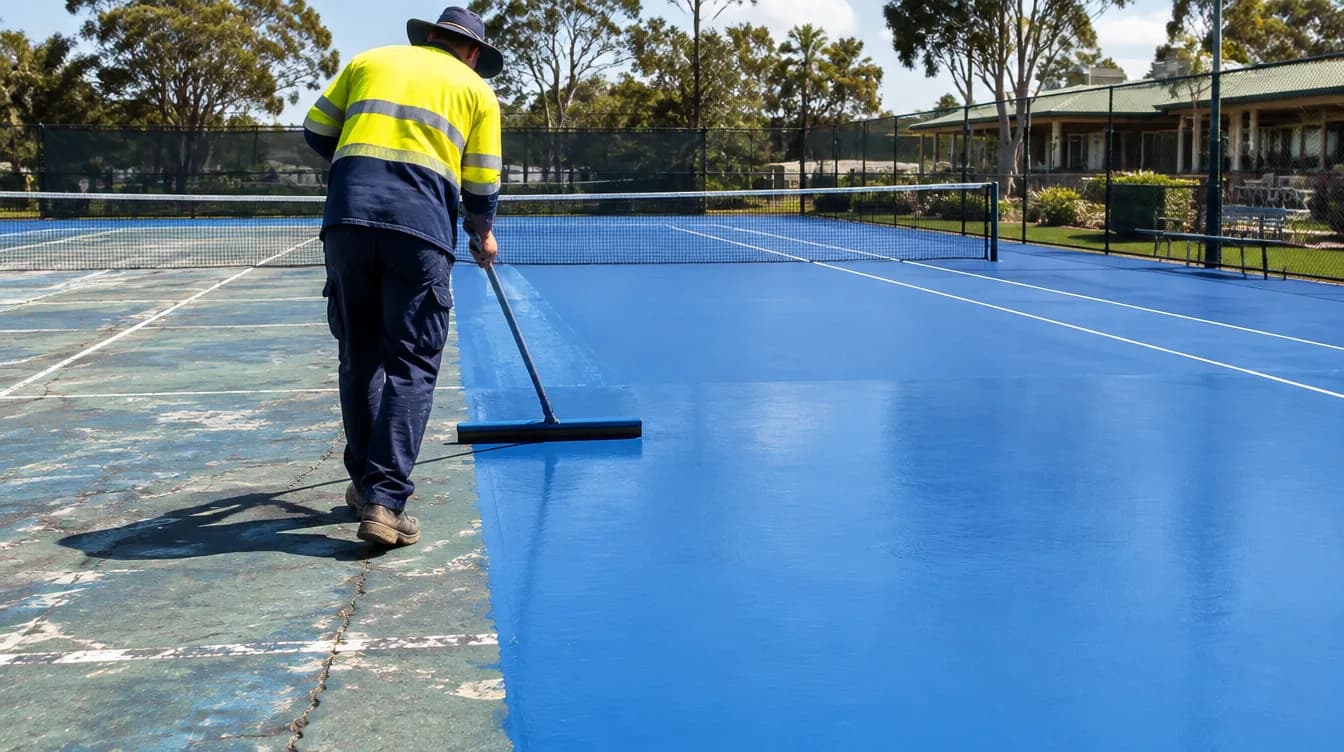
Resurfacing a club court means repairing the base, then rebuilding the surface. For acrylic courts we clean, repair cracks and low spots, apply filler and colour coats, and re-mark the lines. For synthetic grass we lift the old carpet, repair the base and lay new turf. Each step needs dry weather.
- Court inspection and condition report
- Pressure clean and remove moss, mould and loose material
- Crack repair, patching and levelling of birdbaths
- Acrylic filler and colour coats, or new synthetic grass
- Line marking for tennis and any added sports
- Nets and posts checked or replaced
What happens if a club leaves resurfacing too long?
When a club leaves resurfacing too long, small problems become expensive ones. Hairline cracks let water into the base, which widens them and can lift the slab edges. Worn acrylic gets slippery in dew, and flattened synthetic grass gives an uneven bounce. Repairs then cost more, and safety complaints from members follow.
- Cracks that could have been filled need cutting out and patching
- Ponding water breeds moss and mould, making the court slippery
- Faded lines cause disputes in matches and fail visiting teams' expectations
- A neglected base may need rebuilding rather than recoating
Can we add pickleball lines when we resurface?
Yes, a resurface is the ideal time for a club to add pickleball lines. Pickleball lines can be marked in a contrasting colour alongside tennis lines, so the court suits both sports, or a court can be converted to dedicated pickleball. Doing it with the resurface avoids marking over fresh coats later.
Tennis Australia and the National Pickleball League are turning tennis venues into multi-sport racquet hubs, so many clubs plan shared lines into resurfacing projects now.
Are there grants for club court resurfacing?
Yes, resurfacing is a common club grant project in Australia. Queensland's Gambling Community Benefit Fund offers up to $35,000 for club resurfacing, lighting and fencing. The SA Community Facilities Program funded Mount Gambier Tennis Club $431,000. Council and federal grants also support community courts, such as Noosa's $248,900 for pickleball.
We supply a condition report with photos, an itemised quote and a scope for your application. Rounds open and close, so check current criteria on the official site.
Should our club choose acrylic or synthetic grass?
Acrylic and synthetic grass both suit club tennis, and Tennis Australia classifies them in its National Court Surface Policy. Acrylic gives a true, fast bounce, suits shared lines for pickleball and is resurfaced about every 7 to 10 years. Synthetic grass is softer and forgiving, and lasts about 10 to 15 years between replacements.
- Acrylic: suits multi-sport lines, easy to re-mark, needs a sound base
- Cushioned acrylic: rubber layers under the colour coats, easier on joints
- Synthetic grass: popular for social play, needs brushing and infill top-ups
How long will our courts be closed?
A club acrylic court resurface usually takes about a week per court in good weather, because each coat needs drying time before the next. Synthetic grass replacement takes longer if the base needs work. Rain adds days. We stage multi-court jobs so part of the club stays open for members and fixtures.
We agree the order of courts with the committee, fence off the work zone and keep a clear path to the open courts and clubhouse.
How we keep every club resurfacing job compliant
Every club court resurfacing job we deliver follows council rules, safety laws and the right surface and line standards. That means silica dust controls when we grind or cut, safe work methods on site, sediment kept out of drains, slip-resistant finishes, and lines marked to the sport's dimensions and Tennis Australia guidance.
- Tennis Australia guidance for club and community tennis, and the 23.77 m × 10.97 m doubles court
- Pickleball lines to 13.41 m × 6.10 m with a 2.13 m kitchen where added
- Silica dust controls (water suppression, on-tool vacuum extraction) when grinding or cutting
- Sediment and stormwater controls so wash-down water and debris stay out of drains
- Safe Work Method Statements for high-risk work
- Slip-resistant textured finishes
- Builders who hold the licence your state requires, with public liability insurance
Learn more on our court resurfacing page, see other club upgrades on our sports courts for sports clubs page, or read about tennis court construction if a court needs a full rebuild.
What do you need from us to quote club court resurfacing?
To quote club court resurfacing, Line Marking Australia needs to know how many courts need work, the current surface, its age and condition, and which sports you want marked. Photos of cracks, low spots and lines, a site plan and any grant deadline help us return an accurate, itemised quote quickly.
- Number of courts and the sports played on each
- Current surface (acrylic, synthetic grass, asphalt) and its age
- Cracks, ponding, tree roots or drainage problems
- Preferred finish: standard or cushioned acrylic, or synthetic grass
- Lines to mark: tennis, pickleball, netball or others
- Nets, posts, fencing and lighting condition
- Machinery access and fixtures to work around
- Timing, budget and grant deadline
Key Benefits
From about $8,000: acrylic resurfacing per tennis court, every repair itemised
Staged works: part of the club stays open
Shared lines: add pickleball while the court is fresh
Grant-ready: condition reports, photos and scopes
Lines included: tennis, pickleball, netball and more marked after the final coat

Site Inspection
Free assessment and detailed quote

Professional Marking
Expert application with premium materials

Quality Assurance
Final inspection and compliance sign-off
Compliance Standards
Tennis Australia guidance
Club and community tennis guidance and the 23.77 m × 10.97 m doubles court.
Silica dust controls
Water suppression and on-tool vacuum extraction when grinding or cutting.
Sediment & stormwater
Wash-down water and debris kept out of drains.
Slip-resistant finish
Textured acrylic coats for grip in dew and light rain.
WHS & licensing
SWMS for high-risk work; licensed builders with public liability insurance.
Fully Compliant & Certified
All our work meets or exceeds Australian Standards and state road authority requirements
VicRoads Approved
Registered Contractor
$20M Public Liability
$10M Professional Indemnity
5,000+ Projects
Since 2009
Fixed Prices
Not Estimates
AS 1742
Traffic Control Devices
Specifies line colours, widths, arrow designs, and placement for road markings. Ensures all traffic control devices meet national safety standards.
AS/NZS 2890
Parking Facilities
Covers bay dimensions (2.4m × 5.4m standard, 2.4m × 5.4m accessible plus a 2.4m shared zone), aisle widths, and traffic flow requirements for compliant parking areas.
AS 4586
Slip Resistance
Defines slip resistance classifications (P rating) for pedestrian surfaces. Critical for wet areas, ramps, and high-traffic zones.
AS/NZS 1428
Access & Mobility
Sets requirements for accessible parking bays, tactile indicators, and mobility access. Essential for DDA compliance and accessibility audits.
What Our Clients Say
Results based on typical project outcomes. Individual results may vary.
Upload your site plans for a detailed quote within 48 hours
Get an accurate, fixed-price quote tailored to your specific project requirements
Frequently Asked Questions
Tennis Australia's Victorian maintenance guides suggest about every 7 to 10 years for acrylic courts and about every 10 to 15 years for synthetic grass. Line Marking Australia inspects club courts and advises when heavy use or poor drainage means sooner.
Tennis court acrylic resurfacing starts from about $8,000 per court (Airtasker cost guide, 2026). Line Marking Australia quotes each club court for its condition, itemising crack repairs, drainage fixes, coats and line marking.
Yes. Queensland's Gambling Community Benefit Fund offers up to $35,000 for club resurfacing, lighting and fencing, and state and council programs fund community courts. Line Marking Australia supplies condition reports and itemised quotes for applications.
Yes. A resurface is the best time to add pickleball lines in a contrasting colour, so the club court suits tennis and pickleball. Line Marking Australia marks both line sets after the final colour coat.
An acrylic club court resurface takes about a week per court in good weather, because each coat needs drying time. Line Marking Australia stages multi-court jobs so members and fixtures can keep using the other courts.
Both suit club tennis. Acrylic gives a true bounce and suits shared pickleball lines; synthetic grass is softer and lasts about 10 to 15 years. Line Marking Australia explains the trade-offs for your club's members and budget.
Related Services

Court Painting
Learn more about this service
Court Resurfacing
Learn more about this service
Sports Courts for Sports Clubs
Learn more about this service
Tennis Court Construction
Learn more about this service
Tennis Court Line Marking?
Learn more about this service
Tennis Court to Pickleball Conversion
Learn more about this service
Ready to Get Your Line Marking Sorted?
Upload your site plans and receive a fixed-price quote within 48 hours. No surprises, no cost blowouts, just clear pricing you can take to your committee or manager.
Or call us directly: 0417 460 236