

Padel Court Construction Hobart
Indoor and outdoor padel courts for Hobart clubs, gyms, hotels and homes, planned around wind, rain and approvals. From about $60,000.
Jamie (24/7 quotes): 0468 069 002AS 1742.2 Compliant
Fully Insured
24/7 Availability

15+ Years
Get FREE Quote
Fixed-Price Quote Within 48 Hours
Trusted by 5,000+ businesses
VicRoads approved · AS/NZS compliant · $20M insured
Compliance-Ready Guarantee: every job is marked to AS/NZS 2890 & AS 1742, dimensionally verified, and delivered with full compliance documentation, backed by our 12-month workmanship guarantee.
Last updated:
What is Padel Court Construction Hobart?
Line Marking Australia builds padel courts in Hobart for clubs, gyms, hotels and private homes, indoors or outdoors. A padel court in Australia starts from about $60,000, based on a Sydney club build reported in the trade press. We arrange each build through our network of local builders and manage the slab, structure, glass, turf and lighting.
Padel is a doubles racquet sport played on an enclosed court about half the size of a tennis court. The walls are part of the game, so it is easy to learn and very social. That is why Hobart clubs, gyms and venues are starting to ask about it.
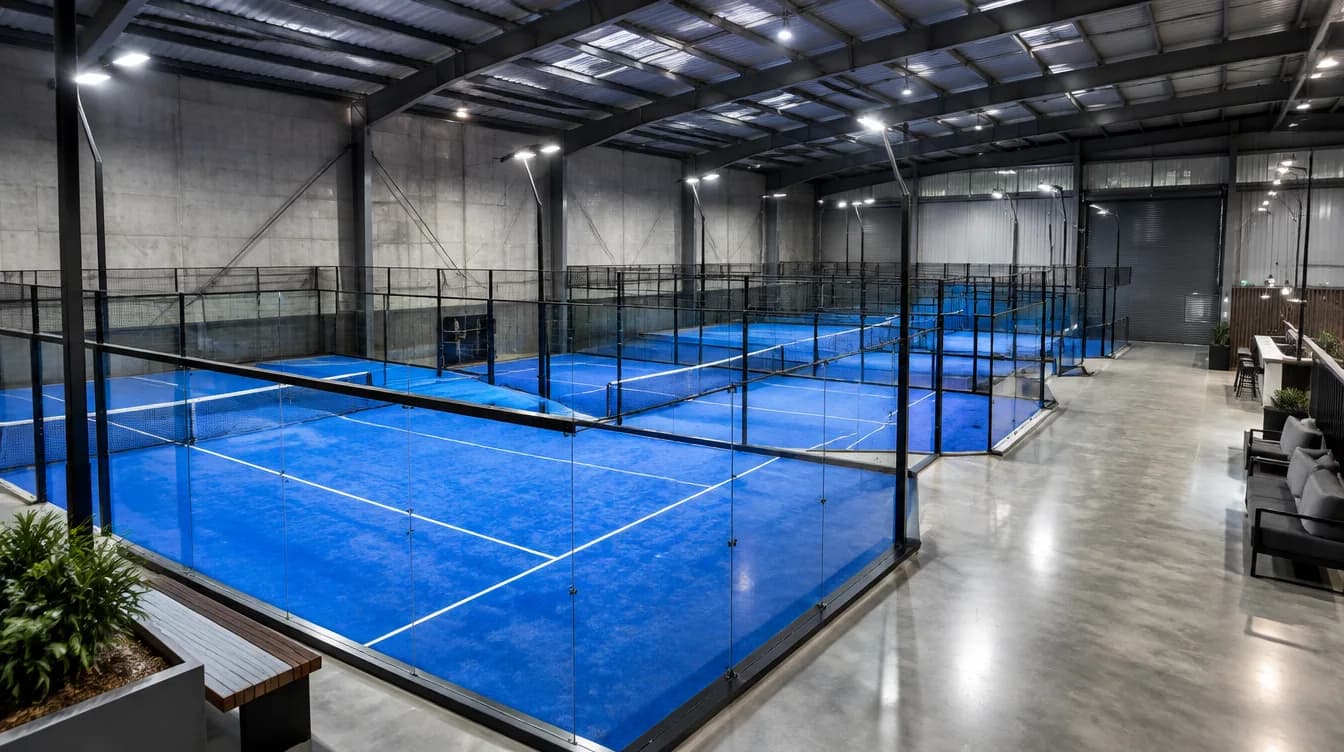
Because the court is enclosed in glass and mesh, a padel build is closer to installing a small structure than painting lines on a slab. Here is what a Hobart project involves.
How much does a padel court cost in Hobart?
A padel court in Hobart starts from about $60,000, the figure reported in the trade press for a Sydney club build. The final price depends on whether the court is indoor or outdoor, the slab and drainage, the glass and frame system, lighting, and the earthworks needed on a sloping Hobart site. We quote every court per site.
The main cost blocks are the base and slab, the steel frame with glass and mesh panels, the synthetic turf and sand infill, lighting, and freight of the court kit to Tasmania. Freight and lifting are worth asking about early, because glass panels need careful handling. We itemise each block in your quote.
How much space does a padel court need?
A padel court has a playing area of 20 m by 10 m, enclosed by walls, so the footprint needs a little extra space around the outside for access, footings and lighting. That is roughly the area of half a tennis court, which is why many Hobart clubs look at using part of an existing tennis court site.
| Court | Playing area | What it means for your site |
|---|---|---|
| Padel | 20 m × 10 m | Fully enclosed; allow access around the outside |
| Tennis (doubles) | 23.77 m × 10.97 m plus run-off | A full tennis court site can hold a padel court with room to spare |
| Squash | 9.75 m × 6.4 m | Too small to convert to padel |
Should a Hobart padel court be indoor or outdoor?
For Hobart, the indoor or outdoor choice is mostly about weather. Outdoor padel courts cost less but wind, rain and cold winter evenings reduce playing time, and moss can build up in shade. Indoor courts give year-round play and protect the turf and glass, but need a building with enough clear height and space.
| Outdoor | Indoor | |
|---|---|---|
| Year-round play | Limited by rain, wind and cold | Yes |
| Upfront cost | Lower | Higher, or depends on the existing building |
| Key design points | Drainage, wind-rated structure, lighting spill | Clear ceiling height, lighting, ventilation |
| Upkeep | Turf brushing, moss and leaf control | Turf brushing and glass cleaning |
A covered outdoor court is a middle path some venues consider. Gyms and centres can read more on our courts for gyms and padel centres page.
Can you convert a tennis court to padel in Hobart?
Yes, a Hobart tennis court site can usually be converted to padel, because a padel court is smaller than a tennis court. The existing slab must be checked first. Padel frames are fixed to the base, so the slab needs to be sound, level and able to take the fixings, and it must drain properly.
A conversion usually means repairing or replacing parts of the slab, setting out the frame, installing glass and mesh, laying synthetic turf with sand infill and adding lighting. Clubs often keep part of the site for tennis or pickleball so members still have options.
Do you need council approval for a padel court in Hobart?
An outdoor padel court in Hobart will often need a planning permit, and the structure may need building approval, because of the walls, lighting and noise. The sound of the ball off the glass carries, so distance to neighbours and hours of use matter. Hobart, Glenorchy, Clarence and Kingborough councils assess this under their zones.
Points we check with your council:
- Zoning and whether the use is allowed on the site
- Walls and structure height, and any earthworks or retaining
- Noise and hours of use near homes
- Lighting spill, assessed under AS/NZS 4282
- Stormwater and heritage, landslip or bushfire overlays
Who needs a builder's licence for a padel court in Tasmania?
In Tasmania, who can build a padel court depends on the category of building work under the CBOS Director's Determination. Only minor low-risk work can be done without a licence. A padel court, with its slab, frame, glass and lighting, will usually fall into a category that needs a licensed builder and often a building surveyor or permit.
We match your project with a builder from our network who holds the right Tasmanian licence and public liability insurance, and who has the lifting gear and experience to handle glass panels safely.
Who is building padel courts in Hobart?
In Hobart, the main interest in padel comes from tennis and sports clubs, gyms and fitness centres, hotels and some private homes on larger blocks. Line Marking Australia manages the project and arranges the build through our network of local builders. Each Hobart padel project is planned from scratch for its own site.
For clubs, padel can turn an under-used court into a busy one. For hotels it adds a guest activity that is easy to pick up. For homes, an outdoor court needs a large, flat area and neighbours who will not mind the sound.
How we keep every padel court build compliant in Tasmania
Every padel court we arrange in Hobart is checked against council planning rules, Tasmanian licensing categories and the relevant Australian Standards. Builders work under Work Health and Safety laws with Safe Work Method Statements for excavation, lifting and mobile plant, and the court is set out to the 20 m by 10 m padel dimensions.
- Council planning and building requirements checked, including noise and lighting
- Before You Dig Australia (BYDA) check before excavation
- Safe Work Method Statements and silica dust controls when cutting concrete
- Sediment and stormwater controls during earthworks
- Slab to AS 3600; accessible paths considered against AS 1428.1
- Lighting to AS 2560.1 and AS 2560.2, with spill limited under AS/NZS 4282
- Builders licensed for the category of work, with public liability insurance
See our main padel court construction page and the sports court construction hub for more.
What do you need from me to quote a padel court in Hobart?
To quote a padel court in Hobart we need to know where it will go, whether it is indoor or outdoor and what is there now. For indoor courts, photos and measurements of the building, including clear height, matter most. For outdoor courts, the slope, neighbours and access for trucks and lifting gear matter most.
- Indoor, outdoor or covered, and how many courts
- Club, gym, hotel or home
- Suburb, slope and what is on the ground now, such as an old tennis court
- Building dimensions and clear height for indoor courts
- Access for trucks, a crane or lifting gear
- Lighting, power and any spectator or seating space
- Distance to neighbours and expected hours of use
- Council permits already in hand, timing and budget
Key Benefits
Indoor or outdoor: planned around Hobart's wind, rain and cold evenings
Tennis site conversions: a padel court fits on part of a tennis court site
Approvals checked early: noise, lighting and structure raised with council up front
Licensed local builders: arranged through our network for Tasmanian categories
From about $60,000: with slab, glass, turf, lights and freight itemised

Site Inspection
Free assessment and detailed quote

Professional Marking
Expert application with premium materials

Quality Assurance
Final inspection and compliance sign-off
Compliance Standards
Padel court dimensions
20 m × 10 m enclosed playing area set out to the sport's dimensions.
Tasmanian building categories
Builders licensed for the CBOS category of work, with public liability insurance.
Council planning & noise
Zoning, structure, noise, lighting and overlays checked with council.
WHS, SWMS & lifting
SWMS for excavation, plant and glass handling; dust controls when cutting concrete.
AS 3600 · AS 2560 · AS/NZS 4282
Slab to AS 3600, lighting to the AS 2560 series with spill limited under AS/NZS 4282.
Fully Compliant & Certified
All our work meets or exceeds Australian Standards and state road authority requirements
VicRoads Approved
Registered Contractor
$20M Public Liability
$10M Professional Indemnity
5,000+ Projects
Since 2009
Fixed Prices
Not Estimates
AS 1742
Traffic Control Devices
Specifies line colours, widths, arrow designs, and placement for road markings. Ensures all traffic control devices meet national safety standards.
AS/NZS 2890
Parking Facilities
Covers bay dimensions (2.4m × 5.4m standard, 2.4m × 5.4m accessible plus a 2.4m shared zone), aisle widths, and traffic flow requirements for compliant parking areas.
AS 4586
Slip Resistance
Defines slip resistance classifications (P rating) for pedestrian surfaces. Critical for wet areas, ramps, and high-traffic zones.
AS/NZS 1428
Access & Mobility
Sets requirements for accessible parking bays, tactile indicators, and mobility access. Essential for DDA compliance and accessibility audits.
What Our Clients Say
Results based on typical project outcomes. Individual results may vary.
Upload your site plans for a detailed quote within 48 hours
Get an accurate, fixed-price quote tailored to your specific project requirements
Frequently Asked Questions
A padel court in Hobart starts from about $60,000, based on a Sydney club build reported in the trade press. Indoor or outdoor, slab work, glass system, lighting, earthworks and freight affect the final price. Line Marking Australia quotes every court per site.
A padel court has a playing area of 20 m by 10 m and is fully enclosed by glass and mesh walls. Allow a little extra space around the outside for access and lighting. That is about half the area of a tennis court.
Indoor padel courts give year-round play in Hobart's rain, wind and cold, and protect the turf and glass, but need a building with enough clear height. Outdoor courts cost less upfront. Line Marking Australia helps you compare both for your site.
Usually yes. A padel court is smaller than a tennis court, so it fits on a tennis court site. The slab must be sound, level, well drained and able to take the frame fixings. Line Marking Australia checks this before quoting.
Outdoor padel courts in Hobart often need a planning permit because of the walls, lighting and ball noise off the glass. Line Marking Australia checks zoning, noise, lighting spill, stormwater and overlays with your council before the final quote.
Usually. Tasmania uses categories of building work, and only minor low-risk work can be done without a licence. A padel court with a slab, frame, glass and lights will usually need a licensed builder, which Line Marking Australia arranges.
Yes, if you have a large flat area, access for trucks and lifting gear, and neighbours far enough away that ball noise is not a problem. A home padel court starts from about $60,000, and Line Marking Australia checks council rules first.
Related Services

Padel Court Construction
Learn more about this service
Sports Court Construction
Learn more about this service
Sports Courts for Gyms and Padel Centres
Learn more about this service
Sports Courts for Hotels and Resorts
Learn more about this service
Sports Courts for Sports Clubs
Learn more about this service
Ready to Get Your Line Marking Sorted?
Upload your site plans and receive a fixed-price quote within 48 hours. No surprises, no cost blowouts, just clear pricing you can take to your committee or manager.
Or call us directly: 0417 460 236