

Cricket Nets and Synthetic Pitches
Backyard, school and club cricket nets with synthetic turf pitches, steel frames and heavy-duty netting. Quoted per site.
Jamie (24/7 quotes): 0468 069 002AS 1742.2 Compliant
Fully Insured
24/7 Availability

15+ Years
Get FREE Quote
Fixed-Price Quote Within 48 Hours
Trusted by 5,000+ businesses
VicRoads approved · AS/NZS compliant · $20M insured
Compliance-Ready Guarantee: every job is marked to AS/NZS 2890 & AS 1742, dimensionally verified, and delivered with full compliance documentation, backed by our 12-month workmanship guarantee.
Last updated:
What is Cricket Nets and Synthetic Pitches?
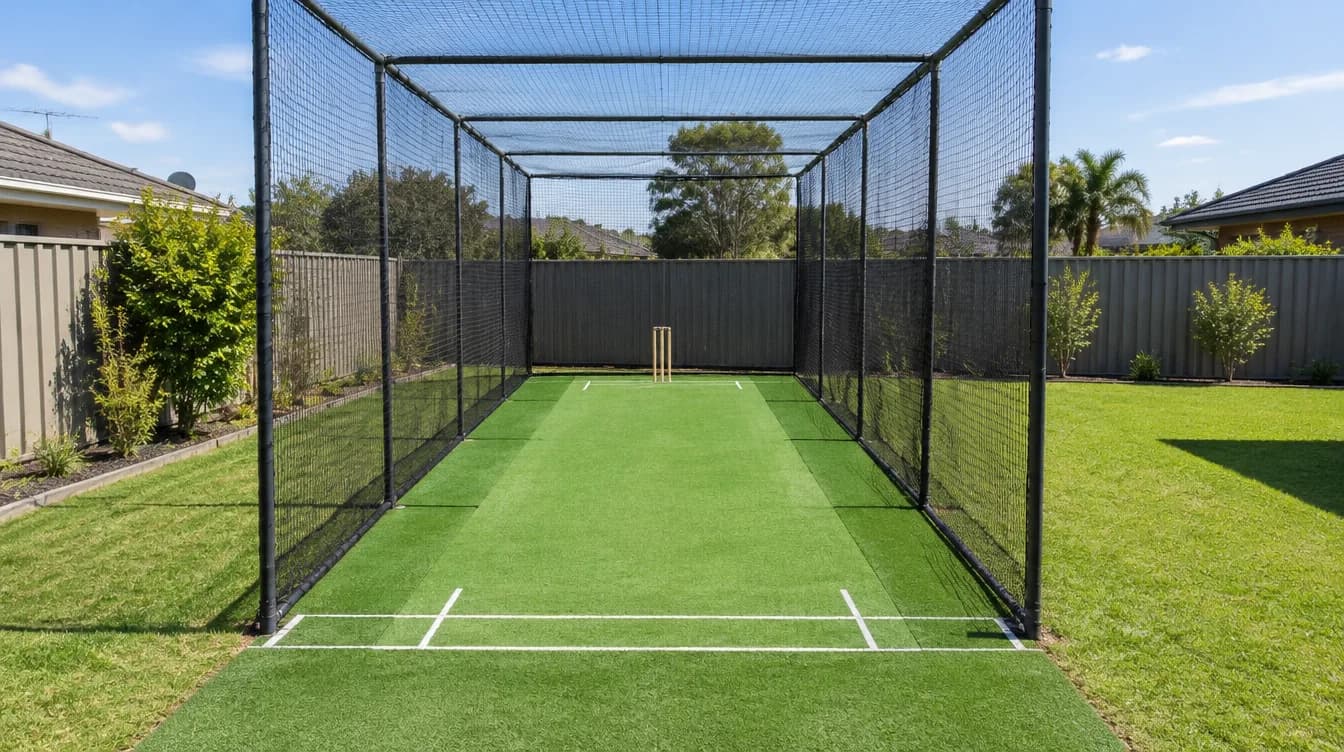
Line Marking Australia builds cricket nets and synthetic cricket pitches across Australia for backyards, schools and cricket clubs. We handle the base, concrete or compacted pitch foundation, synthetic turf, run-up area, steel net frame, side and roof netting, and line marking. Every cricket net and pitch is quoted per site, because length, base and netting vary.
Backyard cricket is a summer tradition, and a proper net lifts it from tennis balls on the lawn to real hard-ball practice without smashed windows. Schools and clubs want multi-lane nets that can take hours of training every week.
A good net comes down to a flat, firm pitch with a consistent bounce, netting strong enough for a hard ball, and enough length for the bowler to run in. Here's how we plan each part.
How much do backyard cricket nets cost?
The cost of backyard cricket nets in Australia depends on the pitch length, the base, the synthetic turf, the net frame and whether you want a roof net. A short pitch with side nets on flat ground costs much less than a full-length enclosed net on a slope. Line Marking Australia quotes each net per site.
| Cost item | What affects it |
|---|---|
| Earthworks and base | Pitch length, slope, soil and access |
| Concrete slab or compacted base | Base type, length and width |
| Synthetic pitch turf | Turf grade and how it's fixed |
| Net frame and netting | Side nets only or a full enclosure with roof net |
| Run-up and surrounds | Synthetic run-up, edging and paths |
| Extras | Lighting, crease line marking, a bowling machine area |
How long should a backyard cricket net be?
A backyard cricket net in Australia can be built to full pitch length or shorter, depending on your block and who's playing. Full length suits older juniors and adults practising real bowling. Shorter nets suit younger kids, spin bowling and batting against a bowling machine. You also need space behind the bowler's crease for a run-up.
- Full-length net: realistic bowling and batting for older juniors and adults
- Shorter net: younger players, spin, throwdowns and bowling machines
- Run-up: clear, level space behind the bowling end
- Width: enough for the batter to play shots without hitting the side nets
We set out the net on site so you can see the real footprint before anything is dug.
Synthetic or concrete cricket pitch: which is better?
A synthetic cricket pitch in Australia is usually synthetic turf laid over a concrete slab or a compacted base, and it gives a softer, more consistent bounce than bare concrete. A plain concrete pitch is cheaper and very durable but plays hard and fast and is harsh on balls. Most backyards and clubs choose synthetic turf on concrete.
| Synthetic turf pitch | Bare concrete pitch | |
|---|---|---|
| Bounce | Consistent and closer to a real wicket | Hard and fast, can skid |
| Ball wear | Gentler on cricket balls | Scuffs balls quickly |
| Comfort | Softer underfoot for bowlers' landings | Hard on bowlers' feet and joints |
| Upkeep | Brush and clear leaves; replace turf when worn | Very little |
| Best for | Backyards, schools, clubs | Tight budgets, temporary practice areas |
What base does a synthetic cricket pitch need?
A synthetic cricket pitch in Australia needs a flat, firm base that won't move or develop low spots, because any unevenness shows up as uneven bounce. A reinforced concrete slab gives the most consistent result. A well-compacted crushed rock or asphalt base can work in some situations, with the turf laid or fixed on top.
- Set out the pitch and run-up on site
- Excavate and compact the subgrade
- Lay a crushed rock base and compact it in layers
- Pour a reinforced concrete slab with even falls, or finish the compacted base
- Lay and fix the synthetic pitch turf once the slab has cured
- Mark creases if required
What are cricket nets made of?
Cricket nets in Australia are usually a galvanised or powder-coated steel frame holding heavy-duty netting along the sides and back, and often across the roof. The netting has to be strong enough to stop a hard ball and UV-stable to last in Australian sun. Lighter netting suits juniors; heavier netting suits senior and club use.
- Frame: steel posts in concrete footings, with top cables or rails
- Side and back nets: heavy-duty, UV-stable netting tied tight to the frame
- Roof net: keeps balls inside, important on smaller blocks
- Bowler's end: open or partly netted so the bowler can run in
How long does it take to build cricket nets?
Backyard cricket nets usually take about one to three weeks on site in Australia once approvals are sorted, including earthworks, the slab, curing time, turf laying and the net frame. Multi-lane school and club nets take longer. Replacing worn turf or netting on an existing net is much quicker.
Do you build cricket nets for schools and clubs?
Yes. Line Marking Australia builds single and multi-lane cricket nets for schools and cricket clubs across Australia, with divider nets between lanes, synthetic run-ups and lighting for evening training. We also mark cricket ovals and creases, so one team can look after nets and ground markings together.
See cricket pitch and oval line marking and sports courts for sports clubs for club projects and grants.
Do backyard cricket nets need council approval?
Backyard cricket nets may need council approval in Australia, depending on the height of the frame, how close it is to boundaries, any earthworks or retaining walls, and lighting. Tall net frames are often treated like fences or structures. Rules vary between councils, so we check yours before the final quote.
Neighbours mostly care about balls coming over and noise in the evening, so a roof net and sensible placement help.
How we keep every cricket net build compliant
Every cricket net and synthetic pitch we build follows the same compliance steps. We check council rules on structure height and earthworks, locate services before digging footings, manage safety and dust on site, and build slabs, footings and any lighting to the Australian Standards that apply.
- Council requirements checked for frame height, setbacks, earthworks, retaining walls and lighting
- Before You Dig Australia (BYDA) check before excavation and post footings
- Work Health and Safety laws, with Safe Work Method Statements for excavation and mobile plant
- Silica dust controls when cutting concrete; sediment and stormwater controls
- Slabs and footings to AS 3600
- Lighting to AS 2560.1:2018 and AS 2560.2:2021, with spill controlled under AS/NZS 4282
- For schools: holiday scheduling where possible and Working with Children checks for crews
What do you need from me to quote cricket nets?
To quote cricket nets or a synthetic pitch in Australia we need to know the length you want, how many lanes, and what's on the ground now. Photos, a sketch of the area with measurements and a note on slope and access let us suggest a layout and give you a realistic starting figure.
- Backyard, school or club, and number of lanes
- Full-length or shorter pitch, plus run-up space
- New build, or replacing turf or netting on an existing net
- What's on the ground now, slope and drainage
- Access for trucks and a concrete pump
- Synthetic turf or concrete pitch
- Side nets only or full enclosure with roof net
- Lighting and power, approvals, timing and budget
Key Benefits
True, consistent bounce: flat, firm bases under quality synthetic turf
Strong netting: UV-stable nets sized for hard-ball cricket
Backyard to club: single nets to multi-lane training facilities
Ovals marked too: creases and oval lines from the same team
Compliance built in: council checks, BYDA, SWMS and dust controls

Site Inspection
Free assessment and detailed quote

Professional Marking
Expert application with premium materials

Quality Assurance
Final inspection and compliance sign-off
Compliance Standards
Local council approval
Frame height, setbacks, earthworks, retaining walls and lighting checked before the final quote.
Before You Dig Australia
Underground services located before excavation and post footings.
WHS Act & SWMS
Safe Work Method Statements for excavation and mobile plant; silica dust controls.
AS 3600
Pitch slabs and post footings to AS 3600.
AS 2560 · AS/NZS 4282
Training lights to the AS 2560 series, with spill controlled under AS/NZS 4282.
Fully Compliant & Certified
All our work meets or exceeds Australian Standards and state road authority requirements
VicRoads Approved
Registered Contractor
$20M Public Liability
$10M Professional Indemnity
5,000+ Projects
Since 2009
Fixed Prices
Not Estimates
AS 1742
Traffic Control Devices
Specifies line colours, widths, arrow designs, and placement for road markings. Ensures all traffic control devices meet national safety standards.
AS/NZS 2890
Parking Facilities
Covers bay dimensions (2.4m × 5.4m standard, 2.4m × 5.4m accessible plus a 2.4m shared zone), aisle widths, and traffic flow requirements for compliant parking areas.
AS 4586
Slip Resistance
Defines slip resistance classifications (P rating) for pedestrian surfaces. Critical for wet areas, ramps, and high-traffic zones.
AS/NZS 1428
Access & Mobility
Sets requirements for accessible parking bays, tactile indicators, and mobility access. Essential for DDA compliance and accessibility audits.
What Our Clients Say
Results based on typical project outcomes. Individual results may vary.
Upload your site plans for a detailed quote within 48 hours
Get an accurate, fixed-price quote tailored to your specific project requirements
Frequently Asked Questions
Backyard cricket net costs depend on pitch length, base, synthetic turf, frame and netting, and whether you add a roof net, so Line Marking Australia quotes each net per site. Flat ground and good truck access keep costs down.
A backyard cricket net can be full pitch length for older juniors and adults, or shorter for young kids, spin and bowling machines. You also need run-up space behind the bowling end. Line Marking Australia sets out the footprint on site first.
Synthetic turf laid over concrete gives a more consistent, ball-friendly bounce and is softer on bowlers. Bare concrete is cheaper but plays hard and scuffs balls. Line Marking Australia recommends synthetic turf on concrete for most backyards and clubs.
A synthetic cricket pitch needs a flat, firm base that won't move. A reinforced concrete slab gives the most consistent bounce, and a well-compacted crushed rock or asphalt base can suit some sites. Line Marking Australia checks your soil first.
They may, depending on frame height, setbacks, earthworks, retaining walls and lighting. Tall net frames are often treated like fences or structures. Line Marking Australia checks your council's requirements before the final quote.
Yes. Line Marking Australia builds single and multi-lane nets with divider netting, synthetic run-ups and lighting for evening training, and can also mark cricket ovals and creases for clubs and schools.
Yes. If the base is sound, Line Marking Australia can replace worn synthetic pitch turf and tired netting, which is much quicker and cheaper than a full rebuild. We check the slab for cracks and low spots first.
Related Services

Backyard Sports Courts
Learn more about this service
Cricket Pitches & Ovals Line Marking
Learn more about this service
Sports Court Construction
Learn more about this service
Sports Courts for Schools
Learn more about this service
Sports Courts for Sports Clubs
Learn more about this service
Ready to Get Your Line Marking Sorted?
Upload your site plans and receive a fixed-price quote within 48 hours. No surprises, no cost blowouts, just clear pricing you can take to your committee or manager.
Or call us directly: 0417 460 236