

Half Court Basketball for Backyards
Pick the right pad size for your yard, then we build the slab, surface, key, three-point line and hoop. From about $10,000.
Jamie (24/7 quotes): 0468 069 002AS 1742.2 Compliant
Fully Insured
24/7 Availability

15+ Years
Get FREE Quote
Fixed-Price Quote Within 48 Hours
Trusted by 5,000+ businesses
VicRoads approved · AS/NZS compliant · $20M insured
Compliance-Ready Guarantee: every job is marked to AS/NZS 2890 & AS 1742, dimensionally verified, and delivered with full compliance documentation, backed by our 12-month workmanship guarantee.
Last updated:
What is Half Court Basketball for Backyards?
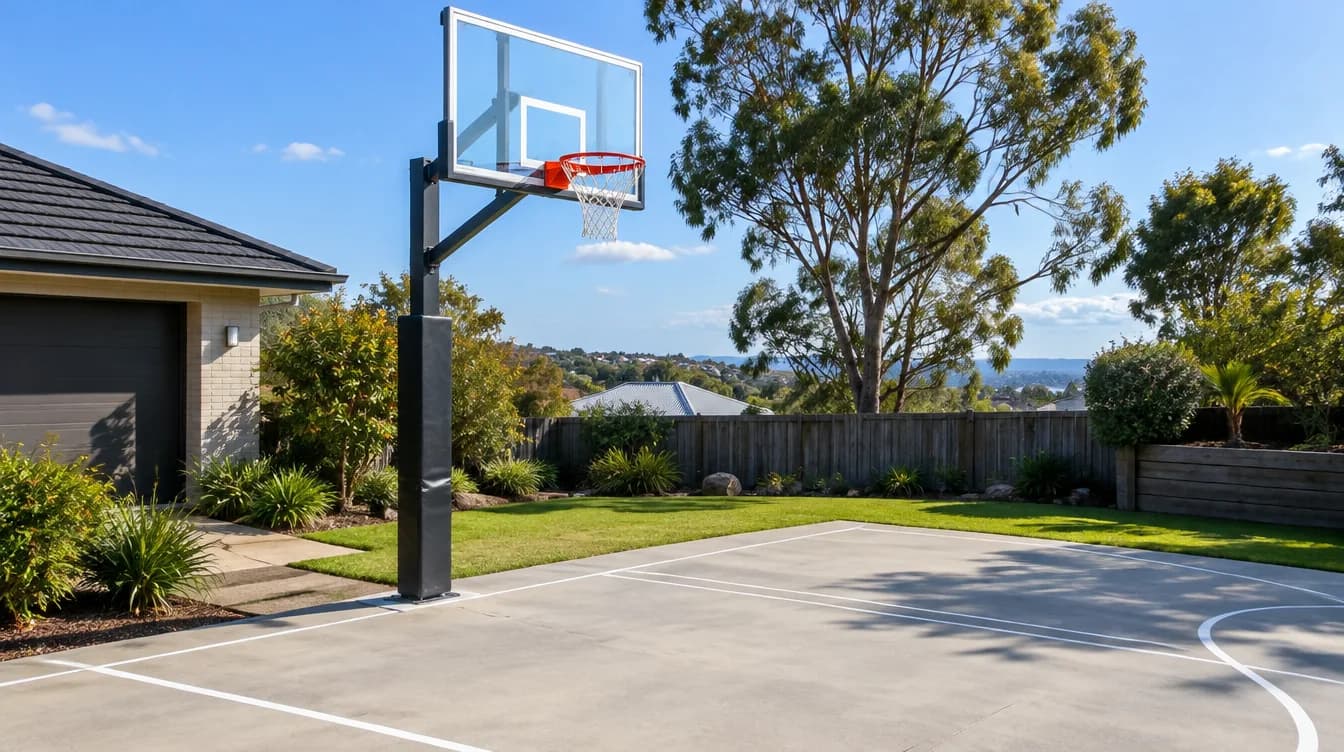
Line Marking Australia builds half court basketball pads in backyards across Australia. A true half court is 14 m by 15 m, but most home half courts are smaller to suit the block. We size the concrete pad, pour it, surface it and mark the key and three-point line. Half courts up to about 165 m² start from about $10,000.
The first question almost everyone asks is "how big does the pad need to be?" The honest answer is: it depends on your yard, who's playing and whether you want a three-point line.
This page is all about getting the size right before you spend money on concrete. Once the pad is poured, it's very hard to make it bigger.
What size is a half court basketball court?
A regulation half court basketball court is 14 m long and 15 m wide, which is exactly half of the 28 m by 15 m FIBA full court used in Australia. That's about 210 m² before run-off. Most backyard half courts are smaller and still fit a full key, a hoop and room to shoot.
Unless you're training for representative basketball, a regulation half court is rarely needed at home. A shorter, narrower pad that keeps the key and some three-point shooting usually gives the best use of the space.
What size concrete pad do I need for half court basketball?
The concrete pad for half court basketball should cover the lines you want to play plus run-off on every side, and extend behind the hoop far enough to hold its footing. For most families, a pad that fits the full key and a short three-point arc is the sweet spot between cost and playability.
Work out your pad in this order:
- Decide on the lines. Key only, key plus a short arc, or the full three-point line.
- Add the hoop zone. The post sits behind the baseline, so the pad runs past the backboard.
- Add run-off. Leave space at the sides and the top so players don't hit fences or garden beds.
- Check the fall. The pad needs a gentle slope to shed water, usually away from the house.
- Check access. A concrete truck or pump has to reach the pad.
We mark the pad out with string lines or paint on site so you can stand on it and picture the court before we dig.
What are common backyard half court sizes?
Common backyard half court sizes range from a compact shooting pad around the hoop up to a large half court of about 165 m², with the full 14 m by 15 m regulation half court for big blocks. The right size for you depends on yard space, the age of the players and your budget.
| Common size we build | Lines that fit | Best for |
|---|---|---|
| Compact shooting pad | Hoop and free-throw shooting | Small yards, younger children |
| Key court | Full key and free-throw line | Narrow suburban blocks |
| Large half court, up to about 165 m² | Key plus most of the three-point arc | Families with teenagers |
| Regulation half court, 14 m × 15 m | Full half-court markings | Acreage, large blocks, serious players |
A smaller pad also leaves room for lawn, a pool or a garden, which matters when it comes to resale.
How much space do I need around a half court?
A backyard half court needs clear space around the playing lines so players can stop safely. Fences, walls, garden edges, taps and pool fences should sit back from the lines, and the hoop post should be padded and set behind the baseline. More run-off makes the court safer and lets you shoot from wider angles.
If space is tight, ball-stop netting along one side or a feature wall at the back, like the painted wall on one of our tiled backyard half courts in Victoria, keeps balls out of neighbours' yards.
How much does a backyard half court cost?
A backyard half court basketball court in Australia starts from about $10,000 for a pad of up to about 165 m², including the concrete slab (published Australian builder pricing, 2026). A regulation 14 m by 15 m half court is bigger, so it costs more. Earthworks, access, surface and extras are itemised in your quote.
The biggest cost drivers for half courts:
- Pad size and slab design
- Slope, soil type and drainage on your block
- Concrete truck or pump access
- Surface: painted concrete, acrylic or modular tiles
- In-ground hoop, netting, lighting and fencing
For a bigger build, compare this with a full court on our basketball court construction page.
Where should the hoop and key go?
On a backyard half court, the hoop should face away from windows and neighbours where possible, with the key running back from it towards open space. Morning and late-afternoon sun matters too: a north-south line keeps the sun out of the shooter's eyes. We set the hoop footing during the slab pour.
Once the surface is down, our line markers set out the key, free-throw line, restricted area and three-point arc with proper measurements, the same way we mark school and club courts. See basketball court line marking.
Can a half court be used for other sports?
Yes. A backyard half court can carry extra lines in a second colour, such as four square, a pickleball-width practice area or a netball goal ring. Keep the basketball lines as the clearest set and add the others lightly, so the court stays easy to read and doesn't look cluttered.
If you want several sports properly, look at our backyard sports courts page, which covers multi-sport layouts.
Do I need council approval for a half court?
A backyard half court often doesn't need council approval, but some do. Lighting, fences over about 2 m, retaining walls, larger earthworks, changes to stormwater and heritage or flood overlays can all trigger a permit. Line Marking Australia checks your council's requirements before we confirm the final price and start date.
How long does a half court take to build?
A backyard half court usually takes one to three weeks on site after any approvals. The dig and slab pour take a few days, the concrete then cures, and the surface, lines and hoop follow. Rain delays concrete and acrylic work, so we keep you updated if the weather changes the plan.
How we keep every half court build compliant
Every half court basketball build follows set compliance steps, whatever the size. We check council rules, locate underground services before digging, work under Work Health and Safety laws, control dust and runoff and use builders who hold the licence your state requires, with public liability insurance. The slab is built to AS 3600.
- Council requirements checked for lighting, fencing, retaining walls, earthworks, drainage and overlays
- Before You Dig Australia (BYDA) search before excavation
- Safe Work Method Statements for excavation and mobile plant
- Silica dust controls when cutting concrete: water suppression or on-tool vacuum extraction
- Sediment and stormwater controls during the build
- Concrete slab to AS 3600 with a slip-resistant textured finish
What do you need from me to quote a half court?
To quote a backyard half court, we need the space you have, what's on the ground now and how you'd like to use the court. With those details, photos and a rough measurement, we can suggest the right pad size and give you an itemised price after a short site visit.
- New pad, resurfacing an existing slab, or extending a driveway
- Rough length and width of the space, and any fixed obstacles
- Current surface: lawn, pavers, old concrete or garden beds
- Slope and where water goes after rain
- Access for machinery and a concrete truck
- Surface choice: painted concrete, acrylic or tiles
- Lines wanted: key, three-point arc, other sports
- Hoop, netting, fencing, lighting and power
- Approvals, plans or photos, timing and budget
Key Benefits
Right-sized pad: we mark it out on site before we dig
From about $10,000: half courts up to about 165 m², slab included
Proper markings: key and three-point arc set out by line marking crews
Hoop footing poured in: stable, padded post behind the baseline
Room for more: extra sports lines in a second colour

Site Inspection
Free assessment and detailed quote

Professional Marking
Expert application with premium materials

Quality Assurance
Final inspection and compliance sign-off
Compliance Standards
Basketball court dimensions
Key, free-throw line and three-point arc marked to FIBA court measurements.
AS 3600
Concrete pad designed and built to the concrete structures standard with drainage falls.
Before You Dig Australia
Underground services located before the pad is excavated.
Local council approval
Lighting, fences over about 2 m, retaining walls and earthworks checked.
WHS & silica controls
SWMS for excavation and plant; dust suppressed when cutting concrete.
Fully Compliant & Certified
All our work meets or exceeds Australian Standards and state road authority requirements
VicRoads Approved
Registered Contractor
$20M Public Liability
$10M Professional Indemnity
5,000+ Projects
Since 2009
Fixed Prices
Not Estimates
AS 1742
Traffic Control Devices
Specifies line colours, widths, arrow designs, and placement for road markings. Ensures all traffic control devices meet national safety standards.
AS/NZS 2890
Parking Facilities
Covers bay dimensions (2.4m × 5.4m standard, 2.4m × 5.4m accessible plus a 2.4m shared zone), aisle widths, and traffic flow requirements for compliant parking areas.
AS 4586
Slip Resistance
Defines slip resistance classifications (P rating) for pedestrian surfaces. Critical for wet areas, ramps, and high-traffic zones.
AS/NZS 1428
Access & Mobility
Sets requirements for accessible parking bays, tactile indicators, and mobility access. Essential for DDA compliance and accessibility audits.
What Our Clients Say
Results based on typical project outcomes. Individual results may vary.
Upload your site plans for a detailed quote within 48 hours
Get an accurate, fixed-price quote tailored to your specific project requirements
Frequently Asked Questions
A regulation half court basketball court is 14 m by 15 m, half of the 28 m by 15 m FIBA full court. Most backyard half courts built by Line Marking Australia are smaller, fitting a full key and some three-point shooting with run-off around the lines.
A half court basketball pad should cover the lines you want, run-off on each side and the area behind the baseline for the hoop footing. Most families choose a pad that fits the key and a short three-point arc, which balances cost and play.
A backyard half court basketball court starts from about $10,000 for a pad of up to about 165 m², including the slab. A regulation half court costs more. Line Marking Australia itemises earthworks, surface, hoop and extras in each quote.
Yes. A half court on a sloping block needs cut and fill, and sometimes a retaining wall, to create a level pad with a gentle drainage fall. Retaining walls can need council approval, which Line Marking Australia checks before quoting.
A backyard half court is best laid out roughly north-south so low morning and afternoon sun isn't in the shooter's eyes. The hoop should face away from windows and neighbours where possible to cut noise and stray balls.
Yes. Line Marking Australia can add four square, practice lines for other sports or a netball ring in a second colour on a backyard half court, keeping the basketball lines clearest so the court stays easy to read.
A backyard half court usually takes one to three weeks on site once approvals are done. The slab cures before the surface goes on, then the lines and hoop are installed. Wet weather can add a few days to the program.
Related Services

Backyard Sports Courts
Learn more about this service
Basketball Court Construction
Learn more about this service
Basketball Court Line Marking
Learn more about this service
In-Ground Basketball Hoop Installation
Learn more about this service
Sports Court Tiles
Learn more about this service
More Sports & Playground Line Marking Services
Ready to Get Your Line Marking Sorted?
Upload your site plans and receive a fixed-price quote within 48 hours. No surprises, no cost blowouts, just clear pricing you can take to your committee or manager.
Or call us directly: 0417 460 236