

Tennis Court Construction Newcastle
New tennis courts and resurfacing across Newcastle, Lake Macquarie and the Hunter, through our network of NSW-licensed builders. From about $40,000.
Jamie (24/7 quotes): 0468 069 002AS 1742.2 Compliant
Fully Insured
24/7 Availability

15+ Years
Get FREE Quote
Fixed-Price Quote Within 48 Hours
Trusted by 5,000+ businesses
VicRoads approved · AS/NZS compliant · $20M insured
Compliance-Ready Guarantee: every job is marked to AS/NZS 2890 & AS 1742, dimensionally verified, and delivered with full compliance documentation, backed by our 12-month workmanship guarantee.
Last updated:
What is Tennis Court Construction Newcastle?
Line Marking Australia arranges tennis court construction across Newcastle, Lake Macquarie and the lower Hunter through its network of NSW-licensed local builders, for homes, schools, clubs and villages. A new tennis court in Australia starts from about $40,000 (Oneflare cost guide, 2026). We manage the slab, surface, lines, nets, fencing and lighting.
The Newcastle region has plenty of older club, school and backyard courts that are due for rebuilding or resurfacing. Building here comes with one check most cities don't have: parts of the region sit over old coal mine workings.
Here's how a Newcastle tennis court build works.
Who builds tennis courts in Newcastle?
Line Marking Australia builds tennis courts in Newcastle by arranging the work through its network of local builders who hold the NSW licences required. You get one contact for site assessment, earthworks, slab, surface, line marking, nets, fencing and lighting, with an itemised quote that shows the cost of each part.
How much does a tennis court cost in Newcastle?
A tennis court in Newcastle starts from about $40,000 for a new court (Oneflare cost guide, 2026), and an acrylic resurface starts from about $8,000 (Airtasker cost guide, 2026). In the Newcastle region, ground conditions, mine subsidence requirements, coastal exposure, slope and lighting are what most often change the price.
| Newcastle tennis project | Starting point | Local price drivers |
|---|---|---|
| New acrylic hard court | From about $40,000 (Oneflare, 2026) | Ground conditions, subsidence requirements, drainage |
| New synthetic grass court | Quoted per site | Base preparation and infill |
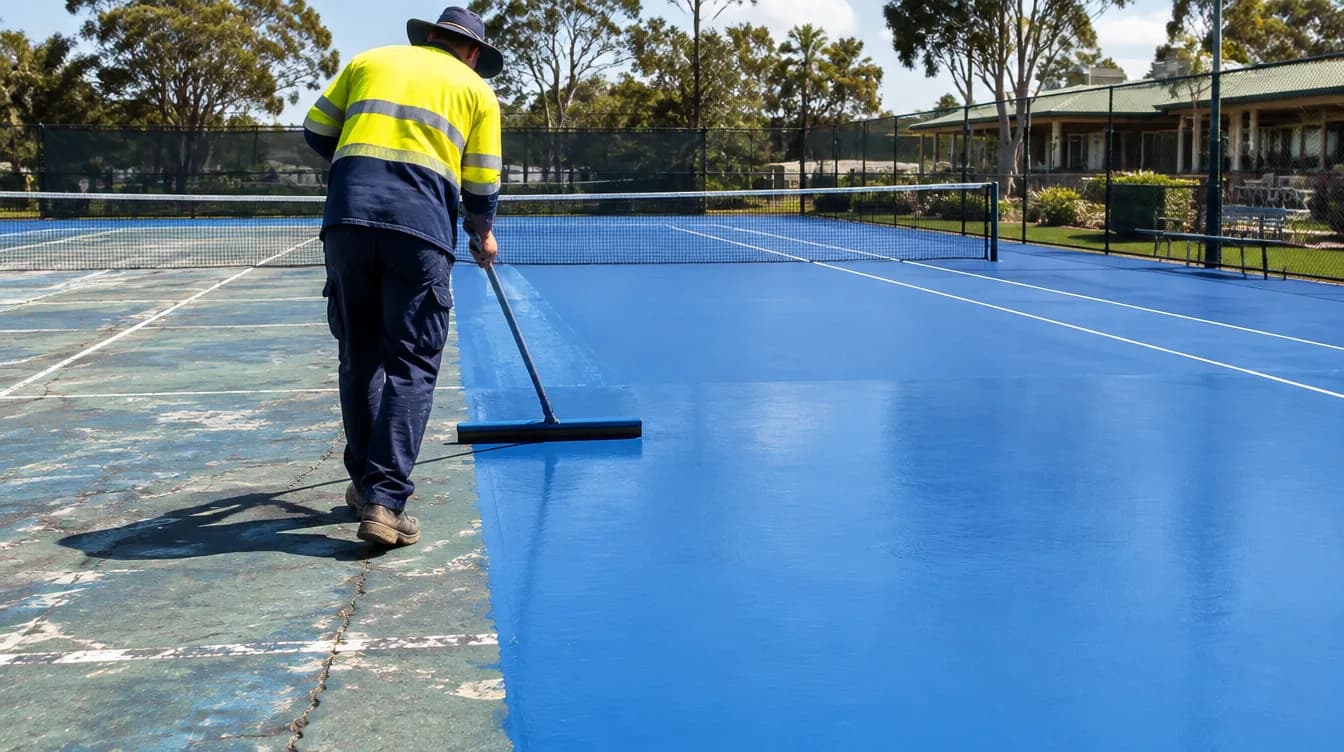
| Acrylic resurface of an existing court | From about $8,000 (Airtasker, 2026) | Crack repairs, number of coats, colours |
| Fencing and lighting | Quoted per site | Height, council conditions, power supply |
Does a tennis court builder need a licence in NSW?
Yes, for most home tennis courts. NSW Government licensing guidance says a contractor licence is required for residential building work valued at more than $5,000 in labour and materials, including GST. Structural landscaping is a listed licence category, and electrical work for court lights needs a licensed electrician regardless of cost. Residential jobs over $5,000 also need a written contract.
Check any builder on Verify NSW or with NSW Fair Trading before you sign. For schools, clubs and community groups, we confirm the licences and approvals that apply before work starts.
Does mine subsidence affect a tennis court in Newcastle?
It can. Parts of Newcastle and Lake Macquarie are in Mine Subsidence Districts, and Subsidence Advisory NSW says anyone building in a district must get its approval before starting work. Approval can come with conditions on design and construction. We check whether your property is in a district and include any requirements in the plan.
- Check the property on the NSW Planning Portal or with Subsidence Advisory NSW
- Applications can go direct or through council as part of a development application
- Conditions may cover slab design, materials and construction method
Do you need council approval for a tennis court in Newcastle?
Many tennis courts in the region need approval from City of Newcastle, Lake Macquarie, Port Stephens or Maitland councils. Some low-impact works may be exempt or complying development under the NSW Codes SEPP, but floodlights, high fencing, retaining walls, earthworks, flood-prone land, bushfire-prone land and heritage areas usually mean a development application.
- Lighting hours and spill into neighbouring yards
- Flood-prone land near the harbour, lake and rivers
- Bushfire-prone land on the bushland fringe
- Heritage conservation areas in older inner suburbs
How do Newcastle's soil and coastal weather affect a court?
Newcastle's ground ranges from coastal sand to clays that move with moisture, plus fill on some older sites, so a tennis court slab must be designed for what's actually there. East coast storms bring heavy rain in short bursts, which calls for good surface falls and drainage. Salt air near the coast means corrosion-resistant fencing and fittings.
We assess the site, and get geotechnical advice where needed, before designing the base. Where a site is in a Mine Subsidence District, that assessment also feeds into any conditions Subsidence Advisory NSW sets, so the slab design, the approval and the quote all line up.
Acrylic or synthetic grass for a Newcastle tennis court?
Both suit Newcastle. Acrylic hard courts give a true bounce and dry fast after storms, while sand-filled synthetic grass is softer and plays in light rain, which clubs like for social tennis. Tennis Australia's Victorian maintenance guides suggest acrylic resurfacing about every 7 to 10 years and synthetic grass about every 10 to 15 years.
| Surface | Strengths | Upkeep guide |
|---|---|---|
| Acrylic hard court | True bounce, fast drying | About every 7 to 10 years |
| Cushioned acrylic | Softer for older players | As for acrylic |
| Synthetic grass | Soft, plays in light rain | About every 10 to 15 years, with brushing and sand |
Who we build tennis courts for in Newcastle
Line Marking Australia arranges Newcastle tennis courts for homeowners, schools, tennis clubs, retirement villages and community groups. Many older club courts in the region are due for resurfacing, and adding pickleball lines at the same time brings in new players as Tennis Australia and the National Pickleball League convert venues into racquet hubs.
See court resurfacing for rebuilds, our tennis court construction guide, or the sports court construction hub.
How we keep every Newcastle tennis court compliant
Every Newcastle tennis court we arrange follows one compliance checklist: council pathway and mine subsidence checks, NSW-licensed builders with public liability insurance, a Before You Dig Australia search, safe work plans for excavation and plant, dust and sediment controls, and court dimensions, slab and lighting built to the relevant standards.
- Council pathway confirmed: exempt, CDC or DA
- Mine Subsidence District checked; Subsidence Advisory NSW approval where required
- Builders holding the NSW contractor licence the work requires
- Before You Dig Australia check before excavation
- Slab to AS 3600 with drainage falls
- Sports lighting to AS 2560.1:2018 and AS 2560.2:2021; spill limited under AS/NZS 4282
- SWMS for excavation and plant; silica dust and sediment controls
- Doubles court of 23.77 m × 10.97 m plus run-off, to Tennis Australia guidance
What do you need from me to quote a tennis court in Newcastle?
To quote a Newcastle tennis court, we need your suburb, what you're building and what's on the site now. Photos, measurements and any survey, subsidence or council information help us check ground conditions and approvals early, so the first quote is close to the final one.
- New court, rebuild or resurface
- Site type: home, school, club, village or community group
- What's there now, slope and drainage
- Any known mine subsidence, flood or bushfire information
- Truck and machinery access
- Preferred surface and extra lines such as pickleball
- Fencing, lighting and power
- Approvals, plans, timing and budget
Key Benefits
NSW-licensed local builders: Newcastle courts built through our licensed network
Subsidence checked: Mine Subsidence District status confirmed before design
Approval pathway sorted: exempt, CDC or DA confirmed with your council
Clear starting prices: new courts from about $40,000; resurfacing from about $8,000
Precise lines: tennis and pickleball lines marked by specialists

Site Inspection
Free assessment and detailed quote

Professional Marking
Expert application with premium materials

Quality Assurance
Final inspection and compliance sign-off
Compliance Standards
NSW contractor licence
Residential work over $5,000 (labour and materials, incl. GST) done by builders holding the right NSW licence, with public liability insurance.
Council and Subsidence Advisory NSW
Council pathway confirmed; Subsidence Advisory NSW approval obtained where the site is in a Mine Subsidence District.
Tennis court dimensions
23.77 m × 10.97 m doubles court plus run-off, to Tennis Australia guidance for club and community courts.
AS 3600 · BYDA
Slab designed for the site's sand, clay or fill with drainage falls; Before You Dig Australia check before excavation.
AS 2560 · AS/NZS 4282
Sports lighting to the AS 2560 series with spill onto neighbours limited under AS/NZS 4282.
WHS, SWMS and silica controls
Safe Work Method Statements for excavation and plant; dust and sediment controls during the build.
Fully Compliant & Certified
All our work meets or exceeds Australian Standards and state road authority requirements
VicRoads Approved
Registered Contractor
$20M Public Liability
$10M Professional Indemnity
5,000+ Projects
Since 2009
Fixed Prices
Not Estimates
AS 1742
Traffic Control Devices
Specifies line colours, widths, arrow designs, and placement for road markings. Ensures all traffic control devices meet national safety standards.
AS/NZS 2890
Parking Facilities
Covers bay dimensions (2.4m × 5.4m standard, 2.4m × 5.4m accessible plus a 2.4m shared zone), aisle widths, and traffic flow requirements for compliant parking areas.
AS 4586
Slip Resistance
Defines slip resistance classifications (P rating) for pedestrian surfaces. Critical for wet areas, ramps, and high-traffic zones.
AS/NZS 1428
Access & Mobility
Sets requirements for accessible parking bays, tactile indicators, and mobility access. Essential for DDA compliance and accessibility audits.
What Our Clients Say
Results based on typical project outcomes. Individual results may vary.
Upload your site plans for a detailed quote within 48 hours
Get an accurate, fixed-price quote tailored to your specific project requirements
Frequently Asked Questions
A new tennis court in Newcastle starts from about $40,000 (Oneflare cost guide, 2026), and an acrylic resurface from about $8,000 (Airtasker, 2026). Ground conditions, subsidence requirements, slope and lighting change the price, so Line Marking Australia quotes each site.
Line Marking Australia arranges tennis court construction in Newcastle, Lake Macquarie and the lower Hunter through its network of NSW-licensed local builders, managing the slab, surface, lines, nets, fencing and lighting as one job.
It can. Parts of Newcastle and Lake Macquarie are Mine Subsidence Districts, where Subsidence Advisory NSW approval is needed before building. Line Marking Australia checks your property and includes any conditions in the tennis court plan.
For most home courts, yes. NSW requires a contractor licence for residential building work valued at more than $5,000 in labour and materials, including GST, and a licensed electrician for any lighting work.
Many Newcastle tennis courts need a development application, especially with lights, high fencing, retaining walls or flood, bushfire or heritage controls. Some low-impact works may be exempt or complying development under the NSW Codes SEPP.
Both suit Newcastle. Acrylic dries quickly after storms and gives a true bounce; synthetic grass is softer and plays in light rain. Tennis Australia guidance suggests acrylic recoats about every 7 to 10 years and synthetic grass about every 10 to 15.
Related Services

Court Resurfacing
Learn more about this service
Sports Court Construction
Learn more about this service
Sports Court Lighting
Learn more about this service
Sports Courts for Sports Clubs
Learn more about this service
Tennis Court Construction
Learn more about this service
Tennis Court to Pickleball Conversion
Learn more about this service
More Sports & Playground Line Marking Services
Ready to Get Your Line Marking Sorted?
Upload your site plans and receive a fixed-price quote within 48 hours. No surprises, no cost blowouts, just clear pricing you can take to your committee or manager.
Or call us directly: 0417 460 236