

Padel Courts for Clubs
Glass-walled padel courts for tennis and sports clubs, built new or on an under-used tennis court, with lighting, approvals and grant-ready quotes.
Jamie (24/7 quotes): 0468 069 002AS 1742.2 Compliant
Fully Insured
24/7 Availability

15+ Years
Get FREE Quote
Fixed-Price Quote Within 48 Hours
Trusted by 5,000+ businesses
VicRoads approved · AS/NZS compliant · $20M insured
Compliance-Ready Guarantee: every job is marked to AS/NZS 2890 & AS 1742, dimensionally verified, and delivered with full compliance documentation, backed by our 12-month workmanship guarantee.
Last updated:
What is Padel Courts for Clubs?
Line Marking Australia builds padel courts for tennis and sports clubs across Australia, either on new ground or on an under-used tennis court. A club padel court starts from about $60,000 (Sydney club build reported in the trade press), covering the slab, glass and mesh enclosure, playing surface, lines and nets.
Padel is the racquet sport clubs keep asking us about. It's played in doubles inside a walled court, the ball comes off the glass, and new players are rallying within minutes.
A padel court is a bigger investment than a re-line, so committees want the full picture before they vote. Here it is.
Why are tennis and sports clubs adding padel courts?
Tennis and sports clubs are adding padel courts because the sport is social, easy to pick up and fits a lot of play into a small footprint. A padel court is 20 m by 10 m, so it sits in less space than a tennis court with run-off, and four players share each booking, which suits court-hire income.
Clubs tell us padel brings in a different crowd: friends who want a quick, sociable game after work, and tennis members who want something new. Tennis Australia and the National Pickleball League are turning tennis venues into multi-sport racquet hubs, and padel often sits in the same plan.
How much does a padel court cost for a club?
A club padel court in Australia starts from about $60,000, based on a Sydney club build reported in the trade press. The final price depends on the ground, whether a sound slab already exists, the glass and frame system, the playing surface, lighting and any shelter. We quote every club padel court for its own site.
| Cost item | What drives it |
|---|---|
| Ground works and slab | Slope, soil, drainage and whether an old tennis slab can be reused |
| Glass and mesh enclosure | Panel system, frame finish and wind rating for your site |
| Playing surface | Synthetic turf with infill, or another court surface |
| Lighting | Pole or frame-mounted lights, design to AS 2560, spill control |
| Extras | Paths, seating, shade, booking gates and signage |
We itemise each line so the committee can see where the money goes and decide what to include in stage one.
Can we build a padel court on an old tennis court?
Often, yes. A padel court's 20 m by 10 m footprint is smaller than a tennis court with run-off, so a club can sometimes place one padel court within an existing tennis court area. The old slab must be level, sound and drain well enough to carry the enclosure footings. We measure and test before recommending it.
Converting a tennis court means losing that tennis court, so most clubs pick the least-booked one. Others build padel on spare land beside the courts and keep every tennis court. We can price both options side by side.
What does a club padel court include?
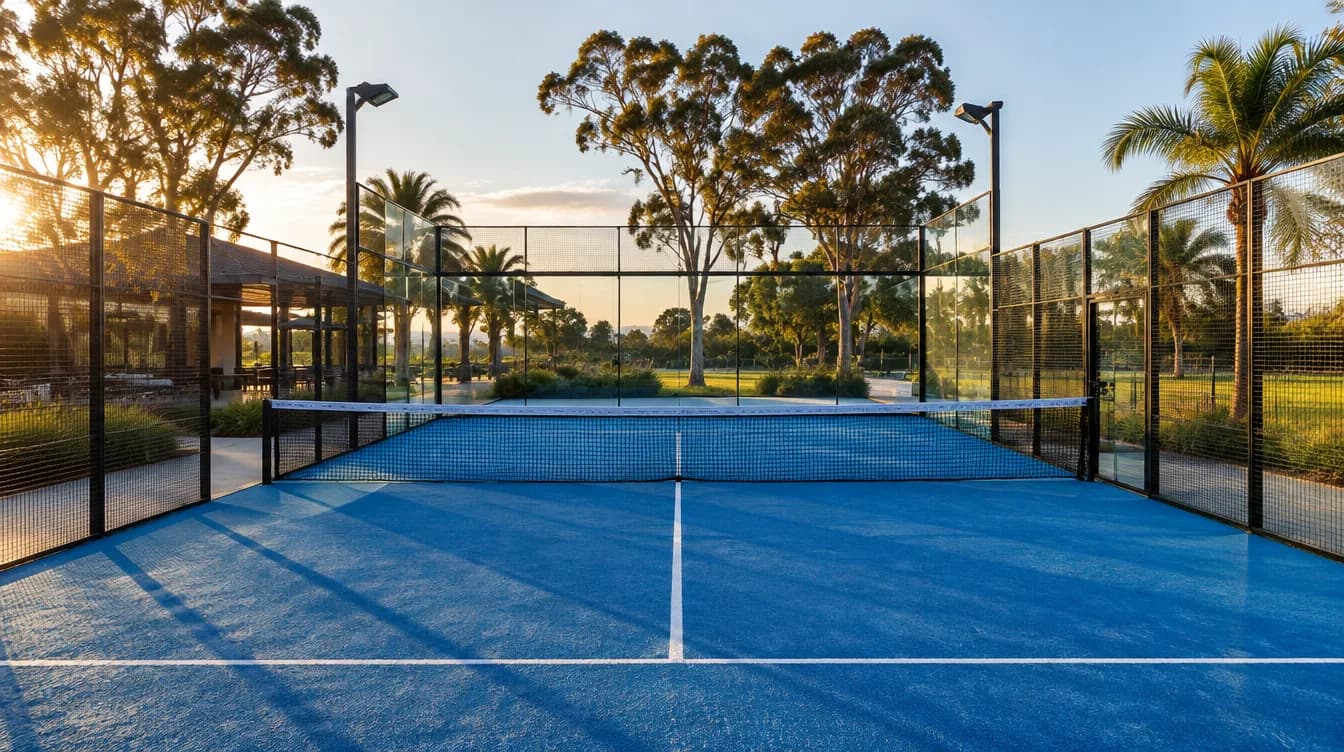
A club padel court includes a level, well-drained base, a framed enclosure of toughened glass walls and steel mesh, a playing surface, painted or inlaid lines, a centre net and posts, and access doors. Most clubs also add lighting for night play, and some add shelter, seating and a path from the clubhouse.
- Base: a concrete slab with falls for drainage, or an existing slab repaired
- Enclosure: glass end walls and mesh side panels on a steel frame
- Surface: commonly synthetic turf with infill, chosen for grip and ball bounce
- Lines and net: marked to the 20 m × 10 m court
- Lighting: designed for even light with low glare inside the glass
Do club padel courts need council approval?
A club padel court often needs council approval in Australia, because the glass and mesh enclosure is a structure, and lighting, fencing height and noise near homes are common council triggers. Many clubs also lease council land, so landlord consent matters too. We check your council's requirements and supply drawings before the final quote.
The ball hitting glass is louder than a tennis rally, so courts placed away from houses, with sensible playing hours, are easier to get approved.
Can grants help pay for a club padel court?
Grants can help some clubs fund a padel court, especially when it's part of a wider club upgrade. Examples of club funding include the SA Community Facilities Program, which funded Mount Gambier Tennis Club $431,000, and Queensland's Gambling Community Benefit Fund, which offers up to $35,000 for club resurfacing, lighting and fencing.
Programs change each round, so check eligibility on the official site first. We supply the itemised quote, layout and scope that assessors expect, and we can split the job into stages that match the amounts on offer.
How long does a club padel court take to build?
A club padel court usually takes a few weeks on site once approvals and the enclosure order are in place. New concrete must cure before the frame and surface go on, and wet weather adds days. Reusing a sound tennis slab can shorten the job. We give you a staged program with the quote.
- Site measure, layout drawing and committee sign-off
- Council and landlord approvals
- Earthworks, drainage and slab, or slab repairs
- Enclosure frame, glass and mesh installed
- Surface laid, lines marked, net fitted
- Lighting commissioned and handover
How we keep every club padel build compliant
Every club padel court we build is planned against council rules, safety laws and the right Australian Standards. That means approvals checked early, underground services located before digging, safe work methods for excavation and lifting, concrete to AS 3600, and lighting designed to AS 2560 with spill controlled for neighbours.
- Local council planning or building approval checked for the enclosure, lighting, fencing and noise
- Before You Dig Australia check before excavation
- Safe Work Method Statements for excavation and mobile plant
- Silica dust controls when cutting or grinding concrete; sediment and stormwater controls on site
- Concrete slabs to AS 3600 with drainage falls
- Sports lighting to AS 2560.1:2018 and AS 2560.2:2021, with spill limited under AS/NZS 4282
- Accessible paths from the clubhouse considered against AS 1428.1
- Builders who hold the licence your state requires, with public liability insurance
Our padel court construction page covers padel builds in general, and our sports courts for sports clubs page shows the other courts and upgrades we deliver for clubs, including sports court lighting.
What do you need from us to quote a club padel court?
To quote a club padel court, Line Marking Australia needs to know where the court will go, what's on the ground now, how many courts you want and whether lighting is included. Photos, a site plan, your lease arrangements and any grant deadline help us return an accurate, itemised quote the committee can act on.
- Number of padel courts, and new build or on an existing tennis court
- Location on site and what's there now (grass, asphalt, acrylic court)
- Slope, drainage and any trees or services nearby
- Machinery access through the club gates
- Preferred surface and enclosure finish
- Lighting, shelter, seating and paths
- Council, lease or landlord approvals already in place
- Plans, photos, timing, budget and grant deadline
Key Benefits
New build or conversion: on spare land or an under-used tennis court
Complete court: slab, glass enclosure, surface, lines, net and lighting
From about $60,000: with every item listed for the committee
Approvals handled early: council, landlord and noise questions answered up front
Grant-ready: staged scopes and layouts for applications

Site Inspection
Free assessment and detailed quote

Professional Marking
Expert application with premium materials

Quality Assurance
Final inspection and compliance sign-off
Compliance Standards
Local council approval
Enclosure, lighting, fencing and noise checked with council, plus landlord consent on leased land.
Padel court dimensions
20 m × 10 m playing area with lines, net and access planned to suit.
AS 3600 · BYDA
Slabs to AS 3600 with drainage falls; Before You Dig Australia check before excavation.
AS 2560 · AS/NZS 4282
Sports lighting to AS 2560.1:2018 and AS 2560.2:2021 with spill limited under AS/NZS 4282.
WHS, SWMS & silica
SWMS for excavation and mobile plant, dust controls and sediment controls on site.
Fully Compliant & Certified
All our work meets or exceeds Australian Standards and state road authority requirements
VicRoads Approved
Registered Contractor
$20M Public Liability
$10M Professional Indemnity
5,000+ Projects
Since 2009
Fixed Prices
Not Estimates
AS 1742
Traffic Control Devices
Specifies line colours, widths, arrow designs, and placement for road markings. Ensures all traffic control devices meet national safety standards.
AS/NZS 2890
Parking Facilities
Covers bay dimensions (2.4m × 5.4m standard, 2.4m × 5.4m accessible plus a 2.4m shared zone), aisle widths, and traffic flow requirements for compliant parking areas.
AS 4586
Slip Resistance
Defines slip resistance classifications (P rating) for pedestrian surfaces. Critical for wet areas, ramps, and high-traffic zones.
AS/NZS 1428
Access & Mobility
Sets requirements for accessible parking bays, tactile indicators, and mobility access. Essential for DDA compliance and accessibility audits.
What Our Clients Say
Results based on typical project outcomes. Individual results may vary.
Upload your site plans for a detailed quote within 48 hours
Get an accurate, fixed-price quote tailored to your specific project requirements
Frequently Asked Questions
A club padel court starts from about $60,000, based on a Sydney club build reported in the trade press. Line Marking Australia quotes each court for its site, because slab condition, the enclosure system, surface and lighting change the final price.
Often, yes. A padel court is 20 m by 10 m, smaller than a tennis court with run-off. Line Marking Australia checks that the old slab is level, sound and drains well enough to carry the enclosure before recommending a conversion.
A padel court's playing area is 20 m by 10 m, enclosed by glass end walls and mesh side panels. Line Marking Australia also plans access doors, paths and space around the enclosure so players and spectators can move safely.
Usually it does. The glass enclosure is a structure, and lighting, fence height and noise near homes are common council triggers. Line Marking Australia checks your council's rules and landlord consent before the final quote.
Padel can be louder than tennis because the ball hits glass walls. Line Marking Australia recommends placing club padel courts away from houses and agreeing sensible playing hours, which also makes council approval easier.
Some clubs use grants, especially as part of a wider upgrade. Programs such as the SA Community Facilities Program and Queensland's Gambling Community Benefit Fund support club facilities. Line Marking Australia supplies itemised, staged quotes for applications.
A padel court usually takes a few weeks on site once approvals and the enclosure order are in place, with concrete curing and weather adding time. Line Marking Australia provides a staged program with every club quote.
Related Services

Padel Court Construction
Learn more about this service
Sports Court Construction
Learn more about this service
Sports Court Fencing
Learn more about this service
Sports Court Lighting
Learn more about this service
Sports Courts for Sports Clubs
Learn more about this service
Ready to Get Your Line Marking Sorted?
Upload your site plans and receive a fixed-price quote within 48 hours. No surprises, no cost blowouts, just clear pricing you can take to your committee or manager.
Or call us directly: 0417 460 236