

Court Lighting for Sports Clubs
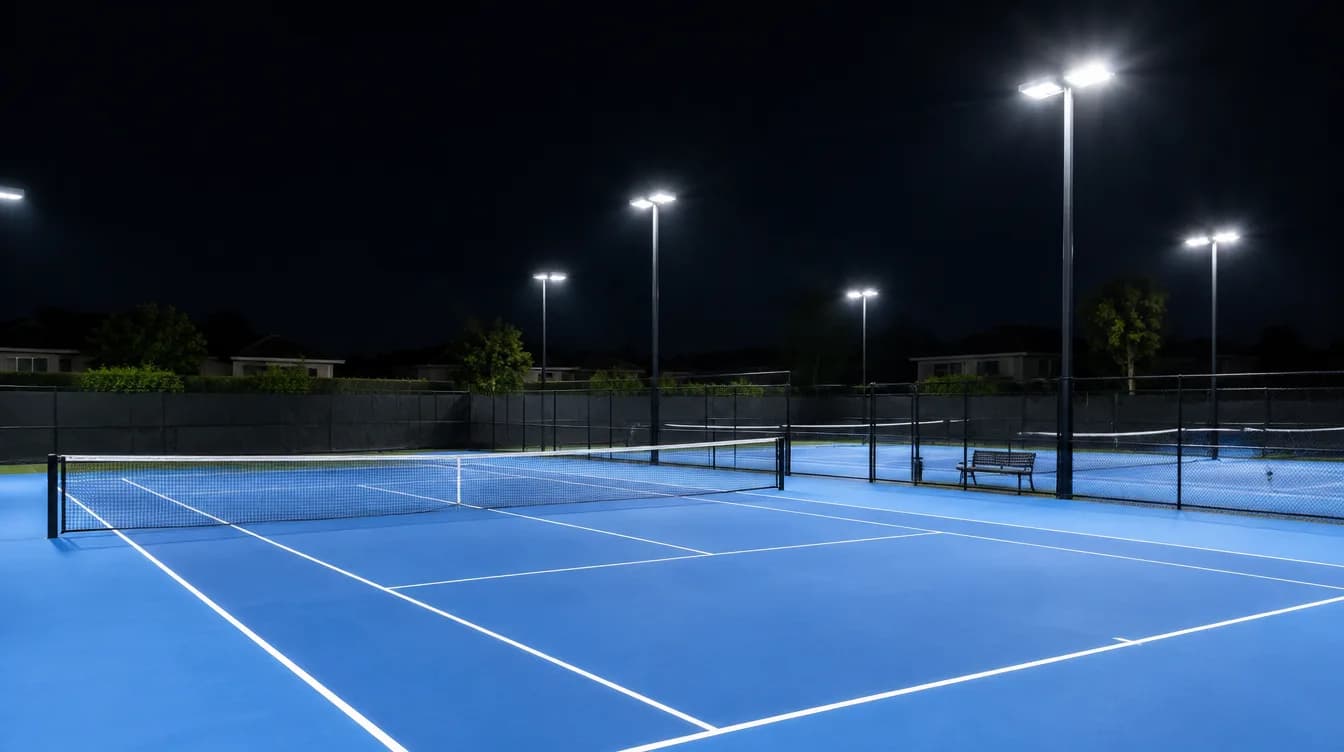
LED court lighting that opens up night competitions and social play, designed to AS 2560 and kept off neighbours' homes under AS/NZS 4282.
Jamie (24/7 quotes): 0468 069 002AS 1742.2 Compliant
Fully Insured
24/7 Availability

15+ Years
Get FREE Quote
Fixed-Price Quote Within 48 Hours
Trusted by 5,000+ businesses
VicRoads approved · AS/NZS compliant · $20M insured
Compliance-Ready Guarantee: every job is marked to AS/NZS 2890 & AS 1742, dimensionally verified, and delivered with full compliance documentation, backed by our 12-month workmanship guarantee.
Last updated:
What is Court Lighting for Sports Clubs?
Line Marking Australia delivers LED court lighting for sports clubs across Australia, so tennis, pickleball, netball and padel courts can host night competitions. Every lighting job is designed to the AS 2560 sports lighting standards, with light spill controlled under AS/NZS 4282, and quoted per site because pole count and power supply vary.
Lights change what a club can offer. Weeknight competitions, after-work social play and winter coaching all depend on them, and court-hire income follows.
They also bring the most questions from council and neighbours. Here's how we plan club lighting so it gets approved and works well on court.
Why are clubs adding court lighting?
Clubs add court lighting because most members can only play after work, and in winter it's dark well before then. Lit courts let a club run night competitions, coaching and social sessions, take more court bookings and share courts with pickleball or padel groups without squeezing tennis out of prime daytime slots.
- More playing hours from the same courts
- Night competitions and pennant matches
- Coaching programs that run all year
- Room for new sports, such as pickleball, on shared courts
What Australian Standard applies to court lighting?
Sports court lighting in Australia is designed to the AS 2560 series: AS 2560.1:2018 covers general principles for sports lighting, and AS 2560.2:2021 covers specific applications. Light falling outside the court, onto homes and roads, is assessed under AS/NZS 4282, the standard for the obtrusive effects of outdoor lighting. Councils often ask for both.
Your sport's governing body may also publish lighting guidance for club and competition play. For tennis, Tennis Australia guidance for club and community tennis is the usual reference. We design to the level your club needs: social play, club competition or higher.
How much does court lighting cost for a club?
Court lighting for a club is quoted per site, because the cost depends on how many courts you light, the number and height of poles, the level of light your competition needs, footings, cabling distance and whether the switchboard needs an upgrade. We itemise poles, fittings, trenching and electrical work so the committee can compare options.
| Cost driver | Why it matters |
|---|---|
| Number of courts lit | Lighting a bank of courts together shares poles and cabling |
| Light level required | Competition play needs more light than social play |
| Pole number and height | Taller poles with better optics usually mean less spill |
| Power supply | Old switchboards and long cable runs add electrical work |
| Controls | Timers, booking-linked switching and dimming |
Do clubs need council approval for court lighting?
Most clubs need council approval for new court lighting in Australia. Councils commonly look at pole height, light spill onto homes, hours of use, glare for drivers and any heritage or flood overlays. A lighting design showing spill levels under AS/NZS 4282 usually forms part of the application. We check your council's requirements before quoting.
If your club leases council land, the landlord's consent is usually needed as well. Talking to neighbours early, and agreeing a lights-off time, helps the application go smoothly.
How do you stop court lights spilling onto neighbours?
Court lights are kept off neighbours' homes through careful design: modern LED fittings with sharp cut-off optics, correct pole positions and heights, and aiming that keeps light on the court. The design is checked against AS/NZS 4282. Timers and auto-off controls make sure lights don't stay on after play finishes.
- Asymmetric LED fittings that throw light forward, not up
- Poles placed to suit the court layout and nearby houses
- Shields on fittings closest to boundaries where needed
- Curfew timers and booking-linked switching
Can grants pay for club court lighting?
Yes, lighting is one of the most common club grant projects in Australia. Queensland's Gambling Community Benefit Fund offers up to $35,000 for club resurfacing, lighting and fencing, and the SA Community Facilities Program funded Mount Gambier Tennis Club $431,000. Federal and council grants also support community sport facilities.
We supply an itemised quote, lighting layout and scope for your application. Check each program's current round on its official site, because criteria and closing dates change.
Which club courts and sports can be lit?
Any outdoor club court can be lit: tennis, pickleball, netball, basketball, padel and multi-sport courts. Each sport plays the ball at different heights and speeds, so the lighting design changes with it. Shared courts are designed for the most demanding sport on them, so every group gets even, glare-free light.
- Tennis: high lobs and fast serves need even light well above the court
- Pickleball: smaller courts, often several per tennis slab, lit as one bank
- Netball and basketball: even light across the whole court for training and fixtures
- Padel: frame-mounted or pole lights designed to limit glare off the glass walls
Should we upgrade old lights to LED?
Upgrading old metal halide court lights to LED usually makes sense for clubs. LED fittings use less power, switch on instantly without warm-up, and give more even light with less spill. Existing poles can sometimes be reused if they're structurally sound and in the right place, which keeps the upgrade cost down.
We check pole condition, footings and the switchboard first, then quote both a like-for-like LED swap and a redesigned layout if the old one leaves dark spots.
How we keep every club lighting job compliant
Every club court lighting job we deliver is designed and installed against the relevant Australian Standards, council conditions and safety laws. That means AS 2560 for light on the court, AS/NZS 4282 for light off the court, services located before trenching, and licensed electrical and construction trades on site.
- Sports lighting to AS 2560.1:2018 and AS 2560.2:2021
- Obtrusive light assessed under AS/NZS 4282
- Local council planning or building approval checked, including hours of use and overlays
- Before You Dig Australia check before trenching and pole footings
- Safe Work Method Statements for excavation and mobile plant such as elevated work platforms
- Pole footings in concrete to AS 3600
- Builders and trades who hold the licence your state requires, with public liability insurance
See our sports court lighting page for lighting on any court, and our sports courts for sports clubs page for resurfacing, fencing and new courts. If you're re-lining after the upgrade, our tennis court line marking crews can help.
What do you need from us to quote club court lighting?
To quote club court lighting, Line Marking Australia needs to know which courts you want lit, the sports and level of play, what lighting and power you have now, and how close the nearest homes are. A site plan, photos of the switchboard and existing poles, and any council or grant deadlines help us quote accurately.
- Number of courts and the sports played on each
- Level of play: social, club competition or higher
- Existing lights, poles and switchboard condition
- Distance to nearest homes and roads
- Preferred controls: timers, booking-linked switching
- Machinery access for elevated work platforms and trenching
- Council, lease or landlord approvals already in place
- Plans, photos, timing, budget and grant deadline
Key Benefits
Night play: competitions, coaching and social sessions after dark
Standards-based design: AS 2560 on court, AS/NZS 4282 off court
Neighbour-friendly: cut-off LED optics, aiming and curfew timers
LED upgrades: reuse sound poles where possible
Grant-ready quotes: itemised layouts and scopes for applications

Site Inspection
Free assessment and detailed quote

Professional Marking
Expert application with premium materials

Quality Assurance
Final inspection and compliance sign-off
Compliance Standards
AS 2560.1:2018 · AS 2560.2:2021
Court lighting designed to the Australian sports lighting standards.
AS/NZS 4282
Obtrusive light onto homes and roads assessed and controlled.
Local council approval
Pole height, hours of use, spill and overlays checked before the final quote.
BYDA · AS 3600
Services located before trenching; pole footings in concrete to AS 3600.
WHS & SWMS
SWMS for excavation and elevated work platforms; licensed trades with insurance.
Fully Compliant & Certified
All our work meets or exceeds Australian Standards and state road authority requirements
VicRoads Approved
Registered Contractor
$20M Public Liability
$10M Professional Indemnity
5,000+ Projects
Since 2009
Fixed Prices
Not Estimates
AS 1742
Traffic Control Devices
Specifies line colours, widths, arrow designs, and placement for road markings. Ensures all traffic control devices meet national safety standards.
AS/NZS 2890
Parking Facilities
Covers bay dimensions (2.4m × 5.4m standard, 2.4m × 5.4m accessible plus a 2.4m shared zone), aisle widths, and traffic flow requirements for compliant parking areas.
AS 4586
Slip Resistance
Defines slip resistance classifications (P rating) for pedestrian surfaces. Critical for wet areas, ramps, and high-traffic zones.
AS/NZS 1428
Access & Mobility
Sets requirements for accessible parking bays, tactile indicators, and mobility access. Essential for DDA compliance and accessibility audits.
What Our Clients Say
Results based on typical project outcomes. Individual results may vary.
Upload your site plans for a detailed quote within 48 hours
Get an accurate, fixed-price quote tailored to your specific project requirements
Frequently Asked Questions
Sports court lighting is designed to AS 2560.1:2018 and AS 2560.2:2021, while light spilling onto homes and roads is assessed under AS/NZS 4282. Line Marking Australia designs club court lighting to both, which councils commonly ask to see.
Club court lighting is quoted per site, because pole numbers, light levels, cabling distance and switchboard upgrades vary. Line Marking Australia itemises poles, fittings, trenching and electrical work so the committee can compare options.
Most do. Councils look at pole height, light spill, hours of use, glare for drivers and overlays. Line Marking Australia checks your council's requirements and supplies a lighting design showing spill under AS/NZS 4282.
Yes. Queensland's Gambling Community Benefit Fund offers up to $35,000 for club resurfacing, lighting and fencing, and state and council programs support club facilities. Line Marking Australia provides itemised quotes and layouts for applications.
Line Marking Australia uses LED fittings with sharp cut-off optics, careful pole placement and aiming, shields near boundaries and curfew timers. Designs are checked against AS/NZS 4282 so light stays on the court.
Usually, yes. LED court lights use less power, switch on instantly and give more even light with less spill. Line Marking Australia checks whether existing poles can be reused, which can lower the cost of the upgrade.
Related Services

Court Resurfacing
Learn more about this service
Sports Court Construction
Learn more about this service
Sports Court Lighting
Learn more about this service
Sports Courts for Sports Clubs
Learn more about this service
Tennis Court Line Marking?
Learn more about this service
Ready to Get Your Line Marking Sorted?
Upload your site plans and receive a fixed-price quote within 48 hours. No surprises, no cost blowouts, just clear pricing you can take to your committee or manager.
Or call us directly: 0417 460 236