

Multi-Sport Courts for Early Learning Centres
Small, soft and colourful courts for under-fives: low hoops, ball-game lines and safe edges, built with minimal disruption to the centre.
Jamie (24/7 quotes): 0468 069 002AS 1742.2 Compliant
Fully Insured
24/7 Availability

15+ Years
Get FREE Quote
Fixed-Price Quote Within 48 Hours
Trusted by 5,000+ businesses
VicRoads approved · AS/NZS compliant · $20M insured
Compliance-Ready Guarantee: every job is marked to AS/NZS 2890 & AS 1742, dimensionally verified, and delivered with full compliance documentation, backed by our 12-month workmanship guarantee.
Last updated:
What is Multi-Sport Courts for Early Learning Centres?
Line Marking Australia builds small multi-sport courts for early learning centres across Australia. We design compact courts with soft, forgiving surfaces, low adjustable hoops, bright ball-game and movement lines and smooth, safe edges, and we schedule noisy work outside operating hours where possible. Every early learning court is quoted per site to suit the outdoor space.
Young children learn through movement: running, throwing, kicking, balancing and taking turns. A small, well-designed court gives educators a dedicated space for ball skills and active games, separate from sandpits and climbing equipment.
Centre directors, owners and educators ask us similar questions before they build. Here are our answers.
What is a multi-sport court for an early learning centre?
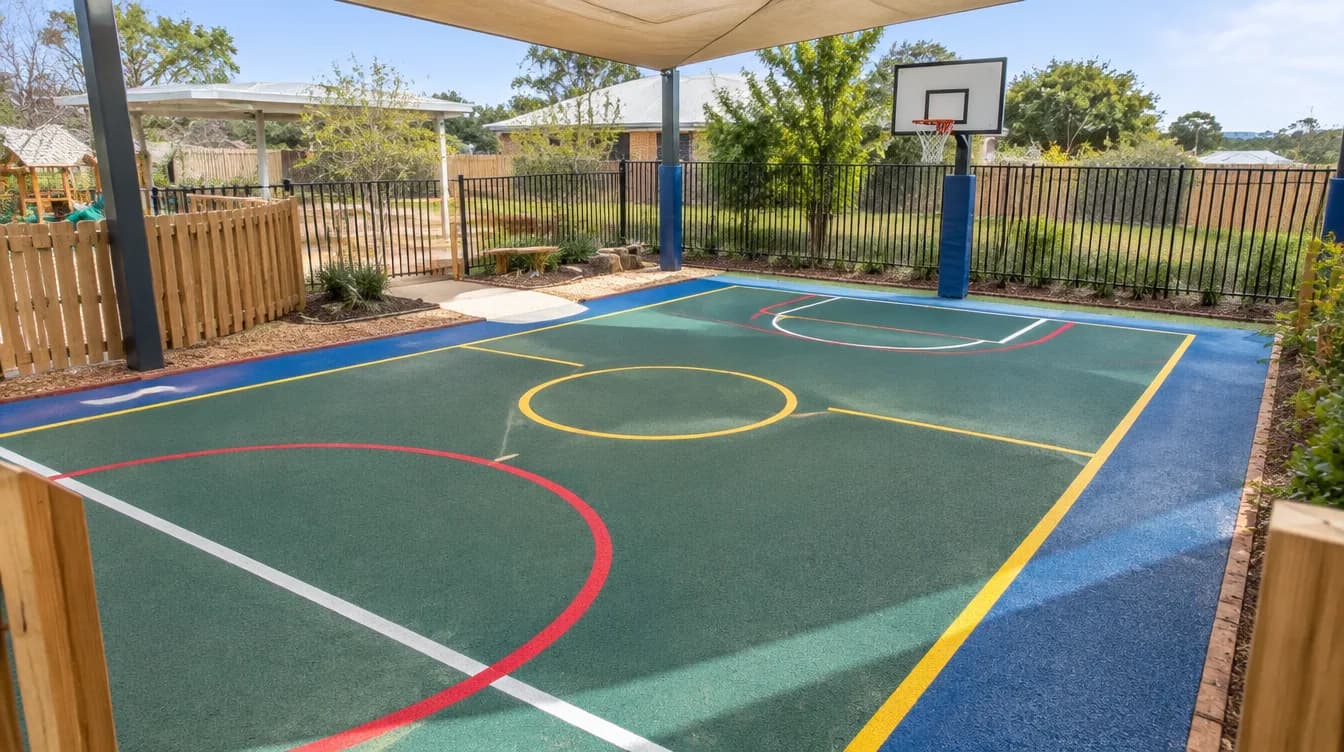
A multi-sport court for an early learning centre is a small, flat play surface marked with simple games and fitted with child-sized equipment. It usually includes a low hoop, a target or rebound panel, and painted lines for running, hopping, ball skills and group games. It is designed for under-fives, not for regulation sport.
- Low, height-adjustable basketball hoop
- Coloured circles, lines and paths for movement games
- Space for throwing, catching, kicking and rolling balls
- Room for educators to run group activities
What size court suits an early learning centre?
An early learning centre court should fit the outdoor space and the group sizes educators run, rather than any sport's regulation dimensions. Most centres choose a compact court that leaves room for sandpits, gardens and climbing equipment. We mark out options on site so educators can picture how children will move around it.
| Common court we build | Good for | Typical features |
|---|---|---|
| Small ball-skills pad | Small groups, tight yards | Low hoop, target, a few painted games |
| Medium play court | Most centres | Hoop, movement paths, circle games |
| Larger multi-use court | Big centres and OSHC sharing the yard | Hoops, mini-game lines, rebound panel |
What is the safest surface for a childcare court?
The safest surface for an early learning centre court is soft and forgiving underfoot while still letting a ball bounce. Cushioned acrylic and rubber surfaces suit ball play and soften falls, and synthetic grass is soft for running games but bounces poorly. Hard concrete and asphalt are durable but unforgiving for small children.
| Surface | Ball bounce | Underfoot |
|---|---|---|
| Cushioned acrylic | Good | Softer than a standard hard court |
| Poured or tiled rubber | Fair | Very forgiving |
| Synthetic grass | Poor | Soft for running and rolling games |
| Plain concrete or asphalt | Very good | Hard; least forgiving |
Choose lighter colours to keep surface temperatures down, and plan shade over the court for Australian summers.
Which games and lines suit under-fives?
Lines for under-fives should be simple, bright and easy to follow: coloured circles for group games, wavy and straight paths for walking, running and riding, number and letter shapes, target areas for throwing and a short hopscotch. Fewer, bolder markings work better than a busy court with overlapping sports lines.
Our crews paint alphabet trails and playground games for schools, and we bring the same approach to early learning courts. See school playground line marking.
What equipment goes on an early learning court?
Early learning courts usually have a low, height-adjustable basketball hoop, soft balls, a target or rebound panel and sometimes a small net for throwing games. Fixed equipment should have padded posts, no sharp edges and footings flush with the surface. Removable items keep the court flexible for other activities.
How much does a court for an early learning centre cost?
An early learning centre court is quoted per site, because cost depends on the size, the base, the surface, equipment, shade and how much existing paving or grass needs removing. Converting an existing concrete area costs less than building a new slab. Line Marking Australia itemises each part so owners can plan the spend.
- Court size and base work
- Cushioned acrylic, rubber or synthetic grass
- Number of painted games and colours
- Hoops, targets and rebound panels
- Shade, edging and access for equipment
How do you keep a childcare court cool and shaded?
An early learning centre court stays cooler and safer in summer with shade overhead and a light-coloured surface. Shade sails or structures over the court and seating protect children from UV, and lighter acrylic or rubber colours absorb less heat than dark surfaces. Educators can then use the court for longer through the day.
Shade structures can need council approval, so we check that early and plan footings around the court layout before the surface goes down.
How do you build without disrupting the centre?
We build early learning courts with minimal disruption by scheduling noisy work outside operating hours or during closure periods where possible, fencing the work zone away from children, keeping entries and pick-up routes clear and controlling dust. Small courts are quick builds, and the centre has one contact throughout the job.
- Work zone fenced and separated from play areas
- Deliveries timed away from drop-off and pick-up
- Dust controls, including water suppression when cutting concrete
- Site left clean and safe at the end of every day
Do early learning centres need approval to build a court?
A small court may need council approval if it involves earthworks, retaining walls, shade structures, fencing over about 2 m, lighting or drainage changes, or the site has heritage or flood overlays. Leased premises may also need the landlord's consent. Line Marking Australia checks council requirements and supplies drawings and scopes.
How we keep every early learning court build compliant
Every early learning court we build follows clear compliance steps. We check council requirements, run a Before You Dig Australia search, work under Work Health and Safety laws with Safe Work Method Statements, control silica dust and sediment, use crews with Working with Children checks and use licensed builders with public liability insurance.
- Council check for earthworks, shade, fencing, drainage and overlays
- BYDA search before excavation
- SWMS for excavation and mobile plant
- Silica dust controls: water suppression or on-tool vacuum extraction
- Sediment and stormwater controls
- Working with Children checks for crews
- Slip-resistant textured finishes; step-free access designed with AS 1428.1 in mind
Our sports courts for early learning centres page covers every option, and multi-sport court construction covers larger courts.
What do you need from the centre to quote a court?
To quote an early learning centre court, we need to understand the outdoor space, the ages and group sizes using it and when work can happen. Send the details below with photos and a rough plan of the yard, and we'll visit outside busy times before giving you an itemised quote.
- New court, resurfacing, or converting existing paving
- Rough size and location in the yard
- What's on the ground now and any slope or drainage issues
- Access for small machinery
- Surface preference: cushioned acrylic, rubber or synthetic grass
- Games and lines you'd like, and equipment
- Shade, fencing and edging
- Closure periods, landlord or council approvals, photos and budget
Key Benefits
Built for under-fives: low hoops and simple, bold games
Soft surfaces: cushioned acrylic, rubber or synthetic grass
Low disruption: work outside operating hours where possible
Safe details: padded posts, flush footings, smooth edges
Itemised quotes: every part priced for your yard

Site Inspection
Free assessment and detailed quote

Professional Marking
Expert application with premium materials

Quality Assurance
Final inspection and compliance sign-off
Compliance Standards
Working with Children checks
Crews hold Working with Children checks; work zones kept separate from children.
Local council approval
Earthworks, shade, fencing, drainage and overlays checked.
Before You Dig Australia
Underground services located before excavation.
WHS & silica controls
SWMS for excavation and plant; dust controls when cutting concrete.
Slip-resistant finish
Soft, textured surfaces for grip and safer falls.
Fully Compliant & Certified
All our work meets or exceeds Australian Standards and state road authority requirements
VicRoads Approved
Registered Contractor
$20M Public Liability
$10M Professional Indemnity
5,000+ Projects
Since 2009
Fixed Prices
Not Estimates
AS 1742
Traffic Control Devices
Specifies line colours, widths, arrow designs, and placement for road markings. Ensures all traffic control devices meet national safety standards.
AS/NZS 2890
Parking Facilities
Covers bay dimensions (2.4m × 5.4m standard, 2.4m × 5.4m accessible plus a 2.4m shared zone), aisle widths, and traffic flow requirements for compliant parking areas.
AS 4586
Slip Resistance
Defines slip resistance classifications (P rating) for pedestrian surfaces. Critical for wet areas, ramps, and high-traffic zones.
AS/NZS 1428
Access & Mobility
Sets requirements for accessible parking bays, tactile indicators, and mobility access. Essential for DDA compliance and accessibility audits.
What Our Clients Say
Results based on typical project outcomes. Individual results may vary.
Upload your site plans for a detailed quote within 48 hours
Get an accurate, fixed-price quote tailored to your specific project requirements
Frequently Asked Questions
An early learning centre court should suit the outdoor space and group sizes, not regulation sport sizes. Most centres choose a compact court beside sandpits and gardens. Line Marking Australia marks out options on site first.
Cushioned acrylic and rubber are the safest childcare court surfaces for ball play because they soften falls and still bounce a ball. Synthetic grass is soft but bounces poorly. Line Marking Australia recommends lighter colours to reduce heat.
An early learning court suits simple, bright markings: circles for group games, paths for running and riding, number and letter shapes, throwing targets and a short hopscotch. Line Marking Australia keeps markings bold and uncluttered.
An early learning centre court is quoted per site, depending on size, base, surface, painted games, equipment and shade. Line Marking Australia itemises each part, and converting existing concrete costs less than a new slab.
Yes, with care. Line Marking Australia schedules noisy work outside operating hours or during closures where possible, fences the work zone away from children and keeps drop-off and pick-up routes clear.
Yes. Line Marking Australia crews working at early learning centres hold Working with Children checks, and the work zone is fenced and kept separate from children and play areas throughout the job.
A low, height-adjustable hoop, soft balls, a target or rebound panel and a small throwing net suit early learning courts. Line Marking Australia pads posts and keeps footings flush with the surface.
Related Services

Gaga Pit Construction
Learn more about this service
Multi-Sport Court Construction
Learn more about this service
Playground Line Marking Services for Schools
Learn more about this service
Sports Court Construction
Learn more about this service
Sports Courts for Early Learning Centres
Learn more about this service
Ready to Get Your Line Marking Sorted?
Upload your site plans and receive a fixed-price quote within 48 hours. No surprises, no cost blowouts, just clear pricing you can take to your committee or manager.
Or call us directly: 0417 460 236