

Sports Courts for Universities
Multi-court precincts, synthetic turf fields and indoor hall line marking, staged around semesters with itemised scopes for campus teams.
Jamie (24/7 quotes): 0468 069 002AS 1742.2 Compliant
Fully Insured
24/7 Availability

15+ Years
Get FREE Quote
Fixed-Price Quote Within 48 Hours
Trusted by 5,000+ businesses
VicRoads approved · AS/NZS compliant · $20M insured
Compliance-Ready Guarantee: every job is marked to AS/NZS 2890 & AS 1742, dimensionally verified, and delivered with full compliance documentation, backed by our 12-month workmanship guarantee.
Last updated:
What is Sports Courts for Universities?
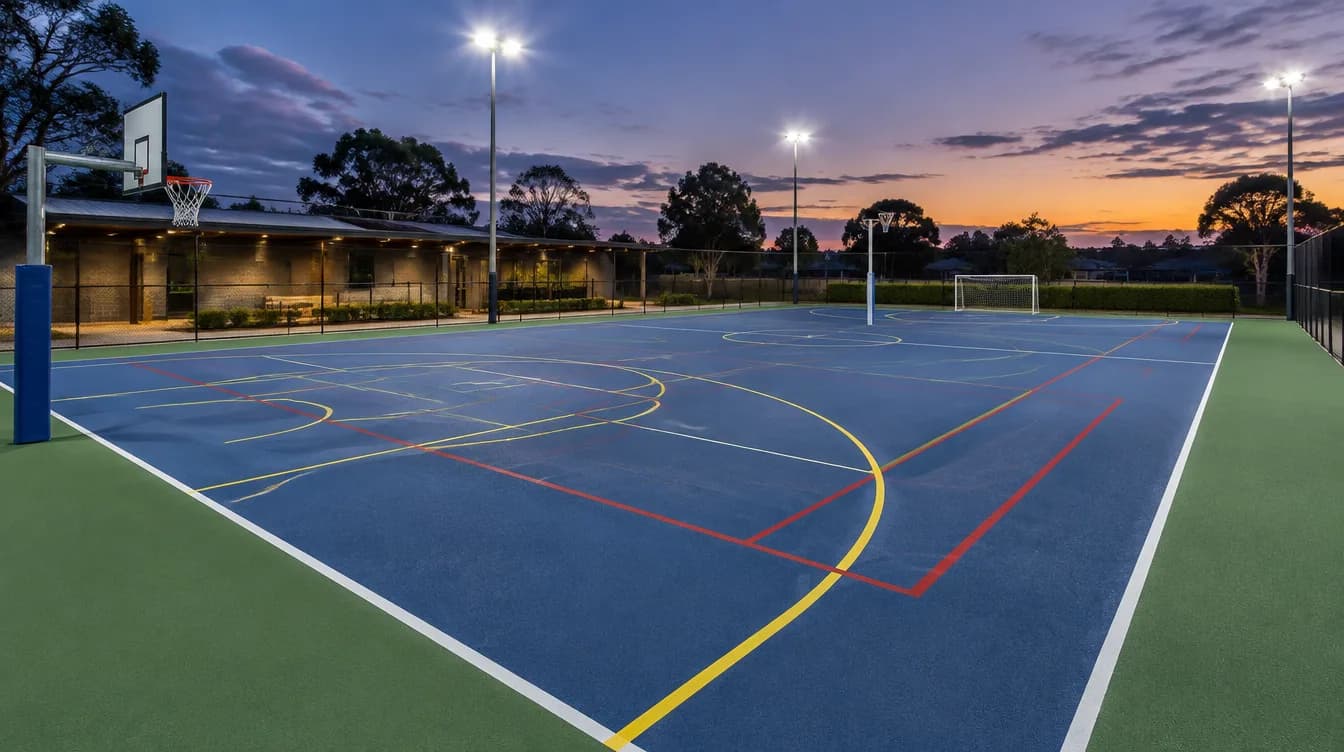
Line Marking Australia builds and renews sports facilities for universities across Australia: multi-court precincts, tennis, netball, basketball and pickleball courts, synthetic turf fields and indoor hall line marking. We plan staged works around semesters and give campus facilities teams itemised scopes. Full-size basketball courts start from about $70,000 installed.
Campus facilities teams manage some of the busiest sports assets in the country: student clubs, intramural comps, community hire and elite programs, all on the same courts and fields.
Our crews line indoor sports halls for basketball, netball, volleyball and badminton, and mark football ovals with boundary lines and painted logos. Here's how we approach university court and field projects.
What sports facilities do universities build?
Universities in Australia mostly invest in multi-court precincts, synthetic turf fields and indoor halls that can serve many sports and user groups. Clustering courts together makes lighting, fencing, booking and maintenance more efficient, and lets campuses host carnivals and community events as well as everyday student use.
- Multi-court precincts: banks of tennis, netball, basketball and pickleball courts
- Synthetic turf fields for football, hockey and rugby training
- Indoor halls lined for basketball, netball, volleyball and badminton
- Padel and squash courts for recreation centres
- Beach volleyball courts for social sport
How much do university courts cost?
University court costs depend on the number of courts, the sports and the site. A full-size basketball court of about 420 m² starts from about $70,000 installed (published Australian builder pricing, 2026), and a tennis court from about $40,000 (Oneflare cost guide, 2026). Synthetic fields, lighting and precinct works are quoted per site.
| Facility | Playing area | Starting price (installed) |
|---|---|---|
| Full-size basketball court (about 420 m²) | 28 m × 15 m (FIBA) | from about $70,000 (published Australian builder pricing, 2026) |
| Tennis court | 23.77 m × 10.97 m (doubles) | from about $40,000 (Oneflare cost guide, 2026) |
| Padel court | 20 m × 10 m | from about $60,000 (Sydney club build reported in the trade press) |
| Netball court | 30.5 m × 15.25 m | Quoted per site |
| Synthetic turf field, lighting | Varies | Quoted per site |
How should a multi-court precinct be planned?
A well-planned multi-court precinct groups courts so they share fencing, lighting, paths, shade and amenities, with each court oriented to reduce sun glare. Courts should allow for each sport's run-off and for future conversions, such as adding pickleball lines to tennis courts. We plan layouts with your campus master plan in mind.
- Shared lighting poles between courts to cut cost
- Courts oriented to limit low sun in players' eyes
- Accessible paths from transport, car parks and buildings
- Room for spectators, team benches and storage
- Drainage designed for the whole precinct
See our multi-sport court construction page.
Are synthetic turf fields worth it for a campus?
Synthetic turf fields suit campuses because they handle far more hours of use than natural grass, stay playable after rain and don't need mowing or watering. That frees up timetabling for clubs, classes and community hire. They do need brushing, infill top-ups and eventual replacement, so build that cycle into your asset plan.
Read more on synthetic turf field construction.
Can courts be converted for pickleball?
Yes. University tennis courts can carry pickleball lines in a contrasting colour, giving two pickleball courts per tennis court while keeping tennis, or up to four dedicated pickleball courts. AusPlay found about 92,000 Australians played pickleball in the year to June 2024, and student clubs are part of that growth.
Shared lines are the low-cost way to test demand. If pickleball bookings take off, a dedicated conversion with its own posts and nets is the next step, and the existing slab, fencing and lighting can usually be reused.
Can you work around semesters and events?
Yes. We schedule university court and field works for semester breaks where possible and stage larger precincts so some courts stay open. Work zones are fenced and signed, deliveries avoid peak foot traffic, and your facilities team has one contact for access, inductions and campus rules throughout the job.
- Noisy works planned for breaks and quieter weeks
- Staging so clubs and competitions can keep running
- Campus induction and permit-to-work processes followed
What lighting do university courts need?
University courts and fields need lighting that suits the level of play, from social sport to competition and training. We design to AS 2560.1:2018 and AS 2560.2:2021 for sports lighting and limit obtrusive light onto nearby residences and colleges under AS/NZS 4282, with controls linked to bookings where possible.
- Higher light levels for competition courts, lower for social play
- LED fittings to cut running and maintenance costs
- Shared poles across a precinct to reduce cost and clutter
Can you mark indoor halls and fields too?
Yes. As line marking specialists, we mark indoor halls for basketball, netball, volleyball and badminton, and mark fields and ovals with boundary lines and painted logos. That means one contractor can deliver the courts, mark the fields and re-line every season. See our indoor sports line marking service.
How often should campus courts be resurfaced?
Tennis Australia's Victorian maintenance guides suggest acrylic courts are resurfaced about every 7 to 10 years and synthetic grass about every 10 to 15 years. Heavy university use can shorten those cycles. Regular cleaning, early crack repairs and fresh line marking between resurfaces extend the life of each court.
We can prepare a simple renewal schedule for each court and field, so your asset plan shows when resurfacing, turf replacement and lighting upgrades fall due across the precinct.
How we keep every university court project compliant
Every university court and field project follows the same compliance framework, documented for your contract file. We check planning and building approval requirements, locate underground services, follow Work Health and Safety laws with Safe Work Method Statements, control dust and sediment and use builders who hold the licence your state requires.
- Planning and building approval checked for lighting, fencing, earthworks and drainage
- Before You Dig Australia (BYDA) check before excavation
- Safe Work Method Statements for excavation and mobile plant
- Silica dust controls and sediment and stormwater controls
- AS 3600 concrete and AS 1428.1 accessible paths
- AS 2560.1:2018, AS 2560.2:2021 and AS/NZS 4282 for lighting
- Tennis Australia guidance and each sport's court dimensions
What do you need from our facilities team to quote?
To quote a university court or field project, we need the scope, the site and your procurement requirements. A site plan, survey and any existing specification make pricing faster. Where you're still at concept stage, we can price options to support the business case and master planning.
- Courts or fields wanted and sports to mark
- New build, resurface or conversion
- Location, survey, slope and drainage
- Machinery access and campus work rules
- Preferred surfaces and colours
- Posts, nets, hoops, fencing, lighting and power
- Planning status and approvals
- Semester timing, procurement format and budget
Key Benefits
Precinct planning: shared lighting, fencing, paths and drainage
Courts and fields: multi-court banks plus synthetic turf fields
Semester-aware staging: works planned around breaks and events
Line marking in-house: indoor halls, courts and ovals re-lined each season
Documented compliance: approvals, BYDA, SWMS and lighting standards on file

Site Inspection
Free assessment and detailed quote

Professional Marking
Expert application with premium materials

Quality Assurance
Final inspection and compliance sign-off
Compliance Standards
Planning & building approval
Approval needs checked for lighting, fencing, earthworks and drainage.
AS 2560 · AS/NZS 4282
Sports lighting to AS 2560.1:2018 and AS 2560.2:2021 with obtrusive light limited.
AS 3600 · AS 1428.1
Concrete to AS 3600; accessible paths considered against AS 1428.1.
Before You Dig Australia
Underground services located before any excavation.
WHS Act & SWMS
Safe Work Method Statements, silica dust and sediment controls.
Tennis Australia guidance
Tennis courts built with Tennis Australia guidance in mind.
Fully Compliant & Certified
All our work meets or exceeds Australian Standards and state road authority requirements
VicRoads Approved
Registered Contractor
$20M Public Liability
$10M Professional Indemnity
5,000+ Projects
Since 2009
Fixed Prices
Not Estimates
AS 1742
Traffic Control Devices
Specifies line colours, widths, arrow designs, and placement for road markings. Ensures all traffic control devices meet national safety standards.
AS/NZS 2890
Parking Facilities
Covers bay dimensions (2.4m × 5.4m standard, 2.4m × 5.4m accessible plus a 2.4m shared zone), aisle widths, and traffic flow requirements for compliant parking areas.
AS 4586
Slip Resistance
Defines slip resistance classifications (P rating) for pedestrian surfaces. Critical for wet areas, ramps, and high-traffic zones.
AS/NZS 1428
Access & Mobility
Sets requirements for accessible parking bays, tactile indicators, and mobility access. Essential for DDA compliance and accessibility audits.
What Our Clients Say
Results based on typical project outcomes. Individual results may vary.
Upload your site plans for a detailed quote within 48 hours
Get an accurate, fixed-price quote tailored to your specific project requirements
Frequently Asked Questions
Line Marking Australia builds multi-court precincts with tennis, netball, basketball and pickleball courts, synthetic turf fields, padel and squash courts, and marks indoor halls, fields and ovals for university clubs, intramural competitions and community hire.
A full-size basketball court of about 420 m² starts from about $70,000 installed, based on published Australian builder pricing for 2026. Line Marking Australia itemises lighting, fencing and precinct works separately.
Synthetic turf fields handle many more hours of use than natural grass, stay playable after rain and need no mowing or watering. Line Marking Australia recommends planning for brushing, infill top-ups and eventual replacement.
Yes. Line Marking Australia schedules university works for semester breaks where possible, stages larger precincts so some courts stay open and follows campus induction and permit-to-work processes, with one contact for your facilities team.
University court and field lighting is designed to AS 2560.1:2018 and AS 2560.2:2021 for sports lighting, with obtrusive light limited under AS/NZS 4282. Line Marking Australia checks approval requirements early.
Yes. Line Marking Australia can mark two pickleball courts over each tennis court while keeping tennis, or convert a court into up to four dedicated pickleball courts for student clubs and social sport.
Related Services

Indoor Sports Line Marking
Learn more about this service
Multi-Sport Court Construction
Learn more about this service
Netball Court Construction
Learn more about this service
Sports Court Lighting
Learn more about this service
Sports Field Line Marking
Learn more about this service
Synthetic Turf Field Construction
Learn more about this service
More Sports & Playground Line Marking Services
Ready to Get Your Line Marking Sorted?
Upload your site plans and receive a fixed-price quote within 48 hours. No surprises, no cost blowouts, just clear pricing you can take to your committee or manager.
Or call us directly: 0417 460 236