

Synthetic Turf Field Construction
Synthetic soccer fields and multi-use sports fields for schools, councils and clubs, from drainage and base to turf, lines and lighting.
Jamie (24/7 quotes): 0468 069 002AS 1742.2 Compliant
Fully Insured
24/7 Availability

15+ Years
Get FREE Quote
Fixed-Price Quote Within 48 Hours
Trusted by 5,000+ businesses
VicRoads approved · AS/NZS compliant · $20M insured
Compliance-Ready Guarantee: every job is marked to AS/NZS 2890 & AS 1742, dimensionally verified, and delivered with full compliance documentation, backed by our 12-month workmanship guarantee.
Last updated:
What is Synthetic Turf Field Construction?
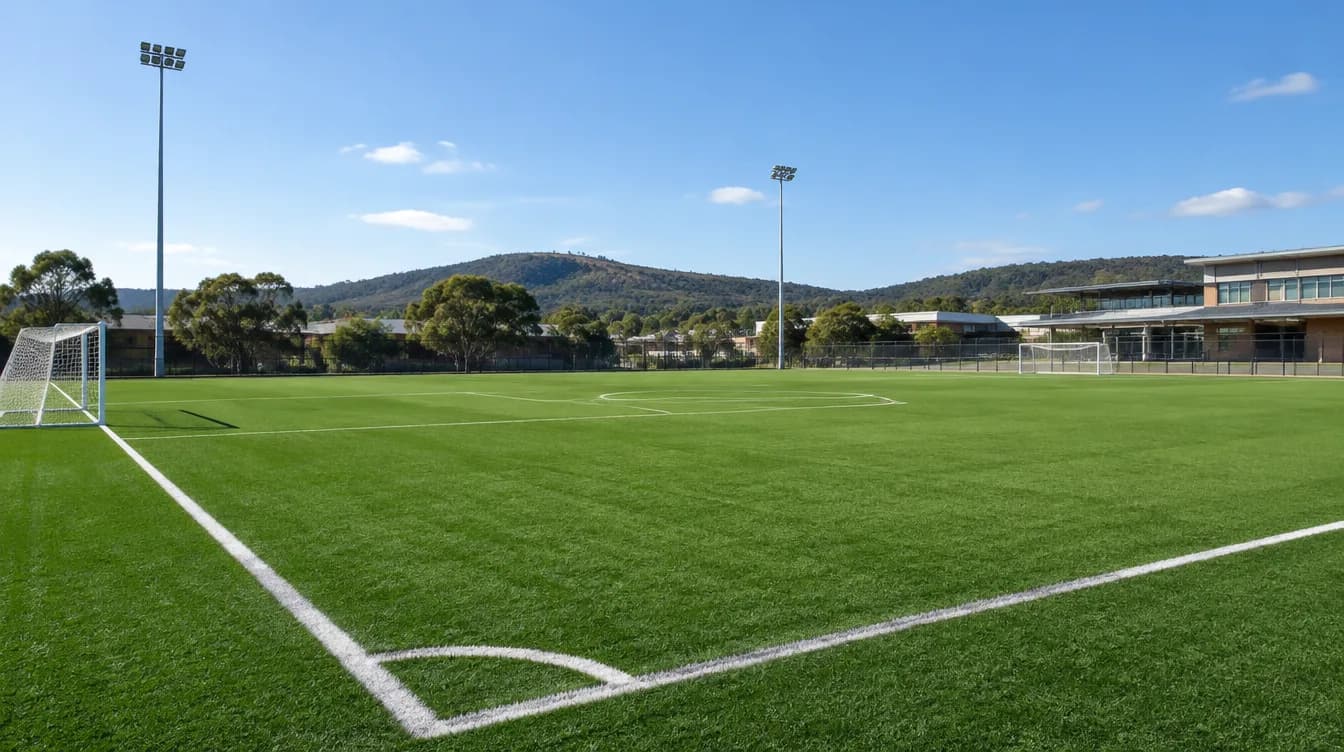
Line Marking Australia delivers synthetic turf fields across Australia for schools, councils, universities and sports clubs, including synthetic soccer fields and small-sided pitches. We manage earthworks, subsurface drainage, the laser-graded base, shock pad, turf, infill, line marking, goals, fencing and lighting. Every synthetic turf field is quoted per site, because size and ground conditions vary widely.
A synthetic field gives a school or club a playing surface that can be used for hours every day, in wet weather and through winter, without the mud, bare goal mouths and closures that come with heavily used grass.
It's a big investment, and most of it sits underground. The drainage and base decide whether the field plays well for years. We also mark grass ovals and fields every week, including football boundary lines and painted club and sponsor logos, so line work is something we know well.
What is a synthetic turf field?
A synthetic turf field is a sports field surfaced with artificial grass laid over a drained, laser-graded base, usually with a shock pad underneath and sand or other infill between the fibres. In Australia, synthetic fields are used for soccer, hockey, rugby, AFL training and school sport where grass can't cope with the use.
Fields range from small-sided school and futsal-style pitches to full-size competition fields with lighting and fencing.
How much does a synthetic turf soccer field cost?
The cost of a synthetic turf soccer field in Australia depends on the field size, earthworks, drainage, base, shock pad, turf and infill system, plus fencing, lighting and goals. A small-sided school pitch costs a fraction of a full-size competition field. Line Marking Australia quotes each synthetic field per site and itemises every stage.
| Cost item | What affects it |
|---|---|
| Earthworks and site preparation | Field size, existing levels, soil and access |
| Subsurface drainage | Soil type, rainfall and connection to stormwater |
| Base construction | Crushed rock layers, laser grading and edging |
| Shock pad and turf | Sport, level of play and turf system |
| Infill | Sand, rubber or organic options |
| Lines, goals, fencing, lighting | Sports marked, equipment and light levels |
Councils, schools and clubs often fund fields through state sport infrastructure programs and council grants. We can provide quotes and scopes for applications.
How is a synthetic turf field built?
A synthetic turf field in Australia is built in layers: earthworks to set the levels, subsurface drainage, a compacted crushed rock base laser-graded to tight tolerances, a shock pad, then the turf rolls joined and infilled. Line markings are tufted or inlaid into the turf, and goals, fencing and lighting finish the job.
- Site investigation, design and approvals
- Before You Dig Australia search and service locating
- Earthworks, sediment controls and subgrade compaction
- Subsurface drainage pipes and collection
- Crushed rock base laid, compacted and laser-graded
- Edging and kerbs to hold the turf system
- Shock pad laid over the base
- Turf rolls laid, joined, and lines inlaid
- Infill spread and brushed in
- Goals, fencing, lighting and handover
What infill and shock pad options are there?
Synthetic turf fields in Australia use infill to support the fibres, control ball roll and add cushioning, and a shock pad under the turf to absorb impact. Common infill choices are sand, rubber and organic materials such as cork. The right mix depends on the sport, the players, heat and maintenance budget.
| Option | Strengths | Things to weigh up |
|---|---|---|
| Sand infill | Stable, lower cost, common for multi-use fields | Firmer underfoot without a shock pad |
| Rubber infill | Cushioning and ball response | Heat and environmental considerations |
| Organic infill (e.g. cork) | Cooler surface, natural material | Needs more top-ups and care |
| Shock pad | Consistent impact absorption, longer life | Added upfront cost, but often reused at turf replacement |
How does drainage work under a synthetic field?
Drainage under a synthetic turf field in Australia works by letting rain pass straight through the perforated turf and shock pad into a free-draining crushed rock base, then into subsurface pipes that carry it to stormwater. A well-designed field can be played soon after heavy rain, which grass fields can't match.
- Perforated turf backing lets water through
- Free-draining crushed rock base under the shock pad
- Subsurface pipes at set spacings collect the water
- Stormwater connection designed for the site
Synthetic turf or natural grass: which suits a school or council field?
Synthetic turf suits Australian schools, councils and clubs that need a field used for many hours a week, year round, in any weather. Natural grass costs less to build and stays cooler in summer, but it needs mowing, watering and rest periods. Many councils mix both: synthetic for heavy-use fields, grass elsewhere.
| Synthetic turf | Natural grass | |
|---|---|---|
| Hours of use | High, all year | Limited; needs recovery time |
| Wet weather | Playable soon after rain | Closures and muddy goal mouths |
| Upfront cost | Higher | Lower |
| Upkeep | Brushing, infill top-ups, cleaning | Mowing, watering, fertilising, re-marking |
| Heat | Gets hot in summer sun | Cooler underfoot |
How do you maintain a synthetic turf field?
A synthetic turf field in Australia needs regular brushing to keep fibres upright and infill even, top-ups of infill in high-wear areas like goal mouths, removal of leaves and rubbish, and periodic deeper cleaning. Good maintenance keeps the field safe, consistent and lasting longer before the turf needs replacing.
Can you line mark synthetic and grass fields?
Yes. Synthetic fields usually have permanent lines inlaid into the turf, and we can add extra sports or temporary markings. Line Marking Australia also marks grass ovals and fields across Australia, including football boundary and centre lines and painted club and sponsor logos, and uses robotic line marking for accurate, repeatable layouts.
See soccer and rugby field line marking and robotic line marking for grass field work.
How we keep every synthetic turf field build compliant
Every synthetic turf field we deliver follows the same compliance steps. We check planning and building approvals, locate services, manage safety, sediment and stormwater on a large earthworks site, and build slabs, kerbs, access paths and lighting to the Australian Standards that apply to sports fields.
- Council planning and building approval checked for earthworks, drainage, fencing, lighting and overlays
- Before You Dig Australia (BYDA) check before excavation
- Work Health and Safety laws, with Safe Work Method Statements for excavation and mobile plant
- Sediment and stormwater controls throughout earthworks
- Concrete kerbs and footings to AS 3600; accessible paths considered against AS 1428.1
- Sports lighting to AS 2560.1:2018 and AS 2560.2:2021, with spill controlled under AS/NZS 4282
- Builders who hold the licence your state requires, with public liability insurance
- Schools: holiday scheduling where possible and Working with Children checks for crews
What do you need from me to quote a synthetic turf field?
To quote a synthetic turf field in Australia we need to know the sports, the size of field and the current site conditions. A site plan or aerial image, any survey or soil reports, photos and your funding timeline let us scope the project and give you a realistic, itemised figure.
- Sports to be played and level of competition
- Full-size field, small-sided pitch or multi-use area
- School, council, university or club site
- What's there now: grass field, old hard court or vacant land
- Levels, soil, drainage and stormwater connection
- Access for heavy machinery and deliveries
- Infill preference, goals, fencing, lighting and power
- Approvals and grants in progress, timing and budget
Key Benefits
Drainage done right: fields playable soon after heavy rain
Whole field, one contact: earthworks to turf, lines, goals, fencing and lighting
Infill options explained: sand, rubber or organic to suit your sport
Field line marking experts: inlaid lines, grass ovals and robotic marking
Grant-ready quotes: itemised scopes for funding applications

Site Inspection
Free assessment and detailed quote

Professional Marking
Expert application with premium materials

Quality Assurance
Final inspection and compliance sign-off
Compliance Standards
Council planning and building approval
Earthworks, drainage, fencing, lighting and overlays checked before the final quote.
Before You Dig Australia
Underground services located before excavation.
WHS Act & SWMS
Safe Work Method Statements for excavation and mobile plant.
Sediment and stormwater
Sediment and stormwater controls throughout earthworks.
AS 3600 · AS 1428.1
Kerbs and footings to AS 3600; accessible paths considered against AS 1428.1.
AS 2560 · AS/NZS 4282
Field lighting to the AS 2560 series with spill controlled under AS/NZS 4282.
Fully Compliant & Certified
All our work meets or exceeds Australian Standards and state road authority requirements
VicRoads Approved
Registered Contractor
$20M Public Liability
$10M Professional Indemnity
5,000+ Projects
Since 2009
Fixed Prices
Not Estimates
AS 1742
Traffic Control Devices
Specifies line colours, widths, arrow designs, and placement for road markings. Ensures all traffic control devices meet national safety standards.
AS/NZS 2890
Parking Facilities
Covers bay dimensions (2.4m × 5.4m standard, 2.4m × 5.4m accessible plus a 2.4m shared zone), aisle widths, and traffic flow requirements for compliant parking areas.
AS 4586
Slip Resistance
Defines slip resistance classifications (P rating) for pedestrian surfaces. Critical for wet areas, ramps, and high-traffic zones.
AS/NZS 1428
Access & Mobility
Sets requirements for accessible parking bays, tactile indicators, and mobility access. Essential for DDA compliance and accessibility audits.
What Our Clients Say
Results based on typical project outcomes. Individual results may vary.
Upload your site plans for a detailed quote within 48 hours
Get an accurate, fixed-price quote tailored to your specific project requirements
Frequently Asked Questions
Synthetic turf field costs depend on size, earthworks, drainage, base, shock pad, turf, infill, fencing and lighting, so Line Marking Australia quotes each field per site. A small-sided school pitch costs a fraction of a full-size competition field.
A synthetic field is built in layers: earthworks, subsurface drainage, a laser-graded crushed rock base, a shock pad, then turf with inlaid lines and infill. Line Marking Australia manages each stage, plus goals, fencing and lighting.
Common infills are sand, rubber and organic materials such as cork. Each balances cushioning, ball roll, heat and maintenance differently. Line Marking Australia recommends an infill and shock pad combination to suit your sport and players.
Yes. Rain passes through perforated turf into a free-draining crushed rock base and subsurface pipes, so a well-built field is playable soon after heavy rain. Line Marking Australia designs the drainage for your soil and stormwater connection.
Synthetic turf suits fields used many hours a week in all weather, while grass costs less to build and stays cooler but needs mowing, watering and rest. Line Marking Australia helps schools weigh use, budget and upkeep.
A synthetic field needs regular brushing, infill top-ups in high-wear areas, debris removal and periodic deeper cleaning. Line Marking Australia explains a maintenance routine at handover so the field stays safe and consistent.
Yes. Synthetic fields usually have permanent inlaid lines, and Line Marking Australia can add extra sports or temporary markings. We also mark grass ovals and fields, including boundary lines and painted logos, and offer robotic line marking.
Related Services

Robotic Line Marking
Learn more about this service
Soccer & Rugby Fields Line Marking
Learn more about this service
Sports Court Construction
Learn more about this service
Sports Courts for Councils
Learn more about this service
Sports Courts for Schools
Learn more about this service
Sports Field Line Marking
Learn more about this service
Ready to Get Your Line Marking Sorted?
Upload your site plans and receive a fixed-price quote within 48 hours. No surprises, no cost blowouts, just clear pricing you can take to your committee or manager.
Or call us directly: 0417 460 236