

Sports Courts for New Estates
Pickleball, tennis, basketball and multi-sport precincts for new estates, planned around civil works, council handover and resident demand.
Jamie (24/7 quotes): 0468 069 002AS 1742.2 Compliant
Fully Insured
24/7 Availability

15+ Years
Get FREE Quote
Fixed-Price Quote Within 48 Hours
Trusted by 5,000+ businesses
VicRoads approved · AS/NZS compliant · $20M insured
Compliance-Ready Guarantee: every job is marked to AS/NZS 2890 & AS 1742, dimensionally verified, and delivered with full compliance documentation, backed by our 12-month workmanship guarantee.
Last updated:
What is Sports Courts for New Estates?
Line Marking Australia builds sports courts for developers and new estates across Australia, from single basketball courts to pickleball, tennis and multi-sport precincts. Starting prices include about $10,000 for a half court, $20,000 for a pickleball court, $40,000 for tennis and $70,000 for a full basketball court, with precincts quoted per site.
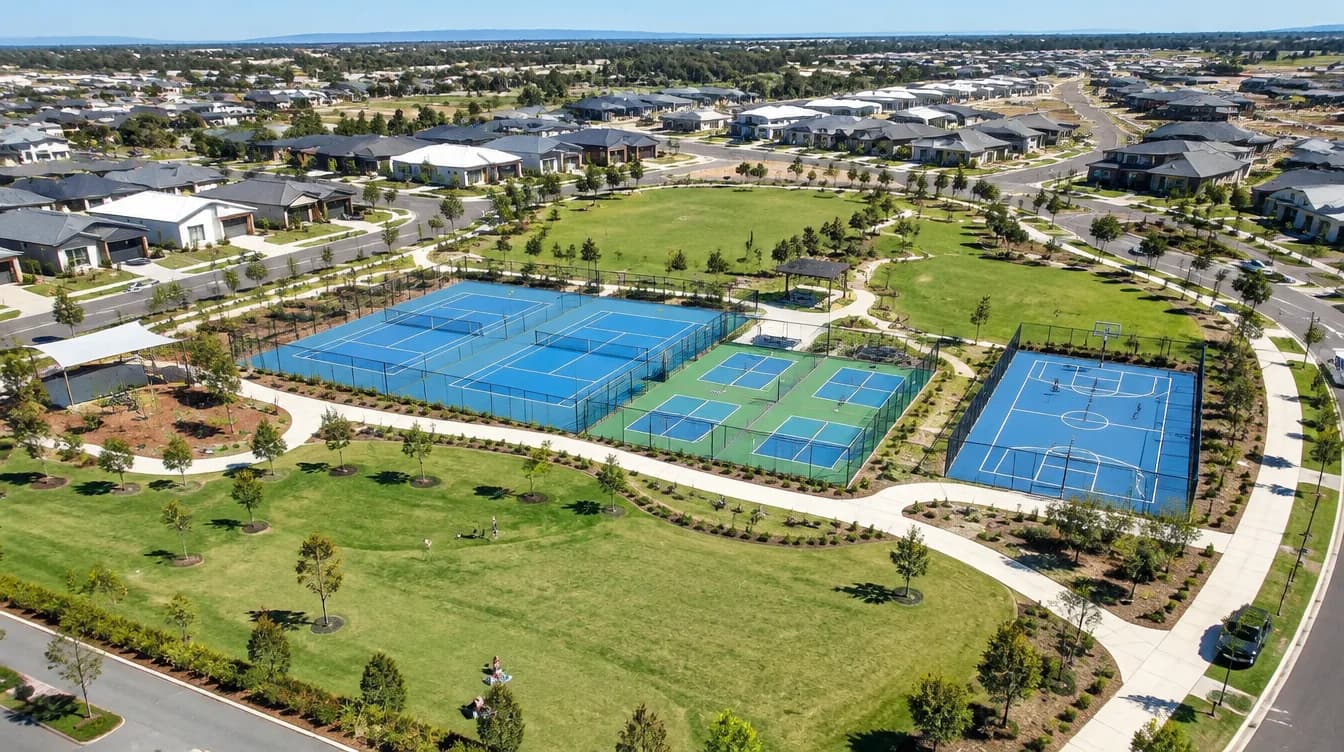
Sports courts give a new estate an active heart. They create early places for residents to meet, support sales and show buyers the lifestyle promised in the brochure.
Developers need courts that fit the master plan, satisfy council and hand over cleanly. Here's how we approach estate projects.
Why are developers adding sports courts to new estates?
Developers add sports courts to new estates because they create visible amenity early, attract families and active buyers and give residents a shared place to meet. Courts also support council open-space planning. Logan's Everleigh estate shows the scale possible, with a 17-court pickleball complex built by Mirvac with $1.1m from Logan City Council.
- Early amenity that supports sales
- Community connection for new residents
- Active open space for families and older buyers
- Courts that can serve several sports and age groups
Which courts suit a new estate?
The best courts for a new estate depend on the target buyers, space, council requirements and nearby facilities. Basketball and multi-sport courts suit families and teenagers, pickleball suits a broad age range, and tennis remains popular with active adults. A mix of courts usually creates the strongest precinct and spreads use across the day.
| Court | Starting price | Suits |
|---|---|---|
| Basketball half court | From about $10,000 (incl. slab, up to ~165 m²) | Pocket parks and family areas |
| Pickleball court | From about $20,000 | All ages and social groups |
| Tennis court | From about $40,000 (Oneflare, 2026) | Active adults and families |
| Full basketball court | From about $70,000 (~420 m²) | Youth precincts and district parks |
| Multi-sport precinct | Quoted per site | Major open-space hubs |
Basketball and pickleball starting prices are from published Australian builder pricing, 2026.
How much does an estate sports precinct cost?
An estate sports precinct is quoted per site, because cost depends on the number and type of courts, earthworks, drainage, lighting, fencing, paths, shade, seating and handover requirements. Individual courts start from about $10,000 for a half court, $20,000 for pickleball, $40,000 for tennis and $70,000 for a full basketball court.
We itemise courts and precinct works separately so development teams can test options, stage delivery and align the budget with sales releases.
When should courts be planned in an estate?
Courts should be planned early in an estate, ideally alongside civil design, drainage, lighting and open-space landscaping. Early planning avoids clashes with services, levels and paths, and lets court slabs, power and stormwater be designed into the precinct rather than retrofitted. It also gives council handover requirements time to be resolved.
- Resident profile and court mix agreed
- Concept layout within the open-space plan
- Civil levels, drainage and power coordinated
- Council review and approval
- Construction staged with landscape works
- Handover documentation and maintenance guidance
Do estate sports courts need council approval?
Estate sports courts usually need council review or approval, especially when they're part of public open space that will be handed to council. Councils may assess layout, drainage, accessibility, lighting, fencing, maintenance access and asset standards. We work with your consultants to provide court drawings, scopes and construction details for approval.
Many councils publish open-space or asset standards for courts, covering surfaces, fencing, equipment and maintenance access. Building to those standards from the start makes handover smoother and avoids costly rework before council accepts the asset.
How should lighting be designed for estate courts?
Estate court lighting should give players even light while protecting new homes from spill and glare. Sports lighting is designed to AS 2560.1:2018 and AS 2560.2:2021, and obtrusive light is assessed under AS/NZS 4282. Timers, curfews and smart controls help balance resident use with neighbour comfort.
Pole positions and power supply are easiest to coordinate during civil works. Planning conduits, pits and switchboards early avoids trenching through finished landscaping after residents move in.
How do developers make courts easy to maintain?
Developers make estate courts easier to maintain by choosing durable surfaces, designing good drainage, specifying robust equipment and providing clear maintenance guidance at handover. Acrylic courts are typically recoated about every 7 to 10 years and synthetic grass about every 10 to 15 years, based on Tennis Australia's Victorian maintenance guides.
- Durable acrylic, cushioned acrylic, synthetic grass or tiles
- Drainage falls and stormwater connections
- Vandal-resistant hoops, nets and fencing
- As-built details and maintenance schedules
How do you stage courts within an active estate?
We stage estate court works around civil construction, sales activity and residents already living nearby. That means coordinated access, fenced work zones, dust and sediment controls, safe pedestrian routes and clear communication with the site manager. Courts can be delivered early as display amenity or later when nearby stages are complete.
Delivering courts early gives sales teams something real to show buyers, while later delivery can reduce damage from ongoing construction traffic. We help weigh both options against the estate's release program.
How we keep every estate court build compliant
Every estate sports court we build is delivered against planning requirements, safety laws, sport dimensions and relevant Australian Standards. That means services located before excavation, safe work methods around active sites, concrete to AS 3600, accessible paths considered against AS 1428.1, sediment controls, and lighting designed with spill controlled.
- Each sport's court dimensions, including pickleball, tennis and basketball
- Planning, building and handover requirements checked
- Before You Dig Australia check before excavation
- Concrete slabs to AS 3600 with drainage falls
- Accessible paths considered against AS 1428.1
- Sports lighting to AS 2560.1:2018 and AS 2560.2:2021, spill limited under AS/NZS 4282
- Safe Work Method Statements, silica dust controls and sediment and stormwater controls
- Builders who hold the licence the state requires, with public liability insurance
See our sports courts for developers page for estate and development projects, our multi-sport court construction page for shared courts, and our pickleball court construction page for pickleball precincts.
What do you need from us to quote estate sports courts?
To quote estate sports courts, Line Marking Australia needs the master plan or open-space plan, the court types and numbers, site levels, drainage and services information, and council handover requirements. Lighting, fencing, shade, paths, staging dates and budget targets help us return an accurate, itemised quote for your development team.
- Master plan, open-space plan and court location
- Court types, numbers and target users
- Civil levels, drainage, services and power
- Surface preference and line marking requirements
- Lighting, fencing, shade, seating and paths
- Council approval and handover requirements
- Construction access, staging, timing and budget
Key Benefits
Estate-ready planning: courts coordinated with civil and landscape works
Clear starting prices: half courts, pickleball, tennis and full basketball
Mixed-use precincts: courts for families, teenagers and active adults
Handover support: drawings, as-built details and maintenance guidance
Neighbour-aware lighting: AS 2560 design with spill controlled

Site Inspection
Free assessment and detailed quote

Professional Marking
Expert application with premium materials

Quality Assurance
Final inspection and compliance sign-off
Compliance Standards
Sport court dimensions
Pickleball, tennis, basketball and multi-sport courts marked to size.
Planning & handover
Council approval, asset standards and handover requirements checked.
AS 3600 · BYDA
Slabs to AS 3600; Before You Dig Australia check before excavation.
AS 1428.1
Accessible paths and spectator areas considered against AS 1428.1.
AS 2560 · AS/NZS 4282
Court lighting with spill controlled for new homes.
Fully Compliant & Certified
All our work meets or exceeds Australian Standards and state road authority requirements
VicRoads Approved
Registered Contractor
$20M Public Liability
$10M Professional Indemnity
5,000+ Projects
Since 2009
Fixed Prices
Not Estimates
AS 1742
Traffic Control Devices
Specifies line colours, widths, arrow designs, and placement for road markings. Ensures all traffic control devices meet national safety standards.
AS/NZS 2890
Parking Facilities
Covers bay dimensions (2.4m × 5.4m standard, 2.4m × 5.4m accessible plus a 2.4m shared zone), aisle widths, and traffic flow requirements for compliant parking areas.
AS 4586
Slip Resistance
Defines slip resistance classifications (P rating) for pedestrian surfaces. Critical for wet areas, ramps, and high-traffic zones.
AS/NZS 1428
Access & Mobility
Sets requirements for accessible parking bays, tactile indicators, and mobility access. Essential for DDA compliance and accessibility audits.
What Our Clients Say
Results based on typical project outcomes. Individual results may vary.
Upload your site plans for a detailed quote within 48 hours
Get an accurate, fixed-price quote tailored to your specific project requirements
Frequently Asked Questions
Sports courts create early amenity, support sales and give residents a place to meet. Line Marking Australia helps developers plan court mixes that suit families, active adults and older buyers within the estate's open-space plan.
Starting prices include about $10,000 for a half court, $20,000 for pickleball, $40,000 for tennis and $70,000 for a full basketball court. Line Marking Australia quotes estate precincts per site with every item listed.
A mix of basketball or multi-sport courts, pickleball and tennis suits many estates. Line Marking Australia considers buyer profile, space, council requirements and nearby facilities before recommending the court mix.
Developers should plan courts early, alongside civil levels, drainage, power and landscaping. Line Marking Australia can help coordinate court layouts so services, paths and handover requirements are resolved before construction.
Usually, especially if the courts will be handed to council as public open space. Line Marking Australia provides court drawings, scopes and construction details to support council review and approval.
Durable surfaces, good drainage, robust equipment and clear handover guidance all help. Line Marking Australia provides as-built details and maintenance advice, and acrylic courts are typically recoated about every 7 to 10 years.
Related Services

Multi-Sport Court Construction
Learn more about this service
Pickleball Court Construction
Learn more about this service
Sports Court Construction
Learn more about this service
Sports Court Lighting
Learn more about this service
Sports Courts for Developers
Learn more about this service
More Sports & Playground Line Marking Services
Ready to Get Your Line Marking Sorted?
Upload your site plans and receive a fixed-price quote within 48 hours. No surprises, no cost blowouts, just clear pricing you can take to your committee or manager.
Or call us directly: 0417 460 236