Road Line Marking Adelaide
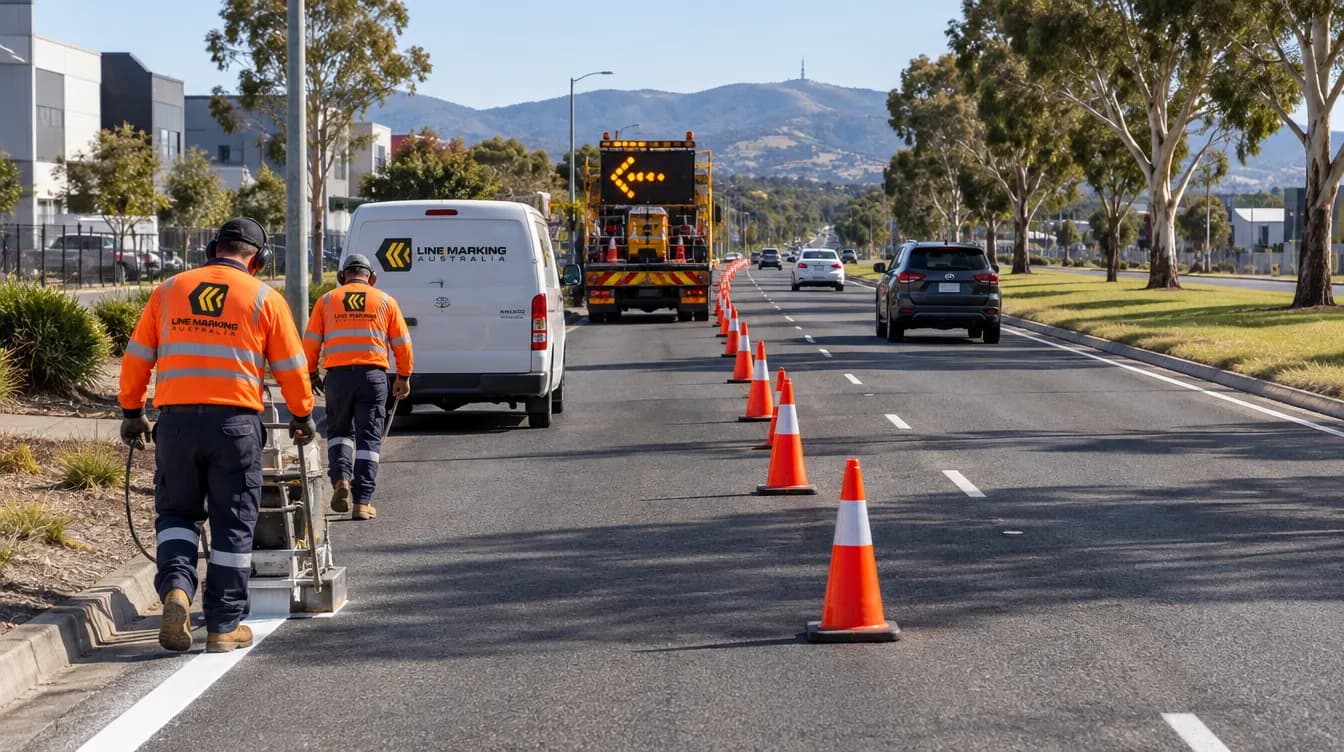
Road and pavement marking for councils, developers and private roads across Adelaide and regional South Australia. Centre and edge lines, arrows, kerbs, crossings and rail level crossing approaches, marked to the DIT pavement marking manual and AS 1742.
Jamie (24/7 quotes): 0468 069 002AS 1742.2 Compliant
Fully Insured
24/7 Availability

15+ Years
Get FREE Quote
Fixed-Price Quote Within 48 Hours
Trusted by 5,000+ businesses
VicRoads approved · AS/NZS compliant · $20M insured
Compliance-Ready Guarantee: every job is marked to AS 1742 and the state road authority specification, dimensionally verified and delivered with full compliance documentation, backed by our 12-month workmanship guarantee.
Last updated:
Road Line Marking for Adelaide and Regional South Australia
Quick answer: Line Marking Australia marks roads, kerbs, arrows and crossings across Adelaide and regional South Australia. On South Australian roads, pavement marking follows the Department for Infrastructure and Transport (DIT) pavement marking manual and AS 1742.2, and work on a live road needs a traffic management plan under AS 1742.3.
Recent road marking jobs in South Australia
- Warnertown, near Port Pirie (May 2026): asphalt road approach to a rail level crossing. See line marking in Port Pirie.
- Prospect (May and Sep 2026): kerbs painted to the DIT pavement marking manual. See line marking near Kilburn and Prospect.
- Enfield (Aug and Sep 2026): night-shift reversal and re-mark of directional arrows and a chevron island. See line marking near Gepps Cross and Enfield.
Road marking we do in South Australia
| Marking | Standard |
|---|---|
| Centre, lane and edge lines | DIT pavement marking manual, AS 1742.2 |
| Arrows, chevrons and painted islands | AS 1742.2 |
| Pedestrian and school crossings | AS 1742.10 |
| Rail level crossing approaches | AS 1742.7 |
| Kerb painting and no-standing zones | DIT manual, council requirements |
| Line removal before a re-mark | Grinding or water blasting |
Who approves road line marking in Adelaide?
It depends on who owns the road. Arterial roads are managed by DIT, local roads by the council (for example Port Adelaide Enfield, Salisbury, Playford or Onkaparinga), and private estate and industrial roads by the owner. Council and DIT work needs their approval and a traffic management plan, while private roads only need the owner's sign-off and a safe work method.
Paint or thermoplastic on Adelaide roads?
Waterborne paint suits low-traffic and private roads. Thermoplastic line marking is thicker, more reflective and lasts several times longer under heavy traffic, so it is the usual choice for busy council and arterial roads.
We work across metropolitan Adelaide and regional SA, including Port Augusta, Whyalla, Mount Gambier and Murray Bridge. Read our road line marking standards guide, or see all our line marking in Adelaide services.

Site Inspection
Free assessment and detailed quote

Professional Marking
Expert application with premium materials

Quality Assurance
Final inspection and compliance sign-off
Compliance Standards
AS 1742 Series
Manual of Uniform Traffic Control Devices specifying road marking requirements. All Adelaide road marking meets AS 1742 specifications.
DIT SA Specifications
South Australian Department for Infrastructure and Transport specifications for marking on classified roads.
Austroads Guidelines
National guidelines for road marking referenced by DIT SA. Ensures consistency across Adelaide road network.
AS 4049 Road Marking Materials
Specifies requirements for road marking paints and thermoplastics. All materials meet these specifications.
AS 1742.3 Traffic Control
Specifies traffic control requirements for works on roads. All Adelaide road marking includes compliant traffic management.
Council Specifications
Adelaide metropolitan councils may have additional requirements. We ensure compliance with local specifications.
Fully Compliant & Certified
All our work meets or exceeds Australian Standards and state road authority requirements
VicRoads Approved
Registered Contractor
$20M Public Liability
$10M Professional Indemnity
5,000+ Projects
Since 2009
Fixed Prices
Not Estimates
AS 1742
Traffic Control Devices
Specifies line colours, widths, arrow designs, and placement for road markings. Ensures all traffic control devices meet national safety standards.
AS 4049
Pavement Marking Paint
Sets the performance of road marking paints, including waterborne paint used on most public roads.
AS/NZS 2009
Glass Beads
Covers the retroreflective glass beads that make road lines visible at night and in the wet.
State specs
Road Authority Rules
Public road work follows the state specification, such as VicRoads Section 721, TMR MRTS45 or MRWA Specification 604.
What Our Clients Say
Results based on typical project outcomes. Individual results may vary.
Upload your site plans for a detailed quote within 48 hours
Get an accurate, fixed-price quote tailored to your specific project requirements
Frequently Asked Questions
Road line marking in South Australia follows the Department for Infrastructure and Transport (DIT) pavement marking manual together with AS 1742.2 for line types, widths and colours. Crossings follow AS 1742.10, rail level crossings AS 1742.7, and any work on a live road needs traffic management under AS 1742.3.
Line marking on an Adelaide local road needs approval from the council that manages it, such as Port Adelaide Enfield, Salisbury, Playford or Onkaparinga. Arterial roads are managed by DIT. Private estate and industrial roads only need the owner's approval and a safe work method.
Yes. Line Marking Australia marked the asphalt road approach to a rail level crossing at Warnertown, near Port Pirie, in May 2026. Level crossing approach marking follows AS 1742.7 and the rail operator's requirements.
Thermoplastic is better for busy Adelaide roads because it is thicker, more reflective at night and lasts several times longer than paint. Waterborne paint is cheaper and suits private roads, car parks and low-traffic streets.
Yes. Road marking in Adelaide is often done at night or early morning to reduce traffic disruption, as with the Enfield arrow and chevron re-mark in 2026. Night work needs a traffic management plan and, on council roads, the council's approval.
Yes. Line Marking Australia paints kerbs in Adelaide to the DIT pavement marking manual, including yellow no-standing kerbs, as it did in Prospect in 2026.
Related Services

Line Marking Sunshine Coast Council
Learn more about this service
Pedestrian Crossings Line Marking
Learn more about this service
Road Line Marking
Learn more about this service
Speed Stencils & RRPMs
Learn more about this service
Thermoplastic Marking That Lasts 4-6 Years Under Heavy Traffic
Learn more about this service
Traffic Management for Works
Learn more about this service
More Road and Council Line Marking Services
Ready to Get Your Line Marking Sorted?
Upload your site plans and receive a fixed-price quote within 48 hours. No surprises, no cost blowouts, just clear pricing you can take to your committee or manager.
Or call us directly: 0417 460 236