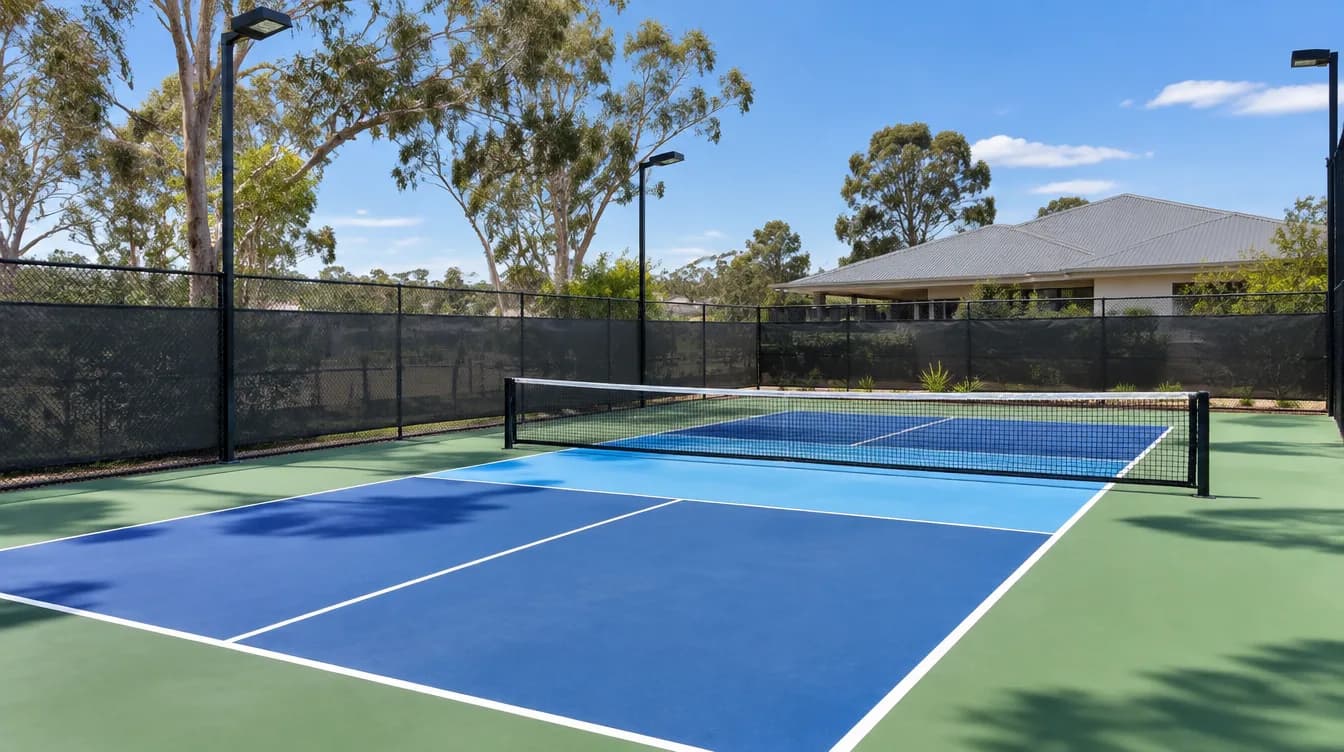
Backyard Pickleball Courts
A full-size pickleball court at home, built on a proper slab with an acrylic or tile surface, lines, posts and net. From about $20,000.
Jamie (24/7 quotes): 0468 069 002AS 1742.2 Compliant
Fully Insured
24/7 Availability

15+ Years
Get FREE Quote
Fixed-Price Quote Within 48 Hours
Trusted by 5,000+ businesses
VicRoads approved · AS/NZS compliant · $20M insured
Compliance-Ready Guarantee: every job is set out to the sport's official court dimensions, built by licensed local builders and handed over with full documentation.
Last updated:
Backyard Pickleball Courts
Line Marking Australia builds backyard pickleball courts for homes across Australia. A pickleball court is 13.41 m by 6.10 m plus run-off, roughly a third of the space of a tennis court, so it fits many suburban blocks. We build the slab, surface, lines, posts and net, with home courts from about $20,000.
Pickleball has taken off with families. Grandparents, parents and kids can all play together on the same court, and the game is easy to pick up in an afternoon. A home court means no waiting for a booking at the local club.
Below are the questions homeowners ask us most, from the space you need to keeping the neighbours happy.
Can I build a pickleball court in my backyard?
Yes, a pickleball court fits in many Australian backyards because the playing area is only 13.41 m by 6.10 m. You'll need extra room around the lines for run-off, a reasonably level spot or room to level it, and access for a small excavator and concrete truck. We check all of that on a site visit.
Things that make a backyard suitable:
- A long, rectangular area, ideally running roughly north-south
- Room for run-off behind each baseline and beside each sideline
- Somewhere for rainwater to go
- Distance from bedroom windows, yours and the neighbours'
- A side gate or lane wide enough for machinery
How much does a backyard pickleball court cost?
A backyard pickleball court in Australia starts from about $20,000 for a home court (published Australian builder pricing, 2026). The price rises with earthworks on sloping or clay sites, difficult access, a cushioned surface, fencing and lighting. Line Marking Australia lists every item separately, so you can see what each extra adds.
What usually changes the price:
- How much digging, levelling or retaining the site needs
- Slab size, including run-off
- Standard acrylic, cushioned acrylic or modular tiles
- Permanent posts and net, or a portable net
- Fencing, windbreak mesh, lighting and power
How much space does a home pickleball court need?
A home pickleball court needs the 13.41 m by 6.10 m playing area plus run-off on every side, so players can chase wide shots without hitting a fence. The court has a 2.13 m non-volley zone, called the kitchen, on each side of the net and 50 mm lines. Many families fit a court where a tennis court never would.
| Court | Playing area | Fits a typical suburban backyard? |
|---|---|---|
| Pickleball | 13.41 m × 6.10 m | Often, with run-off |
| Tennis (doubles) | 23.77 m × 10.97 m | Rarely; usually large blocks only |
| Basketball half court | 14 m × 15 m (regulation) | Smaller versions often fit |
If you've got a large block and want tennis too, see our pickleball court construction page for combined layouts.
What is the best surface for a home pickleball court?
An acrylic hard court on a concrete slab is the best surface for most home pickleball courts in Australia. It gives a consistent bounce and a textured, grippy finish. Cushioned acrylic adds rubber layers that are kinder on knees and hips, and modular tiles are a quick option that drains well after rain.
| Surface | Why people choose it | Keep in mind |
|---|---|---|
| Standard acrylic | True bounce, classic look | Recoat about every 7 to 10 years |
| Cushioned acrylic | Softer underfoot for older players | Costs more than standard acrylic |
| Modular tiles | Fast install, drains through | Ball sound and bounce differ slightly |
Lighter colours stay cooler in Australian summers, which makes a real difference on afternoon games.
Will a backyard pickleball court annoy the neighbours?
A backyard pickleball court can bother neighbours, because the paddle hitting the ball makes a sharp popping sound. Placement is the best fix: keep the court away from neighbouring bedrooms and outdoor living areas, agree sensible playing hours, and consider acoustic or windbreak screening on the fence. Councils may look at noise when assessing a court.
A quick chat with your neighbours before you build goes a long way. Some even end up joining the Sunday games.
Do I need council approval for a backyard pickleball court?
A backyard pickleball court may need council approval depending on earthworks, retaining walls, fences over about 2 m, lighting, drainage and how close it is to neighbours. Heritage and flood overlays can add requirements. Line Marking Australia checks your council's rules first and helps prepare drawings if a permit is needed.
Does a home pickleball court need fencing and lights?
A home pickleball court doesn't strictly need fencing or lights, but most owners add some. Low fencing or ball-stop mesh keeps balls out of gardens and pools, and lighting lets you play after work. Lighting is the extra most likely to need council approval, because of light spill onto neighbours.
We design court lighting with the AS 2560 sports lighting series in mind and control spill under AS/NZS 4282 (obtrusive effects of outdoor lighting). See sports court lighting for options.
Can a backyard pickleball court be used for other sports?
Yes. A backyard pickleball court can carry a basketball hoop at one end, a removable net for badminton or volleyball practice, or lines for kids' games. We mark the pickleball lines in the strongest colour and add the others in a softer shade. Portable nets let you switch between games in minutes.
For a court designed around several sports from the start, see backyard sports courts.
How long does a backyard pickleball court take to build?
A new backyard pickleball court usually takes one to three weeks on site once approvals are in place. Excavation and the slab take a few days, then the concrete cures before the acrylic or tiles go down. Lines, posts and the net come last, and rain can delay concrete and coating work.
How we keep every home pickleball court compliant
Every home pickleball court we build follows the same compliance steps we use on club and council work. We check council requirements, locate underground services, work under Work Health and Safety laws, control silica dust and runoff, and use builders who hold the licence your state requires with public liability insurance.
- Council check for earthworks, fencing, lighting, drainage, setbacks, overlays and noise
- Before You Dig Australia (BYDA) search before excavation
- Safe Work Method Statements for excavation and mobile plant
- Water suppression or on-tool vacuum extraction when cutting concrete
- Sediment and stormwater controls on site
- Slab to AS 3600 and a slip-resistant textured surface
- Court marked to pickleball dimensions: 13.41 m × 6.10 m, 2.13 m kitchen, 50 mm lines
What do you need from me to quote a backyard pickleball court?
To quote a backyard pickleball court, we need to know your yard, your players and the extras you want. Send the details below with photos and rough measurements, and we'll arrange a site visit to check levels, access and drainage before giving you an itemised quote.
- New court, resurfacing, or converting an old tennis court or slab
- Space available and where on the block
- What's there now and how the ground slopes
- Drainage problems you've noticed
- Machinery and concrete truck access
- Surface: standard acrylic, cushioned acrylic or tiles
- Other sports to mark, and net type
- Fencing, lighting and power
- Approvals, plans or photos, timing and budget
Related court pages
Key Benefits
Fits suburban blocks: about a third of the space of a tennis court
From about $20,000: home courts with every extra itemised
Joint-friendly options: standard or cushioned acrylic, or tiles
Neighbour-aware design: court placement, screening and lighting spill planned
Whole build managed: slab, surface, lines, posts and net

Site Inspection
Free assessment and detailed quote

Professional Marking
Expert application with premium materials

Quality Assurance
Final inspection and compliance sign-off
Compliance Standards
Pickleball court dimensions
13.41 m × 6.10 m playing area, 2.13 m kitchen and 50 mm lines.
Local council approval
Earthworks, fencing, lighting, drainage, setbacks and noise near neighbours checked.
AS 3600 · BYDA
Slab to AS 3600 with drainage falls; services located before digging.
AS 2560 · AS/NZS 4282
Court lighting designed with light spill onto neighbours controlled.
WHS & silica controls
SWMS for high-risk work and dust controls when cutting concrete.
Fully Compliant & Certified
Courts are set out to the sport's official dimensions and built to the Australian Standards that apply to slabs, surfaces and lighting
Licensed Local Builders
One contact, start to finish
$20M Public Liability
$10M Professional Indemnity
Official Dimensions
Set out before the slab
Fixed Prices
Not Estimates
Court layout
Official Dimensions
Courts are set out to the governing body's playing area and run-off, such as Tennis Australia, Basketball Australia or FIBA, before any concrete or surface goes down.
AS 3600
Concrete Structures
Slabs are designed for the site's soil, with falls for drainage and a Before You Dig Australia check before excavation.
AS 2560
Sports Lighting
Court lighting is designed to the AS 2560 series, with light spill onto neighbours limited under AS/NZS 4282.
AS 4586
Slip Resistance
Court surfaces and coatings are chosen for slip resistance and safe play when the court is damp.
Upload your site plans for a detailed quote within 48 hours
Get an accurate, fixed-price quote tailored to your specific project requirements
Frequently Asked Questions
A backyard pickleball court in Australia starts from about $20,000 for a home court. Earthworks, access, cushioned surfaces, fencing and lighting add to that. Line Marking Australia itemises every part of the build in your quote.
A backyard pickleball court needs the 13.41 m by 6.10 m playing area plus run-off on every side. That's roughly a third of the space of a tennis court, so a pickleball court fits many Australian suburban blocks.
An acrylic hard court on concrete suits most home pickleball courts. Cushioned acrylic is softer on joints and modular tiles drain quickly. Line Marking Australia recommends lighter colours to keep the court cooler in summer.
A backyard pickleball court makes a sharp popping sound when the paddle hits the ball. Siting the court away from neighbours' bedrooms, agreeing playing hours and adding screening on the fence help keep neighbours happy.
A home pickleball court may need council approval for earthworks, retaining walls, fences over about 2 m, lighting or overlays. Line Marking Australia checks your council's rules and helps with drawings if a permit is needed.
Yes. A backyard pickleball court can take a basketball hoop, extra lines for kids' games and portable nets for badminton or volleyball practice. Line Marking Australia marks pickleball lines boldest and the others in softer colours.
A home pickleball court usually takes one to three weeks on site once approvals are in place, including time for the concrete slab to cure before the surface goes on. Line Marking Australia confirms the timeline before work starts.
Related Services

Basketball Court Construction Adelaide
Learn more about this service
Basketball Court Construction Brisbane
Learn more about this service
Court Resurfacing
Learn more about this service
Sports Court Construction
Learn more about this service
Sports Court Fencing
Learn more about this service
Sports Court Lighting
Learn more about this service
Ready to Get Your Line Marking Sorted?
Upload your site plans and receive a fixed-price quote within 48 hours. No surprises, no cost blowouts, just clear pricing you can take to your committee or manager.
Or call us directly: 0417 460 236