

Backyard Multi-Sport Courts
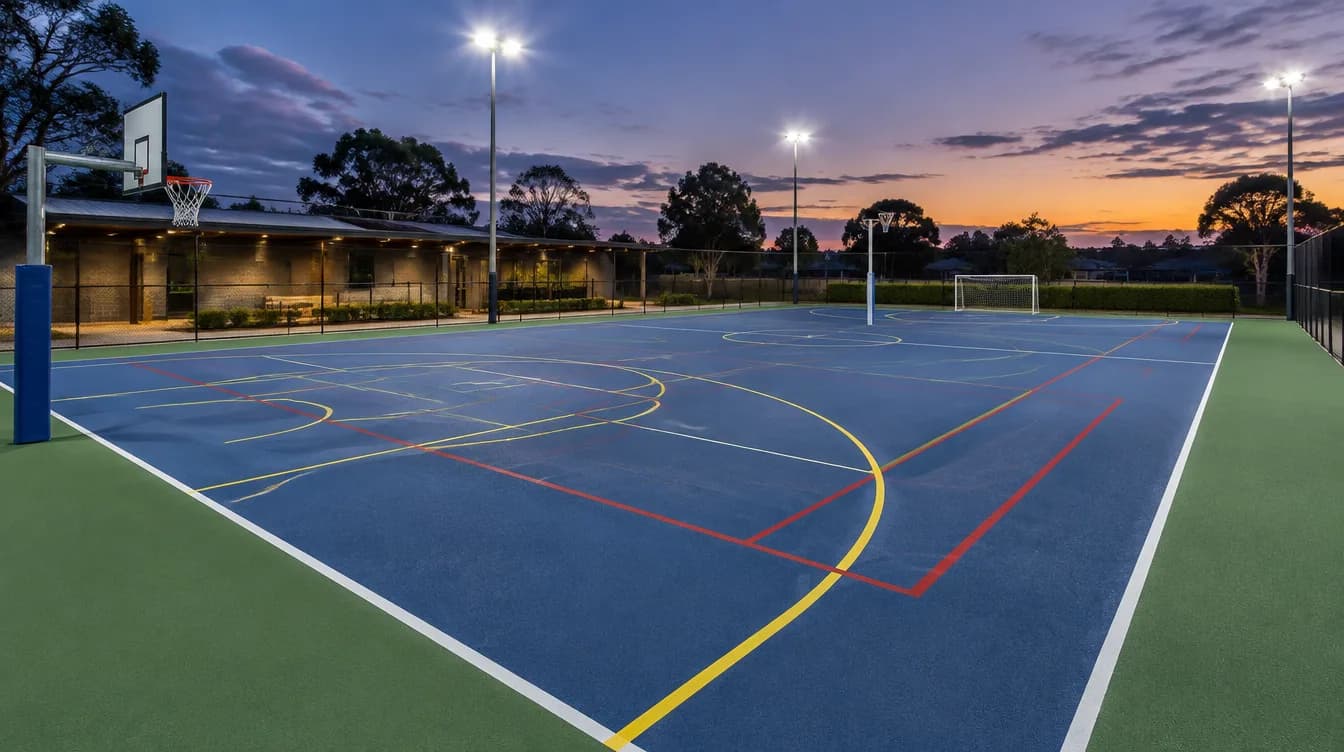
One court, several sports: basketball, pickleball, badminton, four square and more, each marked in its own colour on a surface built to last.
Jamie (24/7 quotes): 0468 069 002AS 1742.2 Compliant
Fully Insured
24/7 Availability

15+ Years
Get FREE Quote
Fixed-Price Quote Within 48 Hours
Trusted by 5,000+ businesses
VicRoads approved · AS/NZS compliant · $20M insured
Compliance-Ready Guarantee: every job is marked to AS/NZS 2890 & AS 1742, dimensionally verified, and delivered with full compliance documentation, backed by our 12-month workmanship guarantee.
Last updated:
What is Backyard Multi-Sport Courts?
Line Marking Australia builds backyard multi-sport courts across Australia, with basketball, pickleball, badminton, four square and other games marked in separate colours on one surface. We build the slab, tiles or acrylic, lines and equipment. A backyard court at half-court size, up to about 165 m² including the slab, starts from about $10,000.
Families rarely agree on one sport. One child shoots hoops, another wants pickleball with the grandparents, and the little ones just want somewhere flat to ride a scooter. A multi-sport court keeps everyone happy on one slab.
The trick is planning the layout before the concrete goes in. Here's how we approach it.
What is a backyard multi-sport court?
A backyard multi-sport court is a single hard surface marked for several sports, with each set of lines in its own colour and equipment that can be swapped or removed. Most combine a basketball hoop with a net game such as pickleball or badminton. It gives more play value per square metre than a single-sport court.
Popular combinations we build:
- Basketball key plus pickleball
- Basketball plus badminton and four square
- Pickleball plus a netball ring and rebound wall
- Half court plus handball and kids' games
How much does a backyard sports court cost?
A backyard sports court in Australia starts from about $10,000 at half-court size, up to about 165 m² including the slab (published Australian builder pricing, 2026). A larger court, cushioned surface, several sets of equipment, fencing and lighting increase the cost. Line Marking Australia itemises each part so you can phase extras later.
Price drivers on multi-sport courts:
- Overall court size, set by the largest sport you want to play
- Site preparation on sloping or clay blocks
- Tiles or acrylic, and the number of line colours
- Hoop, net posts and sleeves, rebound wall
- Ball-stop netting, fencing, lighting and power
A home pickleball-sized court starts from about $20,000 (published Australian builder pricing, 2026), so it pays to decide early which sports really matter.
Which sports can share a backyard court?
Most backyard sports courts are sized around the biggest sport you want, with smaller courts marked inside it. Pickleball and badminton have almost the same playing area, so they share well. A basketball key sits at one end. Volleyball and full tennis need far more space than most backyards allow.
| Sport | Playing area | Backyard fit |
|---|---|---|
| Pickleball | 13.41 m × 6.10 m | Good; shares with badminton |
| Badminton (doubles) | 13.4 m × 6.1 m | Good; needs a sheltered spot for wind |
| Basketball half court | 14 m × 15 m (regulation) | Smaller key-only versions fit most yards |
| Volleyball | 18 m × 9 m | Large blocks only |
| Four square and handball | Common sizes we mark to suit | Fits almost anywhere |
All sizes are playing areas only; add run-off around the lines.
What size should a backyard sports court be?
A backyard sports court should be sized to the largest sport you'll play regularly, plus run-off. For many families that's a pickleball-sized court with a basketball hoop at one end. If basketball is the main game, a larger half-court slab with pickleball lines inside works well. We mark it out on site first.
What is the best surface for a backyard sports court?
Modular tiles and acrylic on concrete are the best surfaces for a backyard sports court. Tiles drain fast, feel slightly softer and make coloured lines easy. Acrylic gives a true, firm bounce for basketball and pickleball and a seamless look. Synthetic grass suits soft play but not basketball dribbling.
| Surface | Strengths | Watch-outs |
|---|---|---|
| Modular tiles | Fast drainage, colour options, easy repair | Slightly different ball sound |
| Acrylic | True bounce, smooth finish | Recoat every several years |
| Synthetic grass | Soft for kids and ball games | Poor for dribbling and scooters |
See sports court tiles for colours and options.
How do you keep several sets of lines easy to read?
We keep a backyard multi-sport court readable by marking the most-played sport in the boldest colour, using softer contrasting colours for the rest, and avoiding lines that run on top of each other where possible. A good layout also puts the basketball key away from the net posts.
Our line marking crews do this every week on school courts and indoor halls lined for basketball, netball, volleyball and badminton, so we know how much is too much.
What equipment goes on a backyard multi-sport court?
A backyard multi-sport court usually has an in-ground adjustable basketball hoop, ground sleeves so net posts can be lifted out, and portable nets for pickleball or badminton. A rebound wall is a popular extra for solo tennis, soccer and handball practice. Removable gear keeps the court clear for scooters and games.
Learn more about rebound wall installation.
Do I need council approval for a backyard sports court?
A backyard sports court may need council approval if it includes lighting, fences or ball-stop netting over about 2 m, retaining walls, larger earthworks or drainage changes, or sits in a heritage or flood overlay. Noise near neighbours can also come up. Line Marking Australia checks your council's rules before the final quote.
How long does a backyard sports court take to build?
A backyard sports court usually takes one to three weeks on site once any approvals are in place. Excavation and the slab pour take a few days, the concrete cures, then tiles or acrylic go down. Multi-sport line marking and equipment come last, and rain can push concrete and coating work back.
- Site visit and layout marked out on the ground
- Before You Dig Australia check and approvals
- Excavation, base, slab and curing
- Surface, then lines for each sport
- Hoop, post sleeves, nets and extras
How we keep every backyard sports court compliant
Every backyard sports court we build follows the same compliance steps as our school and club courts. We check council requirements, run a Before You Dig Australia search, work under Work Health and Safety laws, control dust and sediment and use builders who hold the licence your state requires, with public liability insurance.
- Council check: lighting, fencing, retaining walls, earthworks, drainage, setbacks, overlays, noise
- BYDA search before excavation
- Safe Work Method Statements for excavation and mobile plant
- Silica dust controls when cutting concrete
- Sediment and stormwater controls
- Slab to AS 3600 with a slip-resistant textured finish
- Each sport marked to its court dimensions
Our multi-sport court construction page covers bigger builds, and backyard sports courts covers every court type for the home.
What do you need from me to quote a backyard sports court?
To quote a backyard sports court, we need to know which sports matter most, the space you have and the ground you're starting with. Send the details below with photos and rough measurements, and we'll suggest a layout and give you an itemised quote after a site visit.
- New court, resurfacing, or converting a driveway, patio or old tennis court
- Sports to mark, in order of importance
- Space available and what's on the ground now
- Slope and drainage
- Access for machinery and a concrete truck
- Tiles or acrylic, and colours
- Hoop, net posts, rebound wall, fencing, netting, lighting and power
- Approvals, plans or photos, timing and budget
Key Benefits
Several sports, one slab: basketball, pickleball, badminton and kids' games
From about $10,000: half-court size, slab included
Readable lines: bold main sport, softer secondary colours
Removable gear: sleeved posts and portable nets
Line marking experts: the same crews who line school courts and halls

Site Inspection
Free assessment and detailed quote

Professional Marking
Expert application with premium materials

Quality Assurance
Final inspection and compliance sign-off
Compliance Standards
Sport court dimensions
Each sport marked to its own playing area in a separate colour.
Local council approval
Lighting, fencing, retaining walls, earthworks, drainage and noise checked.
AS 3600 · BYDA
Slab to AS 3600; underground services located before digging.
WHS & silica controls
SWMS for excavation and plant; dust controls when cutting concrete.
Slip-resistant finish
Textured tiles or acrylic for grip in dew and light rain.
Fully Compliant & Certified
All our work meets or exceeds Australian Standards and state road authority requirements
VicRoads Approved
Registered Contractor
$20M Public Liability
$10M Professional Indemnity
5,000+ Projects
Since 2009
Fixed Prices
Not Estimates
AS 1742
Traffic Control Devices
Specifies line colours, widths, arrow designs, and placement for road markings. Ensures all traffic control devices meet national safety standards.
AS/NZS 2890
Parking Facilities
Covers bay dimensions (2.4m × 5.4m standard, 2.4m × 5.4m accessible plus a 2.4m shared zone), aisle widths, and traffic flow requirements for compliant parking areas.
AS 4586
Slip Resistance
Defines slip resistance classifications (P rating) for pedestrian surfaces. Critical for wet areas, ramps, and high-traffic zones.
AS/NZS 1428
Access & Mobility
Sets requirements for accessible parking bays, tactile indicators, and mobility access. Essential for DDA compliance and accessibility audits.
What Our Clients Say
Results based on typical project outcomes. Individual results may vary.
Upload your site plans for a detailed quote within 48 hours
Get an accurate, fixed-price quote tailored to your specific project requirements
Frequently Asked Questions
A backyard sports court in Australia starts from about $10,000 at half-court size, up to about 165 m² including the slab. Larger courts, extra equipment, fencing and lighting add cost. Line Marking Australia itemises each part so you can add extras later.
A backyard multi-sport court commonly combines basketball with pickleball or badminton, plus four square and handball. Line Marking Australia sizes the court to the largest sport you'll play and marks each sport in its own colour.
A backyard sports court should fit the largest sport you'll play often, plus run-off. Many families choose a pickleball-sized court, 13.41 m by 6.10 m playing area, with a basketball hoop at one end.
Modular tiles and acrylic on concrete are the best backyard sports court surfaces. Tiles drain fast and suit coloured lines, while acrylic gives a firm, true bounce. Line Marking Australia builds both on a proper slab.
Not if they're planned well. Line Marking Australia marks the most-played sport in the boldest colour, uses softer colours for the others and avoids overlapping lines where possible, the same approach we use on school courts.
A backyard sports court may need council approval for lighting, fences or netting over about 2 m, retaining walls, earthworks, drainage or overlays. Line Marking Australia checks your council's rules before the final quote.
Yes. Line Marking Australia fits ground sleeves so net posts lift out, and supplies portable nets, leaving the backyard sports court clear for scooters, games and parties. In-ground hoops stay in place but can be height-adjustable.
Related Services

Backyard Sports Courts
Learn more about this service
Multi-Sport Court Construction
Learn more about this service
Multi-Sport Court Line Marking
Learn more about this service
Rebound Wall Installation
Learn more about this service
Sports Court Tiles
Learn more about this service
Ready to Get Your Line Marking Sorted?
Upload your site plans and receive a fixed-price quote within 48 hours. No surprises, no cost blowouts, just clear pricing you can take to your committee or manager.
Or call us directly: 0417 460 236