Affordable Line Marking: How to Keep the Cost Down Without Cutting Corners
Where the money goes on a line marking job, and how to bring the cost down without the markings failing early. Written by the Line Marking Australia team.
Need this marked on your site? See Car Park Line Marking or get a fixed-price quote within 48 hours.
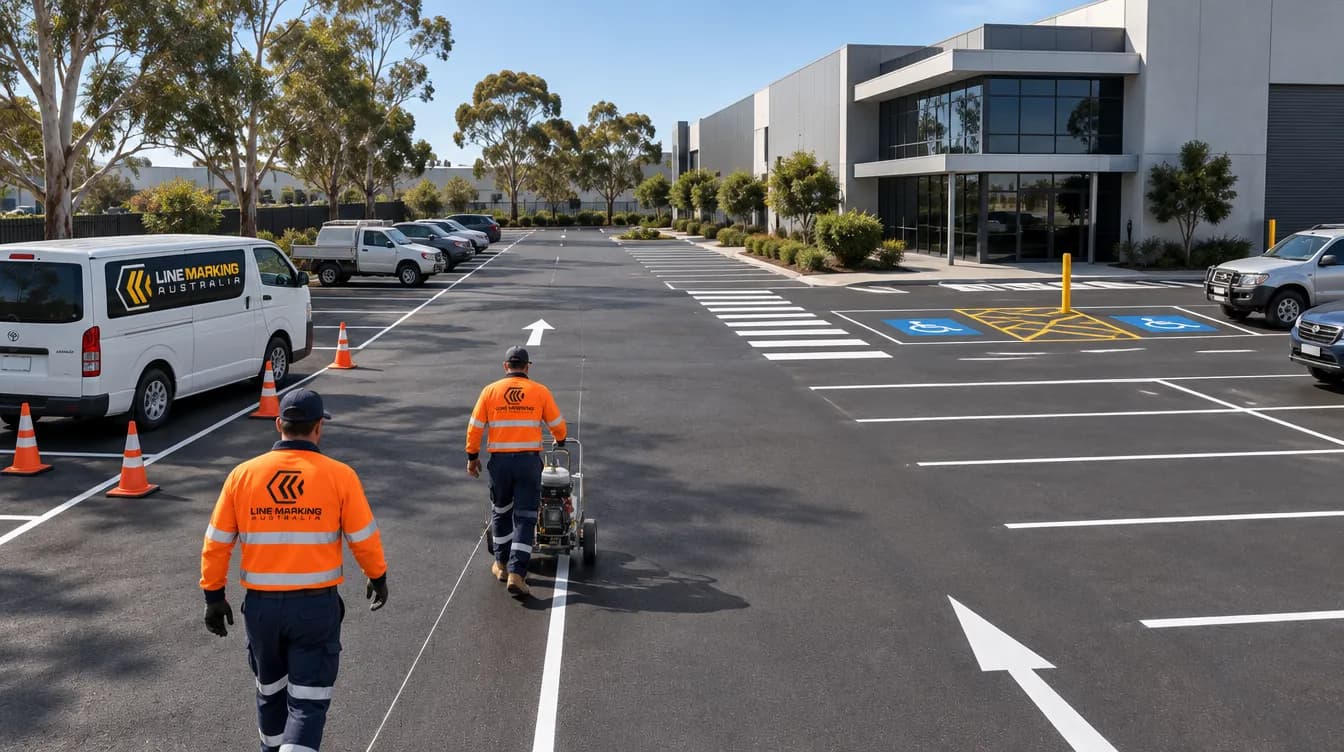
Affordable line marking is mostly about scope, timing and prep, not hunting for the lowest number on a quote. The cheapest price usually leaves something out, and you pay for it later. Below is where the money goes on a typical car park or warehouse job, and the legitimate ways to bring it down.
What does affordable line marking actually mean?
It means the lowest total cost over the life of the markings, not the lowest quote on the day. A job priced cheaply that fades in 12 months and needs doing again costs more than one done properly once. Affordable is a fair price for a clearly written scope that lasts.
Say you manage a strata block with 40 faded bays. One quote is much lower than the other two. Before you celebrate, check what it leaves out. Prep, removal of old lines and after-hours work are the usual casualties. We cover how to compare them properly in how to read a line marking quote.
Where does the money go on a line marking job?
Most of the price comes from five things: getting the crew and gear to site, preparing the surface, the material, the amount of layout work, and when the job has to happen. Paint itself is usually the smaller slice. That's why two jobs of the same size can price very differently.
| Cost driver | Why it moves the price | What you can control |
|---|---|---|
| Mobilisation | The crew and machine arrive whether it's 20 bays or 200 | Bundle jobs into one visit |
| Surface prep | Oil, dust and old paint stop new lines sticking | Sweep, fix leaks, clear cars |
| Old line removal | Grinding or blasting is a separate task | Re-mark over sound lines where suitable |
| Material | Paint, thermoplastic and epoxy cost and last differently | Match material to traffic |
| Layout changes | New set-out takes more time than re-marking what's there | Keep the existing layout if it complies |
| Timing | Night and weekend work costs more to run | Be flexible on dates |
We don't publish a price per bay because the surface and access change the answer too much. A real figure needs your plans, which is why we quote from them.
How can you cut the cost without cutting corners?
Re-mark the layout you've got, bundle work into one visit, prepare the site yourself, and stay flexible on dates. These four moves cut real cost without touching quality. Dropping prep, thinning paint or skipping the setting-out cuts cost too, but it's the kind that comes back as a repaint.
- Keep the layout if it already works. Re-marking existing bays is faster than redesigning them. If the layout was compliant when it went in, you may not need to touch it.
- Bundle. A car park, a loading bay and a few safety symbols done in one visit share the mobilisation cost. Small jobs done separately each carry it again.
- Do the site work. Clear the cars, sweep the surface and fix any leaking vehicle or pipe oil patches first. The crew's time is the expensive bit.
- Be flexible. If you can accept a weekday or a different week, ask what that does to the price. If you need the job done by a hard date, tell us early, because weather can push things.
Our guide to car park line marking shows the full range of what we do on commercial sites.
Is paint cheaper than thermoplastic, and does it matter?
Paint is cheaper to apply and wears faster, so it suits lighter traffic or areas you'll re-mark soon. Thermoplastic costs more upfront and lasts longer where vehicles turn and brake hard. The cheaper option is the one that matches your traffic. A busy ramp on paint is false economy.
Think about where each bay line sits. A visitor bay at the back of a quiet lot barely sees a tyre. The entry lane and the turning circle take a beating every day. Some sites sensibly use two materials.
If you're weighing the options, the cost guide covers each material in more detail: line marking cost guide.
What do cheap quotes usually leave out?
Cheap quotes usually leave out surface preparation, removal of old markings, traffic management, after-hours work and documentation. None of that disappears from the job. It turns up later as a variation, or it doesn't get done and the lines fail early.
Here's a quick check to run on every quote you receive:
- Is surface cleaning and degreasing listed?
- Is removal of old lines included or excluded?
- Does it say which material and how many coats?
- Are accessible bays and symbols itemised?
- Is after-hours work and traffic management in, or extra?
- Do you get completion photos or dimensions?
If two quotes differ by a lot, ask each contractor to price the same written scope. That's the only fair comparison.
Which lines should you not try to save money on?
Don't economise on accessible parking, fire lanes, forklift and pedestrian separation, and anything a council or safety inspector will check. These are the markings people rely on for safety or that carry legal weight, and getting them wrong costs far more than you saved.
Safe Work Australia's guidance on workplace traffic management recommends clearly marking pedestrian walkways and forklift areas, and notes that paint on the ground is one way to do it. Their traffic management guide for warehousing is worth a read if you run a warehouse. Markings that have faded to nothing don't do that job.
For warehouses, see our page on warehouse line marking.
Should you check the Australian Standard before you pay for a redesign?
Yes. Before paying for a new layout, check what the current standard actually requires. AS/NZS 2890.1 is the standard for off-street car parks. Standards Australia consulted on larger bays in 2023, but its March 2026 update says those changes will be reconsidered and won't proceed in their current form.
That matters because we still get asked whether sites should resize bays "ahead of the new standard". On what's published, there's no new standard to get ahead of. Re-marking a compliant layout is usually the affordable move. You can read the update on the Standards Australia news page.
Council conditions can differ, so check your approval before you assume.
How do access and site conditions change the price?
Tight access, busy sites and awkward surfaces slow the crew down, and slow time is what you pay for. A flat, empty, clean car park is the cheapest kind of job. A basement with a low ramp, a live loading dock or a surface covered in oil patches takes longer, so it costs more.
Three site questions come up on almost every quote:
- Can we get the machine to the work? Hand-marking a basement is slower than running a ride-on or walk-behind unit across open bitumen.
- Can the area be empty? Working around parked cars means the crew stops and starts. A clear site means one clean run.
- What's the surface like? New concrete needs time before it's marked, and a damp or freshly sealed surface can hold things up. Ask your contractor what they'll check before they start.
Say you run a medical centre with a car park that's never really empty. Offer the contractor a weekend or an early start with cones out and a sign at the entry. You'll often get a better price for a clear window than for squeezing the crew around patients' cars.
What should you ask a contractor before you say yes?
Ask what's in the price, what material they'll use, what happens if the weather turns, and what you get at the end. A good contractor answers those without fuss. A vague answer is a reason to keep looking, even if the headline number is attractive.
- What exactly is included, and what's an extra?
- Which material and how many coats?
- Will you re-set out the layout, or re-mark what's there?
- What happens if rain stops the job halfway?
- What do I get at the end: photos, measurements, a record of what was used?
- Is there a warranty on workmanship, and what does it cover?
You're after straight answers, not a sales pitch. Contractors who work to a written scope tend to quote tighter and argue less afterwards.
What are the common mistakes that make line marking cost more?
The expensive mistakes are marking over contaminated or damp surfaces, picking a quote on price alone, skipping a site measure, and leaving small repairs until they're big ones. Each one turns a cheap job into a second visit.
- Marking over oil or damp. Paint won't stick to a greasy or wet patch, so it peels and you pay again.
- Choosing on the lowest price. A quote that's far below the others is usually missing scope, not magic.
- Guessing quantities. Wrong bay counts mean variations. Measure, or send plans.
- Leaving it too long. Once lines disappear, removal and re-setting out cost more than a timely re-mark.
- Layering new paint over failing paint. Flaking old paint takes the new coat with it. Sometimes removal first is the cheaper path.
If old markings need to come off, our line marking removal page explains the methods.
How do you get a fair, fixed price?
Send your plans, a few photos of the surface and any access limits, and ask for a fixed price against a written scope. A fixed price tied to plans lets you compare quotes fairly and means you know the total before work starts.
Picture a small warehouse owner who needs a few forklift lanes redone. A quick call gets a ballpark. Plans and photos get a number you can budget against. We'd rather spend ten minutes on the plans than surprise you on the invoice.
Ready to see what your job actually costs? Upload your plans for a fixed-price quote, and we'll come back with an itemised price.
Related: our complete guide · how to read a line marking quote · car park line marking · line marking cost guide · warehouse line marking · line marking removal · get a fixed-price quote · get a fixed-price quote
Need Professional Line Marking?
Upload your site plans and get a fixed-price quote within 48 hours. AS/NZS compliant. No call-out fees.
Frequently Asked Questions
What is the cheapest way to get a car park line marked?
Re-mark the layout you already have, rather than setting it out again, and bundle other small jobs into the same visit. Clear the cars and sweep the surface first. That keeps the crew's time down, and time is most of the price. Cheap prep shortcuts usually cost more later.
Is affordable line marking the same as cheap line marking?
No. Affordable means a fair price for a clearly written scope that lasts. Cheap usually means something was left out, like surface prep, old line removal or after-hours work. Those costs don't vanish. They show up as variations or as markings that fade and need redoing within a year or two.
How do I compare line marking quotes properly?
Ask every contractor to price the same written scope, then check what each one includes: surface cleaning, removal of old lines, material and coats, accessible bays, traffic management and documentation. A quote far below the others is usually missing something, so ask what's left out before you say yes.
Does paint cost less than thermoplastic for line marking?
Paint usually costs less to apply but wears faster, so it suits light traffic or areas you'll re-mark soon. Thermoplastic costs more upfront and lasts longer where vehicles turn and brake hard. The cheaper choice over time is the one that matches your traffic, not the lowest price per metre.
Can I save money by doing the surface prep myself?
Often, yes. Clearing parked cars, sweeping the surface and dealing with oil drips before the crew arrives reduces their time on site. Ask your contractor first what they expect you to do, and leave anything involving grinding, removal or chemicals to them so the markings still bond properly.
Do I need to resize my car park bays for the new Australian Standard?
On what's published, no. Standards Australia consulted on larger car park bays in 2023, but its March 2026 update says those changes will be reconsidered and won't proceed in their current form. Re-marking a compliant layout is usually the affordable option. Check your council conditions if you're unsure.
Which line markings shouldn't I try to save money on?
Accessible parking bays, fire lanes, forklift lanes and pedestrian walkways, plus anything a council or safety inspector will look at. Safe Work Australia's workplace traffic management guidance recommends clearly marking pedestrian and forklift areas. Getting these wrong costs far more than the saving, and faded lines don't protect anyone.
How do I get a fixed price for line marking?
Send your plans, a few photos of the surface and any access limits, and ask for a fixed price against a written scope. At Line Marking Australia, you can upload your plans on our quote page and get an itemised fixed price, so you know the total before any work starts.
Need this done? Get a fixed-price quote in 48 hours
Tell us where and what you need. AS/NZS compliant, no call-out fees, and a real fixed price — not an estimate that changes at invoicing.
Or call 0417 460 236Jamie (24/7 quotes): 0468 069 002Compliance-Ready Guarantee: every job is marked to AS/NZS 2890 & AS 1742, dimensionally verified, and delivered with full compliance documentation, backed by our 12-month workmanship guarantee.
Written by
Nizi BhandaryLine Marking Specialist, Line Marking Australia
Nizi Bhandary is a line marking specialist with Line Marking Australia, working hands-on across car park, warehouse, road and sports-court projects nationwide. Nizi focuses on AS/NZS 2890 and AS 1742 compliant work and writes these guides to help facility managers, builders and councils get compliant, long-lasting line marking — without the guesswork.
Related Articles
Car Park Line Marking Cost: What Drives the Price
Explore the key factors affecting car park line marking cost in Australia, including surface conditions and compliance requirements, for accurate budgeting.

Line Marking Cost Guide 2025 | Pricing Explained
What affects line marking costs in Australia? Surface type, materials, compliance needs, and project timing all impact pricing.
Line Marking Cost Per Metre in Australia
Discover the factors affecting line marking costs per metre in Australia. From project size to paint types, learn what's involved.
Our Line Marking Services
Professional services related to the topics covered in this guide:
Ready to Get Your Line Marking Sorted?
Upload your site plans and receive a fixed-price quote within 48 hours. No surprises, no cost blowouts, just clear pricing you can take to your committee or manager.
Or call us directly: 0417 460 236