Road Marking Companies in Australia: How to Choose One
Not every road marking company can work on a public road. Here's how to check accreditation, which standards apply, and what a fair quote should include.
Need this marked on your site? See Road Line Marking or get a fixed-price quote within 48 hours.
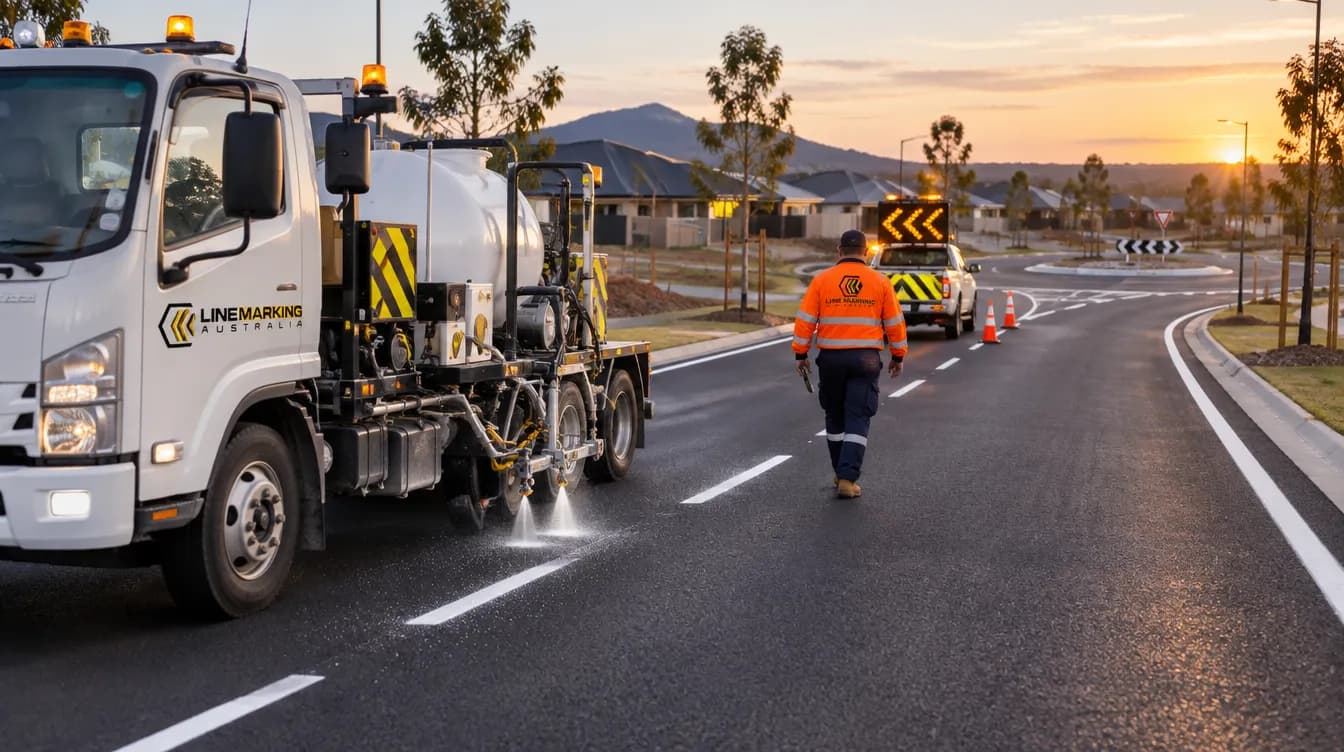
If you've typed "road marking companies" into Google, you've probably got a stack of directory listings and not much else. Nobody tells you what separates a crew that can mark a public road from one that does car parks, or what to ask before you sign. That's what this page is for. We've been on site at 5am before the traffic builds, so here's what we'd check if we were hiring.
What does a road marking company actually do?
A road marking company applies and maintains the painted or thermoplastic lines, symbols and legends that control traffic: centre lines, edge lines, stop bars, arrows, crossings and parking bays. Some also remove old markings. Most specialise in either public roads, private roads and car parks, or a mix of both.
The trade splits more than people expect. A crew set up for long highway runs uses truck-mounted machines and traffic control. A crew set up for industrial estates and car parks uses smaller rigs, stencils and a lot of careful setting out. Both are "road marking", but they're different jobs with different kit.
So the first question isn't "who's cheapest". It's "who does the type of work I actually have".
Which road marking companies can work on public roads?
On public roads, the road authority or council sets the rules, and many require the contractor to hold PCCP accreditation. CSIRO's information sheet says Transport for NSW, Main Roads WA, the NT Government, South Australia's DIT and Queensland's Main Roads mandate PCCP for anyone who puts down or removes pavement markings.
Councils do the same in their own specs. One NSW council's pavement marking worksection says the supplier or installer must be a PCCP accredited entity, and that the works can't be subcontracted to a non-PCCP entity. That second part catches people out. A company can win the job with a certificate and then send someone else to do the work.
The rules differ by state and by authority, and they change. Always read the tender documents or ask the road authority what applies to your job. Sources: CSIRO PCCP information sheet and a council pavement marking specification (1191).
What is PCCP accreditation and how do you check it?
PCCP, the Painting Contractor Certification Program, is an accreditation scheme managed day to day by CSIRO. It was formed in 1992 and audits contractors on quality, workplace health and safety, environmental management, and whether they have the right equipment and trained operators. Accredited contractors receive a certificate with a unique number and an expiry date.
Audits alternate between desktop reviews of past job records and on-site audits of actual marking jobs in progress. Any non-conformance has to be fixed, with evidence, before accreditation continues. That's a real check, which is why authorities lean on it.
For pavement marking, contractors apply by class:
| PCCP class | What it covers |
|---|---|
| Class 20 | Longitudinal markings on major roads |
| Class 21 | Longitudinal markings on minor roads |
| Class 22 | Audio tactile markings |
| Class 23 | Car park markings |
| Class 24 | Transverse markings, messaging and similar |
| Class 25 | Raised pavement markings |
| Class 26 | High friction surfacing |
| Class 27 | Pavement marking removal |
| Class 28 | Airport markings |
| Class 29 | Short-run new or re-markings on major and minor roads |
Accreditation is also recorded by material: waterborne coatings, thermoplastic, or cold applied plastic. So a company can hold one class for paint and not another for thermoplastic.
To check a contractor, ask for the certificate and look at the classes listed on it, then compare against the list of accredited contractors on the PCCP website. Don't take a logo on a ute as proof.
Do private roads and car parks need the same standard?
Not always by law, but the same standards are still the right benchmark. A private estate road, industrial park or car park usually isn't governed by a road authority's mandate. Your insurer, your council conditions or your tenants' safety still mean the markings should follow AS 1742 and use proper materials.
Say you manage an industrial estate with a loop road that's lost half its centre line and the stop bars at two intersections. Nobody from a road authority is going to audit it. But if there's a forklift-and-truck incident at a faded give-way line, "we got the cheap quote" is a miserable thing to say to an insurer.
Our advice: for private work, ask the same questions you'd ask for a public job (our road line marking service is built around exactly that). A contractor who's happy to talk about standards, materials and traffic control is usually the one who'll do the job properly. Our guide to AS 1742 road marking standards explains what the series covers.
What standards should road marking follow?
Pavement markings should follow AS 1742.2 for how markings are used, with materials covered by AS 4049.2 for thermoplastic and AS 4049.3 for waterborne paint, and glass beads to AS/NZS 2009. Work on live roads is also read alongside AS 1742.3 for traffic control, according to the council specification we reviewed.
You don't need to memorise clause numbers. You do need to hear a contractor name the right standards without flinching. Here's what to listen for:
- AS 1742.2 for the markings themselves: what goes where and how it looks.
- AS 4049.2 and AS 4049.3 for thermoplastic and waterborne paint materials.
- AS/NZS 2009 for the glass beads that make lines visible at night.
- AS 1742.3 for traffic control while the work is happening.
If a contractor can't tell you which standard applies to your job, that tells you plenty. For more on beads and night visibility, see our page on glass beads and retroreflectivity.
Paint or thermoplastic: what should a contractor recommend?
It depends on traffic volume, surface and how long you want the lines to last. Waterborne paint suits lower-traffic areas and car parks. Thermoplastic generally lasts longer on busy roads and intersections but costs more up front. A good contractor explains the trade-off instead of pushing one product.
| Material | Where it usually fits | Trade-off |
|---|---|---|
| Waterborne paint | Car parks, low-traffic private roads, re-marks | Cheaper and quick to apply, wears faster under heavy traffic |
| Thermoplastic | Busy roads, intersections, high-wear stop bars | Higher cost, longer life, needs the right surface and temperature |
| Cold applied plastic | Specialist and high-wear areas | Specific applications, ask why it's being suggested |
Our line marking paint types guide goes deeper if you're weighing it up.
What should a road marking quote include?
A solid road marking quote lists the scope by line type and length, the material, whether traffic control is included, how the surface will be prepared, and who does the work. If any of those are missing, you're comparing apples with a very vague fruit salad.
- Line lengths and types (centre, edge, stop bars, arrows, bays), ideally against a plan
- Material and bead type
- Traffic control or site protection: included, or extra?
- Surface prep and removal of old markings, if any
- Accreditation and insurance certificates available on request
- Rain and re-attendance terms
- Whether the crew doing the work is the one you're hiring
Say you get three quotes for a subdivision handover and one is a third lower than the rest. Before you celebrate, check it's marking the same lengths, using the same material, with traffic control included. Often the gap is scope, not cleverness. Our road line marking cost guide covers what drives the price.
What are the most common mistakes when hiring a road marking company?
The most common mistakes are choosing on price alone, not checking accreditation, leaving traffic control out of scope, and not confirming who will actually turn up. Most of them come down to assuming all road marking quotes mean the same thing, and they don't.
- Taking the logo on trust. Ask for the certificate and check the classes and expiry.
- Not asking about subcontracting. The accredited company on the quote might not be the crew on the day.
- Forgetting traffic control. It's a real cost on live roads and it needs to be someone's job.
- Marking over bad surface. New lines on a failing surface won't last. Good prep matters more than the paint.
- Vague scope. "Re-line the estate" isn't a scope. Lengths and line types are.
- No plan. Without drawings, everyone guesses differently. Send plans and you'll get like-for-like quotes.
What if the job is a subdivision or council handover?
Council handovers are tightly specified, so the contractor needs to follow the council's pavement marking spec exactly, including accreditation, materials and tolerances. If you're a developer or civil contractor, get the spec to your marking contractor before the quote, not after the council inspection.
We see this one regularly. The civil crew finishes the kerbs and asphalt, the council inspector walks the road, and the markings are the last thing standing between the developer and handover. Leave line marking to the final week and every delay upstream lands on it. Book it in early, and send the council's spec with the plans. Our page on subdivision and civil road line marking explains how those jobs run.
What should you ask a road marking company before you sign?
Ask for their accreditation certificate, the standards and materials they'll use, whether traffic control is included, who does the work on the day, and what happens if rain or a failed inspection means a return visit. Written answers beat verbal promises every time.
- Can you show me your current accreditation certificate and the classes it covers?
- Which standards will this job follow, and which materials will you use?
- Is traffic control included in the price?
- Will your own crew do the work, or is any of it subcontracted?
- How do you handle surface prep and old markings?
- What are the re-attendance and weather terms?
How do you get a fixed-price road marking quote?
Send your plans or a marked-up site drawing with line types and lengths, and ask for a fixed price that spells out materials, traffic control and prep. With plans in hand, a contractor can quote like-for-like instead of guessing, which makes comparing quotes honest.
If you're lining up a road, estate or car park job and want a clear number, upload your plans for a fixed-price quote and we'll come back to you with a written scope. Tell us what's on the site, and we'll be upfront about what we can and can't take on, including anything that needs a specific road authority accreditation.
Need Professional Line Marking?
Upload your site plans and get a fixed-price quote within 48 hours. AS/NZS compliant. No call-out fees.
Frequently Asked Questions
What do road marking companies do?
Road marking companies apply, maintain and remove the lines, symbols and legends that control traffic, including centre lines, edge lines, stop bars, arrows, crossings and parking bays. Some focus on public roads with truck-mounted machines, while others specialise in private roads, industrial estates and car parks using smaller rigs and stencils.
Do road marking contractors need to be accredited in Australia?
On public roads, often yes. CSIRO's PCCP information sheet says several road authorities mandate PCCP accreditation for anyone who puts down or removes pavement markings. Private sites usually aren't governed by that mandate, but accreditation is still a sensible check, and tender documents will tell you what applies to your job.
What is PCCP accreditation for line marking?
PCCP is the Painting Contractor Certification Program, managed day to day by CSIRO. It audits contractors on quality, safety, environmental management, equipment and trained operators. Audits alternate between desktop reviews and on-site checks of live jobs. Accredited contractors receive a certificate with a unique number, an expiry date and the classes they're approved for.
How do I check a road marking company's accreditation?
Ask for the current certificate and read the classes and expiry date listed on it. Then compare the company against the list of accredited contractors on the PCCP website. A logo on a ute or website isn't proof, and it's worth asking whether any of the work will be subcontracted to someone else.
Which Australian standards apply to road marking?
AS 1742.2 covers the use of pavement markings, AS 4049.2 covers thermoplastic materials, AS 4049.3 covers waterborne paint, and AS/NZS 2009 covers the glass beads used for night visibility. Work on live roads is also read alongside AS 1742.3 for traffic control. Ask your contractor to name the ones that apply to your job.
Should I use paint or thermoplastic for road marking?
It depends on traffic volume, surface condition and how long you need the lines to last. Waterborne paint suits car parks and lower-traffic private roads, while thermoplastic generally lasts longer on busy roads and intersections but costs more upfront. A good contractor explains the trade-off for your site rather than pushing one product.
What should a road marking quote include?
A proper quote lists line types and lengths, the material and bead type, whether traffic control is included, surface preparation and removal of old markings, weather and re-attendance terms, and who will do the work. Accreditation and insurance certificates should be available on request. Quotes missing these items usually aren't comparable.
How do I get a fixed-price road marking quote?
Send a plan or a marked-up site drawing showing line types and lengths, plus any council or authority specification that applies. With that in hand, a contractor can give you a written fixed price that spells out materials, traffic control and prep, so you can compare quotes on the same scope.
Need this done? Get a fixed-price quote in 48 hours
Tell us where and what you need. AS/NZS compliant, no call-out fees, and a real fixed price — not an estimate that changes at invoicing.
Or call 0417 460 236Jamie (24/7 quotes): 0468 069 002Compliance-Ready Guarantee: every job is marked to AS/NZS 2890 & AS 1742, dimensionally verified, and delivered with full compliance documentation, backed by our 12-month workmanship guarantee.
Written by
Nizi BhandaryLine Marking Specialist, Line Marking Australia
Nizi Bhandary is a line marking specialist with Line Marking Australia, working hands-on across car park, warehouse, road and sports-court projects nationwide. Nizi focuses on AS/NZS 2890 and AS 1742 compliant work and writes these guides to help facility managers, builders and councils get compliant, long-lasting line marking — without the guesswork.

Our Line Marking Services
Professional services related to the topics covered in this guide:
Ready to Get Your Line Marking Sorted?
Upload your site plans and receive a fixed-price quote within 48 hours. No surprises, no cost blowouts, just clear pricing you can take to your committee or manager.
Or call us directly: 0417 460 236