Airport Line Marking to CASA Aerodrome Standards
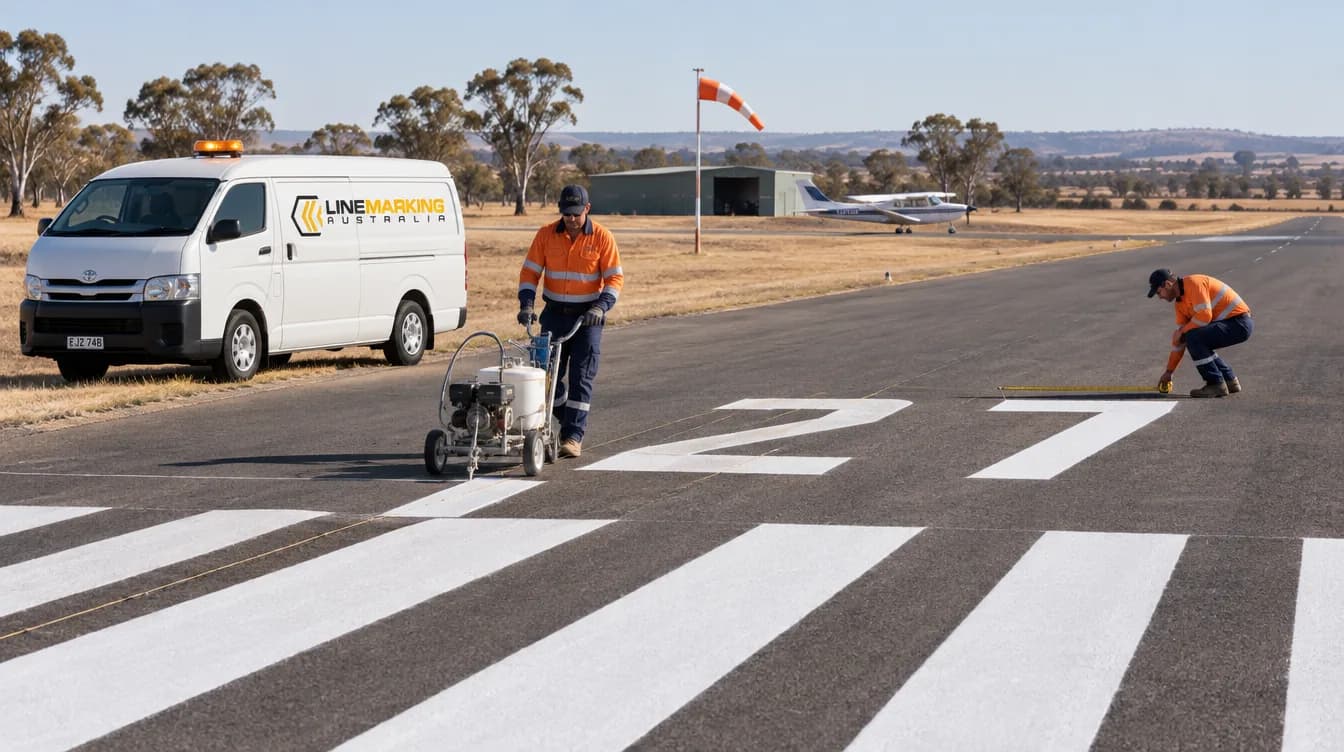
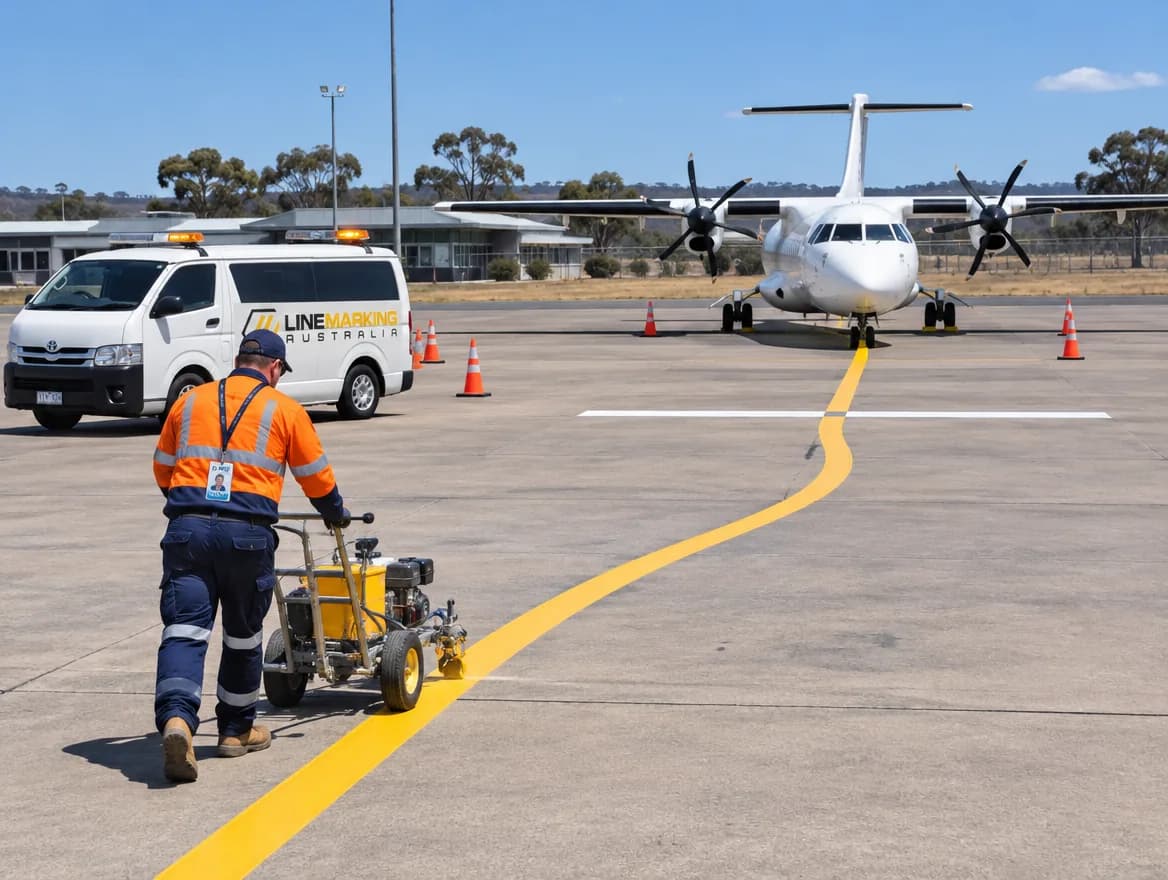
Airport marking operates under strict CASA regulations with zero tolerance for error. Runway threshold bars at exact dimensions. Taxiway centre lines in precise yellow. Apron stand numbers positioned for pilot visibility. Our ASIC-cleared crews have worked at regional airports across Australia, delivering CASA Part 139 MOS compliant marking with the documentation your aerodrome compliance requires.
Jamie (24/7 quotes): 0468 069 002AS 1742.2 Compliant
Fully Insured
24/7 Availability

15+ Years
Get FREE Quote
Fixed-Price Quote Within 48 Hours
Trusted by 5,000+ businesses
VicRoads approved · AS/NZS compliant · $20M insured
Compliance-Ready Guarantee: every job is marked to CASA Part 139 MOS, dimensionally verified and delivered with full measurement records, backed by our 12-month workmanship guarantee.
Last updated:
Airport Marking Demands Specialist Expertise
Quick answer: Line Marking Australia marks runways, taxiways, aprons and airside roads at regional aerodromes to the CASA Part 139 (Aerodromes) Manual of Standards 2019. Runway markings are white and taxiway markings are yellow. Our crews hold ASIC clearances and work during runway closures or overnight, with full measurement records for CASA audits.
Airport line marking isn't road marking with extra paperwork. It's a completely different discipline with its own standards, colours, symbols, and tolerances. The consequences of getting it wrong aren't just fines, they're potential safety incidents.
CASA Part 139 Manual of Standards specifies everything: runway marking dimensions and colours, taxiway centre line widths and patterns, holding position markings, apron stand layouts, and airside road markings. The tolerances are tight. A runway threshold bar needs to be exactly 1.8m wide and 30m long, spaced at 1.8m intervals. That's not approximate, that's exact.
We've worked at regional aerodromes across Victoria and NSW. Each project requires careful coordination with airport operations. Work windows are typically during runway closures or at night. Our crews hold ASIC (Aviation Security Identification Card) clearances for airside access. We understand the protocols: radio communication, FOD (Foreign Object Debris) prevention, and movement area procedures.
The materials are also specific. Airport marking paints need particular retroreflectivity and durability characteristics. We use aviation-grade materials that meet CASA requirements and provide the night visibility that pilots depend on.
Airport marking standards and airside roads
Movement area markings at Australian aerodromes are set by the Part 139 (Aerodromes) Manual of Standards 2019, which CASA administers. Airside roads and landside car parks follow road rules: car parks use AS/NZS 2890.1:2004, accessible bays use AS/NZS 2890.6:2009, and road signs and lines use AS 1742.2:2022.
We work at regional aerodromes in many states, including airport line marking in Melbourne and Cairns. Read more about our airport and port line marking work and how glass beads and retroreflectivity help pilots and drivers see markings at night.
Airside markings need high night visibility, so see our glass beads and retroreflectivity work, and how we mark to agency specifications when an airport or authority sets its own.

Site Inspection
Free assessment and detailed quote

Professional Marking
Expert application with premium materials

Quality Assurance
Final inspection and compliance sign-off
Compliance Standards
Aerodrome Marking Standards
CASA Part 139 MOS, Civil Aviation Safety Authority Part 139 Manual of Standards. The primary regulatory document for aerodrome marking in Australia. Specifies all runway, taxiway, apron, and airside marking requirements including dimensions, colours, and materials.
International Aviation Standards
ICAO Annex 14, International Civil Aviation Organization standards for aerodromes. CASA Part 139 MOS aligns with ICAO standards. Understanding both helps ensure international consistency.
Runway Marking Specifications
CASA Part 139 MOS Chapter, Specific requirements for runway threshold markings, centre line markings, touchdown zone markers, and runway designation numbers. Exact dimensions and spacing requirements.
Taxiway & Apron Marking
CASA Part 139 MOS Chapter 10, Taxiway centre line marking, holding position markings, apron stand numbers and equipment positioning guides. Yellow marking for taxiways, specific patterns for holding positions.
Aviation Security Requirements
Aviation Transport Security Act 2004, Security requirements for airside access. Personnel working on aerodromes must hold appropriate security clearances including ASIC for security-controlled airports.
Airside Safety & FOD Prevention
CASA Part 139 MOS Chapter 11, Safety requirements for work on movement areas. FOD prevention, vehicle operating procedures, radio communication requirements, and work area safety protocols.
Fully Compliant & Certified
Airside markings follow CASA's aerodrome standards and each airport's method of working plan
$20M Public Liability
$10M Professional Indemnity
5,000+ Projects
Since 2009
Airside Crews
ASIC-cleared
Fixed Prices
Not Estimates
CASA Part 139 MOS
Aerodrome Markings
The Part 139 (Aerodromes) Manual of Standards 2019 sets marking colours, sizes and positions for runways, taxiways and aprons.
MOWP
Method of Working Plan
Airside work is planned around the airport's method of working plan, runway closures and flight schedules.
AS/NZS 2009
Glass Beads
Retroreflective glass beads are applied where markings must be seen at night under aircraft and vehicle lights.
What Our Clients Say
Results based on typical project outcomes. Individual results may vary.
Upload your site plans for a detailed quote within 48 hours
Get an accurate, fixed-price quote tailored to your specific project requirements
Frequently Asked Questions
Runway markings are white. Taxiway centre lines and edge markings are yellow. Apron safety lines can be white or red depending on purpose. Vehicle roadways use standard road colours. CASA Part 139 MOS specifies exact colour requirements including retroreflective properties.
Yes. All personnel working airside at security-controlled airports need ASIC (Aviation Security Identification Card) clearances. Our airport crews maintain current ASICs. For non-security airports, we still follow aerodrome access procedures.
Runway and taxiway work typically happens during scheduled closures or overnight when movements are minimal. Apron work can sometimes be done during operational hours in closed sections. We coordinate closely with airport operations.
We focus primarily on regional aerodromes. Major airports like Melbourne, Sydney, and Brisbane typically use large specialist contractors. Regional airports, private airfields, and smaller aerodromes are our specialty. Same CASA standards apply regardless of airport size.
Complete compliance documentation including measurement records verifying dimensions meet CASA MOS requirements, material certifications, retroreflectivity test results where required, and photos. Everything needed for aerodrome certification audits.
Yes, we mark private heliports and airfields. Requirements vary based on whether the facility is registered with CASA. We can advise on appropriate marking standards for your specific operation.
Runway threshold markings in Australia are white stripes 1.8 metres wide and 30 metres long, spaced 1.8 metres apart, under the CASA Part 139 (Aerodromes) Manual of Standards 2019. Line Marking Australia measures each stripe to these exact dimensions and records the measurements for the aerodrome operator’s audit file.
Airport line marking time depends on the area and the closure window. A small apron remark may take one night, while a full runway remark at a regional aerodrome can take several planned closures. Line Marking Australia works out the staging with airport operations before work starts so the runway reopens on time.
Expert Guides
In-depth compliance guides and resources related to airport line marking to casa aerodrome standards.
Airport Line Marking in Australia: How an Airside Job Actually Runs
How an airside line marking job really runs, from the works plan and closure window to colours, tolerances and handback.
Read guideAerodrome and Helipad Ground Markings
Get expert guidance on aerodrome and helipad ground markings in Australia. Understand CASA Part 139 standards and avoid common mistakes.
Read guideRunway and Taxiway Marking (CASA Part 139)
Discover the essentials of runway and taxiway markings in Australia, guided by CASA Part 139 standards. From procedures to common pitfalls, get expert insights.
Read guideRelated Services

Agency Specifications
Learn more about this service
Line Removal That Actually Eliminates Ghosting
Learn more about this service
Pedestrian Crossings Line Marking
Learn more about this service
Road Line Marking
Learn more about this service
Thermoplastic Marking That Lasts 4-6 Years Under Heavy Traffic
Learn more about this service
Ready to Get Your Line Marking Sorted?
Upload your site plans and receive a fixed-price quote within 48 hours. No surprises, no cost blowouts, just clear pricing you can take to your committee or manager.
Or call us directly: 0417 460 236